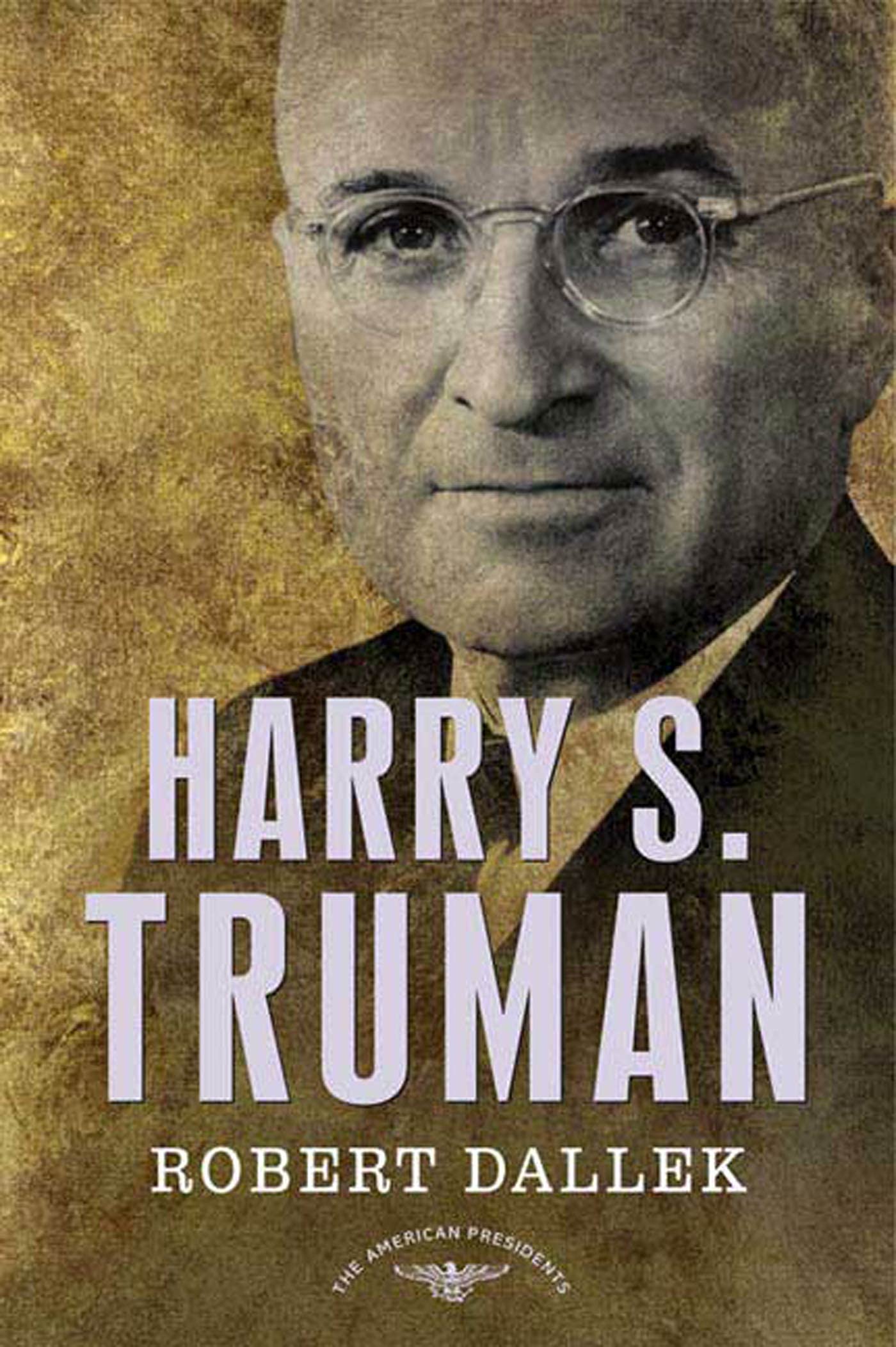
Harry S. Truman: The American Presidents Series: The 33rd President, 1945-1953
$14.31
by Robert Dallek



The plainspoken man from Missouri who never expected to be president yet rose to become one of the greatest leaders of the twentieth century In April 1945, after the death of Franklin Delano Roosevelt, the presidency fell to a former haberdasher and clubhouse politician from Independence, Missouri. Many believed he would be overmatched by the job, but Harry S. Truman would surprise them all. Few chief executives have had so lasting an impact. Truman ushered America into the nuclear age, established the alliances and principles that would define the cold war and the national security state, started the nation on the road to civil rights, and won the most dramatic election of the twentieth century―his 1948 "whistlestop campaign" against Thomas E. Dewey. Robert Dallek, the bestselling biographer of John F. Kennedy and Lyndon B. Johnson, shows how this unassuming yet supremely confident man rose to the occasion. Truman clashed with Southerners over civil rights, with organized labor over the right to strike, and with General Douglas MacArthur over the conduct of the Korean War. He personified Thomas Jefferson's observation that the presidency is a "splendid misery," but it was during his tenure that the United States truly came of age. The first paragraph of Dallek’s yeomanly contribution to the American Presidents series pontificates that, with the Roosevelts and Wilson, Truman is one of the “great or near-great” twentieth-century presidents. What follows suggests that he was the best of those four, anyway. FDR had told him nothing, even of the atomic bomb that he would have to decide whether to use. He got no immediate credit for his administration’s real achievements, such as the Marshall Plan. His party fractured beneath him when he headed the ticket in 1948. He got blamed for FDR’s failings, such as employing the Communists Joe McCarthy demagogued about, and for an early career beholden to crooked Kansas City Democrat Tom Pendergast. That he very quickly adapted to wartime leadership, prevailed in 1948 by sheer energy and common-man appeal, seized initiative against security risks before Congress did, and was the clean cog in Pendergast’s machine went largely unappreciated almost until his death. Dallek leaves little doubt that you must disagree with Truman philosophically to consider him less than a damn good president. --Ray Olson "Like so many other biographies in the splendid American Presidents series, Dallek's little book is now the best starting point for knowledge of Truman's life and for an astute assessment of his career. " - Publishers Weekly Robert Dallek is the author of several bestselling presidential histories, including Nixon and Kissinger: Partners in Power ; An Unfinished Life: John F. Kennedy, 1917–1963 ; and the classic two-volume biography of Lyndon Johnson, Lone Star Rising and Flawed Giant . He has taught at Columbia, Oxford, UCLA, Boston University, and Dartmouth, and has won the Bancroft Prize, among numerous other awards for scholarship and teaching. He lives in Washington, D.C. Arthur M. Schlesinger, Jr. , (1917-2007) was the preeminent political historian of our time. For more than half a century, he was a cornerstone figure in the intellectual life of the nation and a fixture on the political scene. He won two Pulitzer prizes for The Age of Jackson (1946) and A Thousand Days (1966), and in 1988 received the National Humanities Medal. He published the first volume of his autobiography, A Life in the Twentieth Century , in 2000. Sean Wilentz , a professor of history at Princeton University, is the author or editor of several books, including Chants Democratic and The Rise of American Democracy . He has also written for The New York Times , the Los Angeles Times , The New Republic , and other publications. He lives in Princeton, New Jersey.