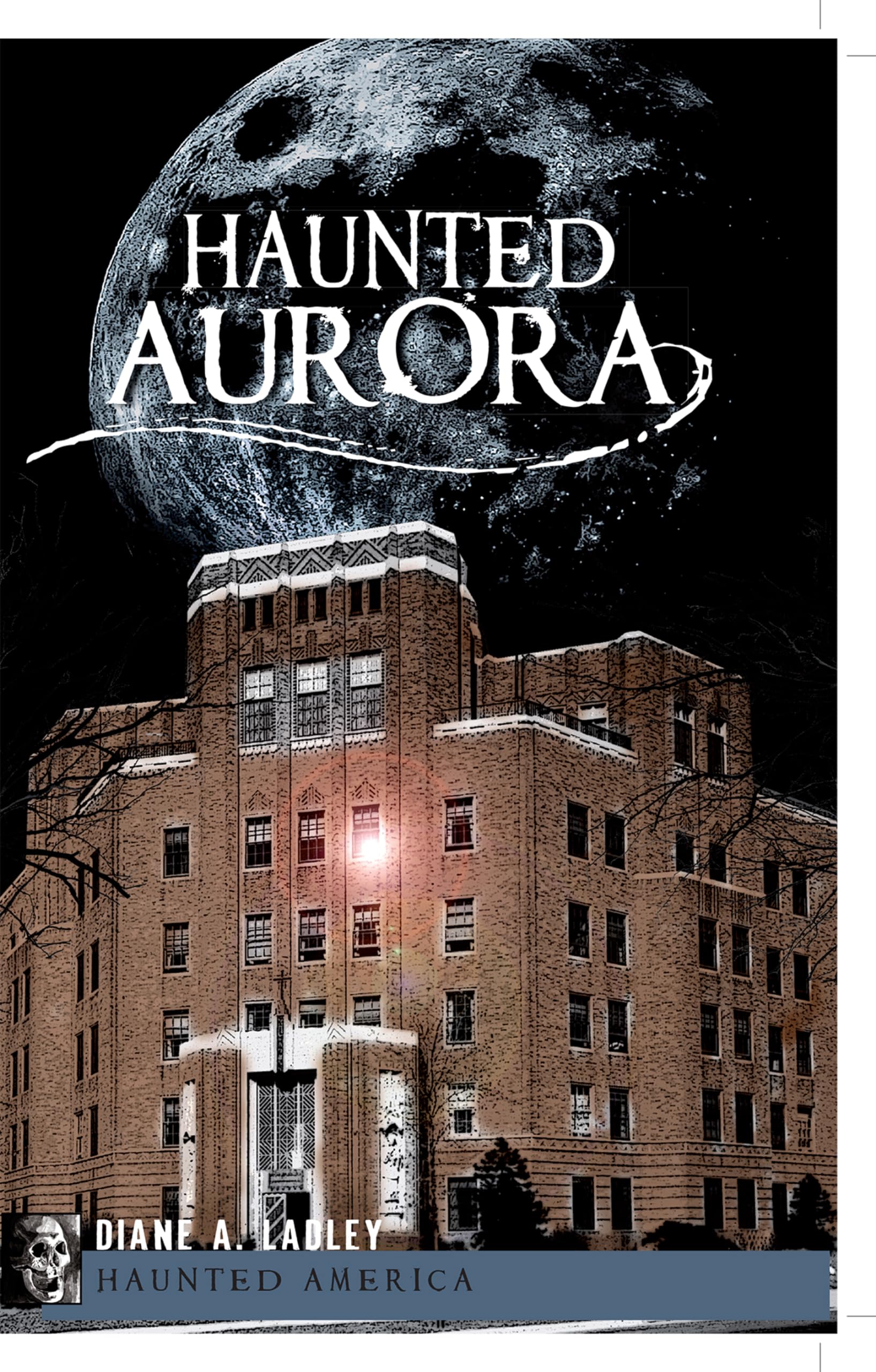



Aurora was the first Illinois city to have electric streetlights, but a dark history has resisted illumination as stubborn as the chilly corner of the old roundhouse repels the summer heat. Learn why Aurora counts ""City of Cemeteries"" among its nicknames as Diane Ladley, ""America's Ghost Storyteller,"" describes the nineteenth-century doctor suspected of trading bodies between his cancer center and a neighboring graveyard. Other eerie legends and strange stories revealed in this book include the marauding brave brought to justice in the Devil's Cave by his own tribe, the sweet legacy of NFL great Walter Payton and the elephants that saved a circus from a tornado. Diane Ladley is the founder and president of Historic Ghost Tours of Aurora, Historic Roundhouse Ghost Tours, Historic Ghost Tours of Naperville and the Haunted Hometowns Corporation. Her first book, Haunted Naperville (Arcadia Publishing, 2009), was widely acclaimed and praised by critics for its highly readable style and in-depth scholarship. Ladley is a nationally award-winning storyteller, local folklorist, public speaker and writer, renowned as "America's Ghost Storyteller." Her coast-to-coast reputation for masterfully told, spine-tingling tales is hailed by critics, peers and ghost story enthusiasts alike. She was a State of Illinois ArtsTour Artist for 2001, 3 and again in 2003, 5. In 2003, Ladley's own adaptation of a classic folktale, "The Liver," from her Late Night Fright: Tales of Supernatural Terror and Macabre Mirth audio CD won a national Storytelling World Honor Award for "Best Story of the Year for Adolescents." Ladley is the foremost authority on local supernatural lore, and after two years of dedicated research and personal interviews, she is proud to be the first to offer the authentic, comprehensive haunted history of Aurora. Haunted Aurora By Diane A. Ladley The History Press Copyright © 2010 Diane A. Ladley All rights reserved. ISBN: 978-1-59629-805-7 Contents Acknowledgements, Introduction: Aurora, the City of Lights
and Dark, Tanner House and Payroll Rock, A Hell Becomes a Haven, America's Historic (and Haunted) Roundhouse, Devil's Cave, Murder in St. Nicholas Cemetery, Suicide Skyscraper, The Paramount Palace, The McArthur/Kennedy House, Mysteries of Root Street Cemetery, The Elephant Graveyard, Phantom of the Food Court, Creepy Tales of Spring Lake Cemetery, Our Savior Lutheran Church, "Paula" of White Eagle, The Librarian's Tales and Do-It-Yourself Ghost-busting, The Strange Case of the Lincoln Murders, Pauper's Field, Aurora's Top Five Eeriest Places, The Grampa-Man, Bibliography, About the Author, CHAPTER 1 TANNER HOUSE AND PAYROLL ROCK It was the evening of October 23, 2006. The geomagnetic field was active. Solar X-rays were normal. The moon phase was one day after the new moon, with disk illumination at 1 percent. It was noted in the field report that this moon was the thinnest crescent in eighteen years. Eight investigators of the Will County Ghost Hunters Association had been invited to partake in an overnight investigation of the William Tanner House, located at 304 Oak Avenue in the historic Tanner district on the west side of Aurora. The science of paranormal investigation is difficult at best. Ghost hunters use all kinds of measurement and recording devices to capture any hard, solid evidence of paranormal activity and meticulously use established scientific methodologies to document any and all findings. What makes it so difficult is that we don't exactly know what it is we're measuring and recording. Electricity? Ectoplasm? Lost souls? Invisible people? What's the nature of paranormal activity? Why, if it's a natural phenomenon, does it not occur on a regular basis? What possible influences might increase the likelihood that a ghost will appear — solar flares, lightning storms or phases of the moon perhaps? Pinpointing the unknown to hard and fast scientific principles may or may not be an act of futility, but explorers of this realm from all around the world keep trying. The Tanner House was built in 1857 by William Augustus Tanner and his wife, Anna Plum Makepeace Tanner. He was a prosperous hardware dealer, made rich by selling the necessary tools and equipment the early pioneers needed to make it in this rich new land. They had ten children: Amy, Eugene, Florence, George, Henry, Imogene, Lucy, Marion and the twins Martha and Mary. With the exception of Lucy, who died at age two, the others all survived into adulthood. Of the twelve members of the family, four people died in the house, all of natural causes: William Tanner in 1892, Anna in 1900 and Imogene and Henry in 1934, neither of whom ever married. The two-and-a-half-story brick mansion is an outstanding example of the Italianate style and is laid out in the shape of a Latin cross, with seventeen spacious rooms and an octagonal cupola. In later years, the last of the Tanner children, Mary an