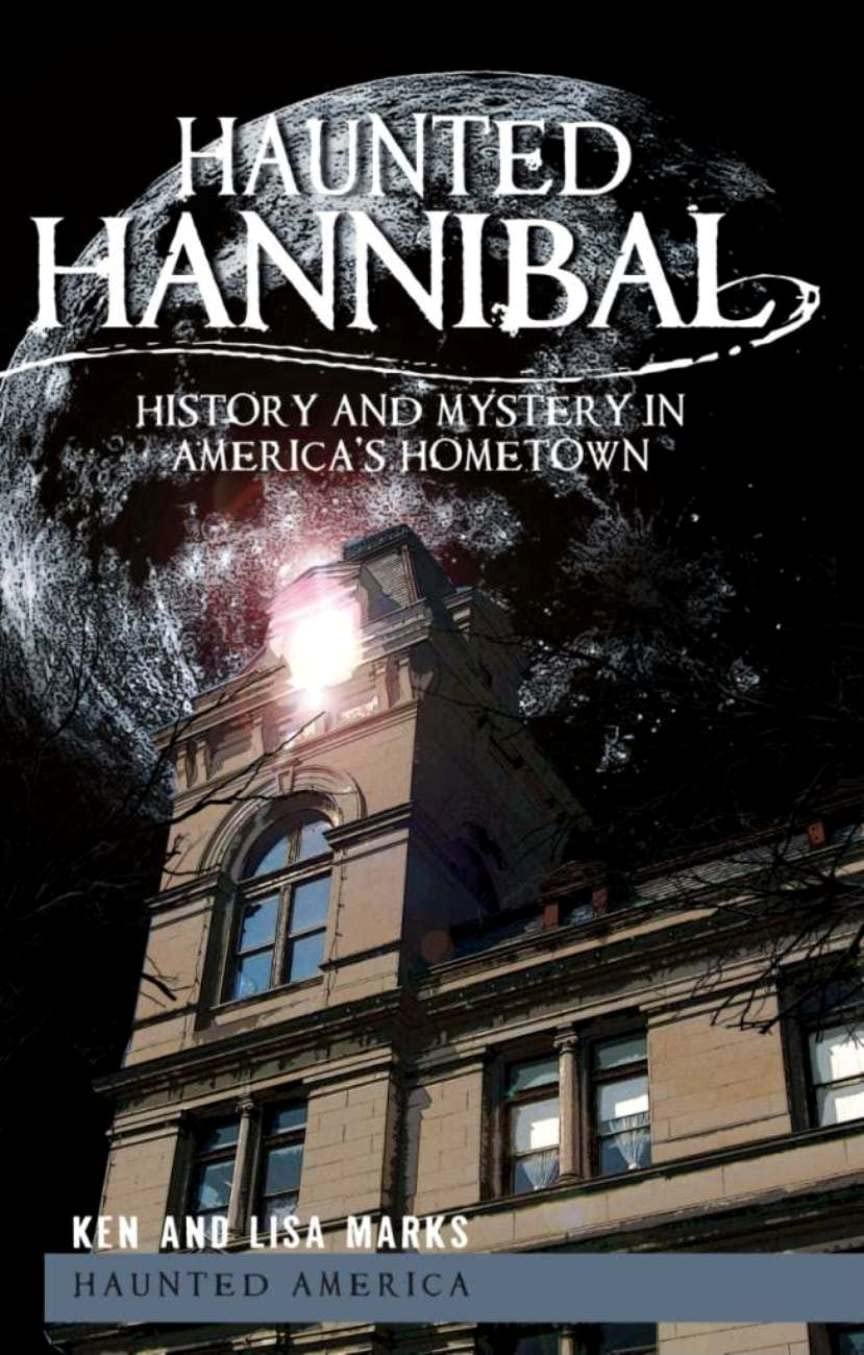



After living in Rockcliffe Mansion, where the haunted hallways were a rite of passage for countless Hannibalian youth, Ken and Lisa Marks learned firsthand that Hannibal, Missouri, is indeed haunted. Hannibal's own Mark Twain held a lifelong fascination with paranormal activity after experiencing an uncanny premonition of the death of his brother in 1858. Even skeptics will find it hard to resist the marvelously strange history of the limestone cave made famous in The Adventures of Tom Sawyer where the real-life, macabre Dr. McDowell experimented with his own daughter's corpse. Stories of the town's notorious red-light district and Hannibal's larger-than-life lumber barons provide even more spine-tingling evidence of the haunting of America's Hometown. Ken Marks and his wife Lisa act as curators of the Hannibal History Museum, conduct Haunted Hannibal Ghost Tours and are contributors to publications such as Hannibal Magazine. The Marks are members of the Friends of Historic Hannibal, the Marion County Historical Society and the Historic Hannibal Marketing Council. Lisa Marks and her husband Ken act as curators of the Hannibal History Museum, conduct Haunted Hannibal Ghost Tours and are contributors to publications such as Hannibal Magazine. The Marks are members of the Friends of Historic Hannibal, the Marion County Historical Society and the Historic Hannibal Marketing Council. Haunted Hannibal History and Mystery In America's Hometown By Ken Marks, Lisa Marks The History Press Copyright © 2010 Ken and Lisa Marks All rights reserved. ISBN: 978-1-60949-044-7 Contents Preface, Acknowledgements, Introduction: Haunted Hannibal, Violent Crime, Death and Ghosts During Samuel Clemens's Boyhood, Mary of Mark Twain's Home Town, The Enchantment of Rockcliffe Mansion, The Girl Suspended in McDowell's Cave, The Stillwell Murder: Hannibal's Most Scandalous Crime, The Old Catholic Church, Old Baptist Cemetery: Spirits of Slavery and Civil War, The Real Injun Joe, Checking Out Garth Memorial Library, The Girls at Lulabelle's, Java Jive and the Spirits Next Door, Blood Alley Runs to North Street, The Ghosts of the Garden House, Lover's Leap: Legend and Divine Intervention High Above Hannibal, The Benevolent Spirit of Cliffside Mansion, Bibliography, About the Authors, CHAPTER 1 VIOLENT CRIME, DEATH AND GHOSTS DURING SAMUEL CLEMENS'S BOYHOOD Everything human is pathetic. The secret source of humor itself is not joy but sorrow. There is no humor in heaven. — Mark Twain He remembered his dead siblings and revisited the guilt of transgressions against them unforgiven. He recalled old sweethearts, often with photographic clarity of the moments of final partings. His manuscript papers reveal, posthumously, that he had carried inside his head a remarkably detailed mythic version of his boyhood Hannibal. — Ron Powers, Dangerous Water It is well documented, by historians and by the man himself, that Mark Twain was haunted as an adult by things that happened to him during his childhood. Although Twain remembered many joyous moments and retained a fondness for Hannibal all his life, he was also tormented by memories of murder, drowning, accidental death, disease and mischievous pranks gone awry that occurred during his boyhood days on the banks of the Mississippi. Although he did not come to Hannibal until he was four years old (Sam Clemens was actually born about forty miles from Hannibal, in Florida, Missouri, in 1835), it was Hannibal that Mark Twain thought of as his hometown, Hannibal that he remembered so vividly when he wrote Tom Sawyer and Huckleberry Finn. It was Hannibal that provided the texture to the tales he would so famously weave in his lifetime. From the unspeakable tragedies he witnessed and experienced during his boyhood in Hannibal would emerge a comic genius upon which Twain would rely throughout his life. Twain was able to transform the pain of childhood heartbreak that would never leave him into humor and wit that would help him retain his sanity and eventually lead him to fame and fortune. And tragedy there was. During the years Samuel Clemens was a member of the community, from 1839 to 1853, Hannibal was very much the epitome of a wild western frontier town. Missouri had achieved statehood in 1821, just fourteen years before Sammy's birth, and was then considered the western edge of the nation. (Kansas would not become a state until 1861; Oklahoma, not until 1907.) The mighty Mississippi River that flowed alongside the small town brought to Hannibal's shores rough- languaged roustabouts, riverboat gamblers, land speculators, gold rush forty-niners, traveling minstrel show performers and many other colorful characters; they would form a rowdy, sometimes violent and always entertaining sideshow of humanity. Young Sammy absorbed everything and seemingly forgot nothing. His curiosity and yearning for adventure were evident at a young age, and the escapad