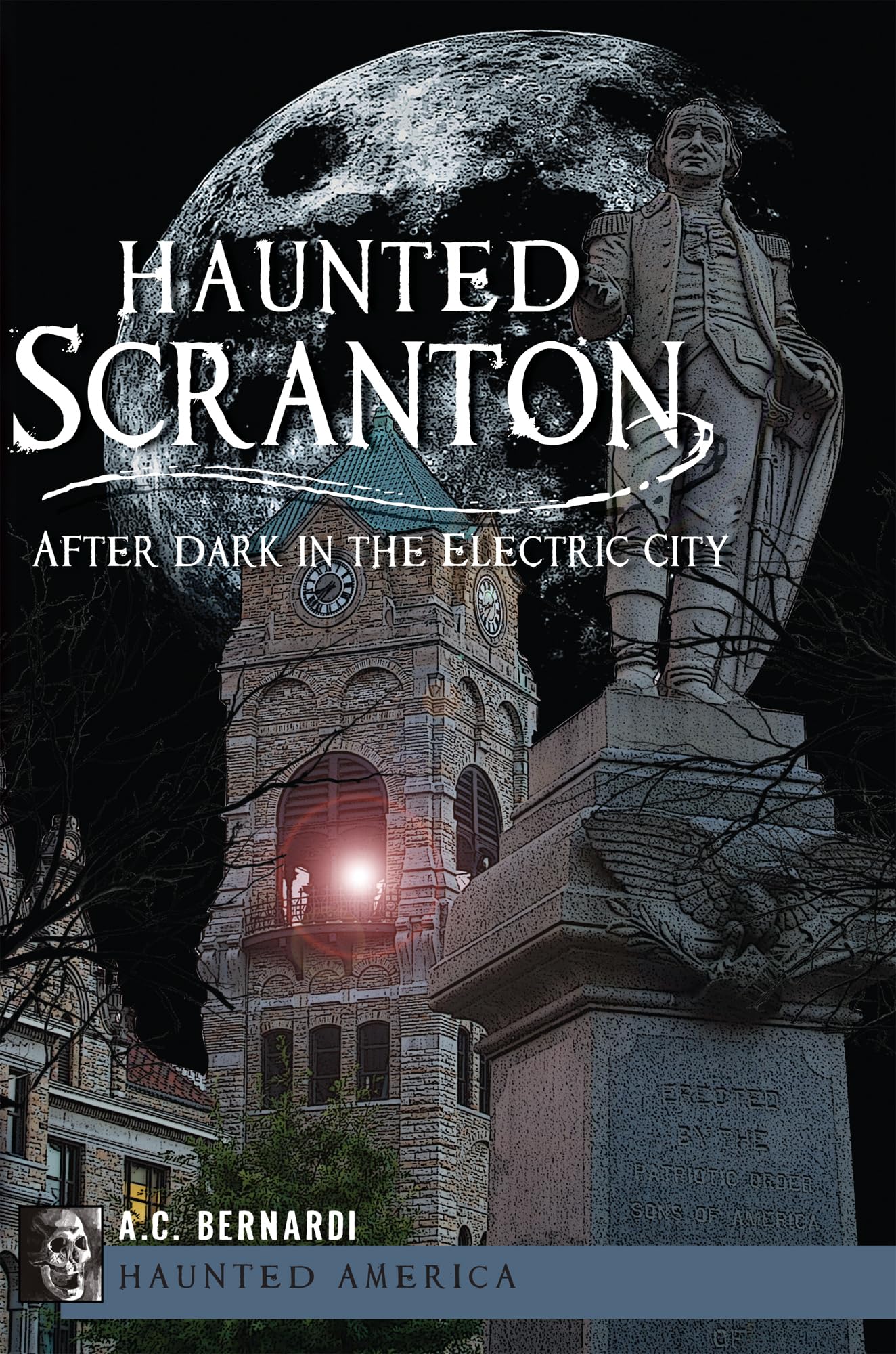
Haunted Scranton:: After Dark in the Electric City (Haunted America)
$21.99
by Anthony C. Bernardi Jr



At the heart of the Lackawanna Valley, Scranton is haunted by those who once walked its streets and worked its mines and rail lines. From the woman in white who lingers in Courthouse Square to the passenger of trolley car #46 who never reached her destination, the specters of Scranton make their presence known. Supernatural investigator A.C. Bernardi chronicles chilling tales of the city's landmarks, from the mysterious happenings on the sixth floor of the Lackawanna Station Hotel to stories of the angry spirits of victims of the Spanish influenza epidemic who lurk in the basement of the Banshee Pub. Join Bernardi as he traverses the dark side of Scranton, Pennsylvania. Through historical research and his own documented experiences during actual paranormal investigations of local haunted sites, A.C. Bernardi developed the script for the popular Scranton after Dark, A Walk through Haunted History"? tour." Haunted Scranton After Dark in the Electric City By A.C. Bernardi The History Press Copyright © 2012 A.C. Bernardi All rights reserved. ISBN: 978-1-60949-585-5 Contents Acknowledgements, Introduction: How I Got Started/Once an Industrial Epicenter, 1. The Catlin House: Did the Catlins Ever Leave?, 2. The Lackawanna Station Hotel: Terror on the Sixth Floor, 3. Courthouse Square: The Lady in White and Other Macabre Tales, 4. The Hotel Jermyn: Leave the Ghost Light On for Eleanor, 5. The Banshee Pub: Beware of the Basement, 6. Andy Gavin's Eatery and Pub: A Ghost Named George, 7. The Scranton Cultural Center at the Masonic Temple: Masonic Ghosts, 8. The Colonnade: Boys Will Be Boys, Even After Death, 9. The Electric City Trolley Museum: Haunted Car #46, Conclusion, Bibliography, About the Author, CHAPTER 1 The Catlin House DID THE CATLINS EVER LEAVE? At 232 Monroe Avenue, within the heart of the University of Scranton campus, sits an exquisitely preserved and beautifully decorated slice of local history. This stately three-story antique gem of a building presently stands enveloped by the looming modernized university — offices, lecture halls and recreation centers — like a hidden treasure waiting to be discovered. The home is presently one of the few remaining estates in that area of the city that formerly consisted of a neighborhood containing the most prominent and important names in the region, such as Scranton and Archbald. This picturesque structure with its peaked roofs and striped awnings was designed by the architect Edward Langley in the English Tudor Revival style and constructed in 1912 as the private sixteen-room home of the once successful Scranton lawyer and banker George Catlin and his second wife, Helen. George Catlin was born on August 26, 1845, in Shoreham, Vermont, to Lynde Catlin and Amelia Harriet Moore. He graduated from Union College in 1866 with an undergraduate degree in law but soon afterward, in 1867, received a master's degree from Lafayette College. George was then admitted to the New York state bar in Albany and later worked for the law firm of Pope, Thompson and Catlin at 17 Nassau Street in New York City. He married his first wife, Mary Woodrow Archbald, in the same year he joined the law firm, and the couple lived in New York City for several years before relocating to Scranton, Pennsylvania, in 1870 for unknown reasons. George may have been enticed into moving to Scranton because it was a fairly new and rapidly growing city where one had great potential to become successful and make a name for himself by his own ingenuity. Perhaps for this reason, soon after reaching Scranton, George decided to end his short-stemmed law career to pursue the matter of finances. This new endeavor may have been influenced by the economic boom occurring in Scranton at this time due to the start of some very successful coal-mining and iron-manufacturing businesses that were generating great sums of money and prompted the need for local banks. However, the couple may have simply relocated to Scranton because his wife had family in the city, with whom the Catlins decided to make their home after arriving. In 1872, George Catlin became the organizer and founder of the Third National Bank in Scranton. He served as vice-president for a number of years and as director for an astounding sixty-three years up until the time of his death. The ambitious Mr. Catlin also served as director of the Scranton Savings Bank, the Scranton Street Railway Company, the Erie & Wyoming Valley Railroad and the Crown Point Iron Company. However, George's ambition and passion also was channeled into other interests, such as the importance of preserving local history. This interest eventually prompted him to join the Lackawanna Institute of History and Science in 1886. The group's main focus was to preserve the local history of Lackawanna County, which is the youngest in the state. Mary Archbald Catlin passed away in 1902, and George was remarried on January 10, 1904, to Helen Wals