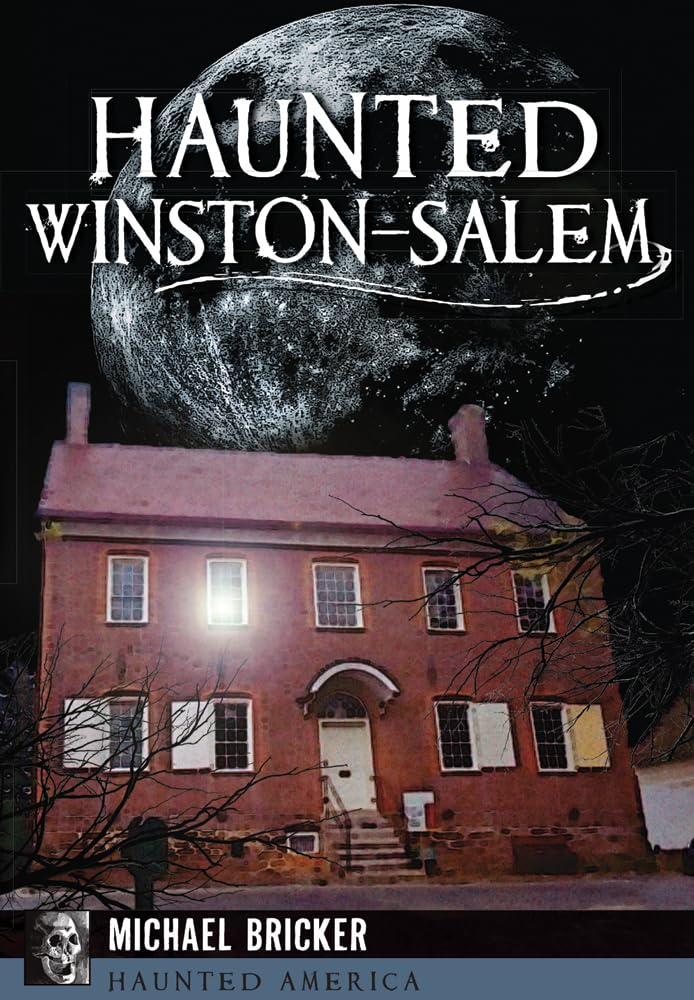



Whether it was Winston, Salem or Winston-Salem, the city has a rich history in the strange, unusual and ghostly. Colonial Salem was once visited by George Washington, and accounts tell of the president entering the cave of three witches. Locals still see an old tobacco wagon rolling around the streets of Winston in the early morning, harkening back to the days when tobacco was king. Elaborate systems of tunnels and pipes once existed beneath the city that many believe were home to groups of chanting monks. Join author and historian Michael Bricker as he vividly retells these stories and more in a historically haunted guide to Winton-Salem. As a sixty-plus-year resident of Winston-Salem, author Michael L. Bricker has combed the older neighborhoods of Old Salem and Old Winston in search of local history. He is the lay historian of Old West Salem and founder of the West Salem Historical Association. He presided over the nomination of West Salem as a historic neighborhood on the National Register of Historic Places. Preceding this publication, he has authored five local history books of West Salem, Winston-Salem and Forsyth County. Haunted Winston-Salem By Michael L. Bricker The History Press Copyright © 2015 Michael L. Bricker All rights reserved. ISBN: 978-1-62619-585-1 Contents Acknowledgements, Maps, Introduction, 1. The Paper Mill and the Ragman, 2. The Witches of West Salem, 3. A Bridge Too Far, 4. The Booger Comes at Night, 5. The Caves of West Salem, 6. The Shaman, 7. The Girl in the Window, 8. The Spooky Suburb of Salem, 9. The Haunted City Block, 10. The Old Tobacco Wagon Still Rolls, 11. Salem Cemetery Horror, 12. An Occurrence at the Masonic Temple, 13. The Last Picture Show, 14. The Old Dark House, 15. The Devil Will Get You If You Don't Watch Out, 16. Westdale and the Wall to Nowhere, 17. The House That Moved, 18. The Chanting Monks, 19. The Haunted Painting, 20. The Game That Would Not End, 21. The Hermit of Shallowford Street, 22. The Poor Little Lost Boy, 23. Granville School Mystery, 24. The White-Haired Man, 25. The Haunted Grocery Store, Bibliography, About the Author, CHAPTER 1 THE PAPER MILL AND THE RAGMAN One of our oldest stories begins with two individuals who, history shows, were as different as night and day. The Moravian records state that one was very successful and the other not so successful. The oldest of the old-timers, Mr. Johns, states this fact much more sinisterly: "My great-great-grandpappy heard they were opposites all right, but more like light is to darkness!" The first, Brother George Stockburger, was an early arrival to Salem, North Carolina. Salem was the central town circa 1766 of the Southern Moravians. The layout of the town was designed years before the Moravians arrived in North Carolina from their home state of Pennsylvania. The Salem town lot was divided into two distinct properties by the chief land surveyor, Brother Gottlieb Reuter. East Salem, Old Salem in today's landscape, contained the Moravian craftsmen and church hierarchy. The second part, West Salem, was home to the farms and industry. Brother Stockburger managed the largest farm in the town lot located in Old West Salem. Unfortunately, the records show that the dairy farm failed due to bad luck, bad location and poor management. The Moravian archives referenced many disagreements that the church had personally with Brother Stockburger, which led to his dismissal from the church membership. Old-timer Mr. Johns had recollections of the farm that were more macabre and dark: "I believe the land and anyone who attempted to work it as a farm could never be successful, since many of my older friends and relatives said the bottomland of the farm was cursed." History shows that others tried to make the farm a profitable venture but were not successful. In 1820, the land was divided, and a new venture for the land was pursued by the Moravians. The Salem Merchant Mill in Old West Salem became the most lucrative commercial flour mill of the town and state. The darkness experienced by Brother Stockburger was thought to be behind him, but it did not actually pass until a new Moravian brother arrived on the scene. The second individual to our story, the light, was Brother Gottlieb Schober. Research shows that he brought a progressive nature to the table of the Moravian Church like no other individual before him and, some have said, like no other since. Brother Schober (1756–1838) led both East and West Salem through his understanding of Moravian culture, religion and new United States politics. Ironically, Brother Schober may have been similar to Brother Stockburger in that both continually pushed the Moravians' tolerance to the limit. However, Brother Schober's fate as a church member was different than that of Stockburger and much more rewarding. He championed many causes for the Moravians in church and political circles through his self-styled law pra