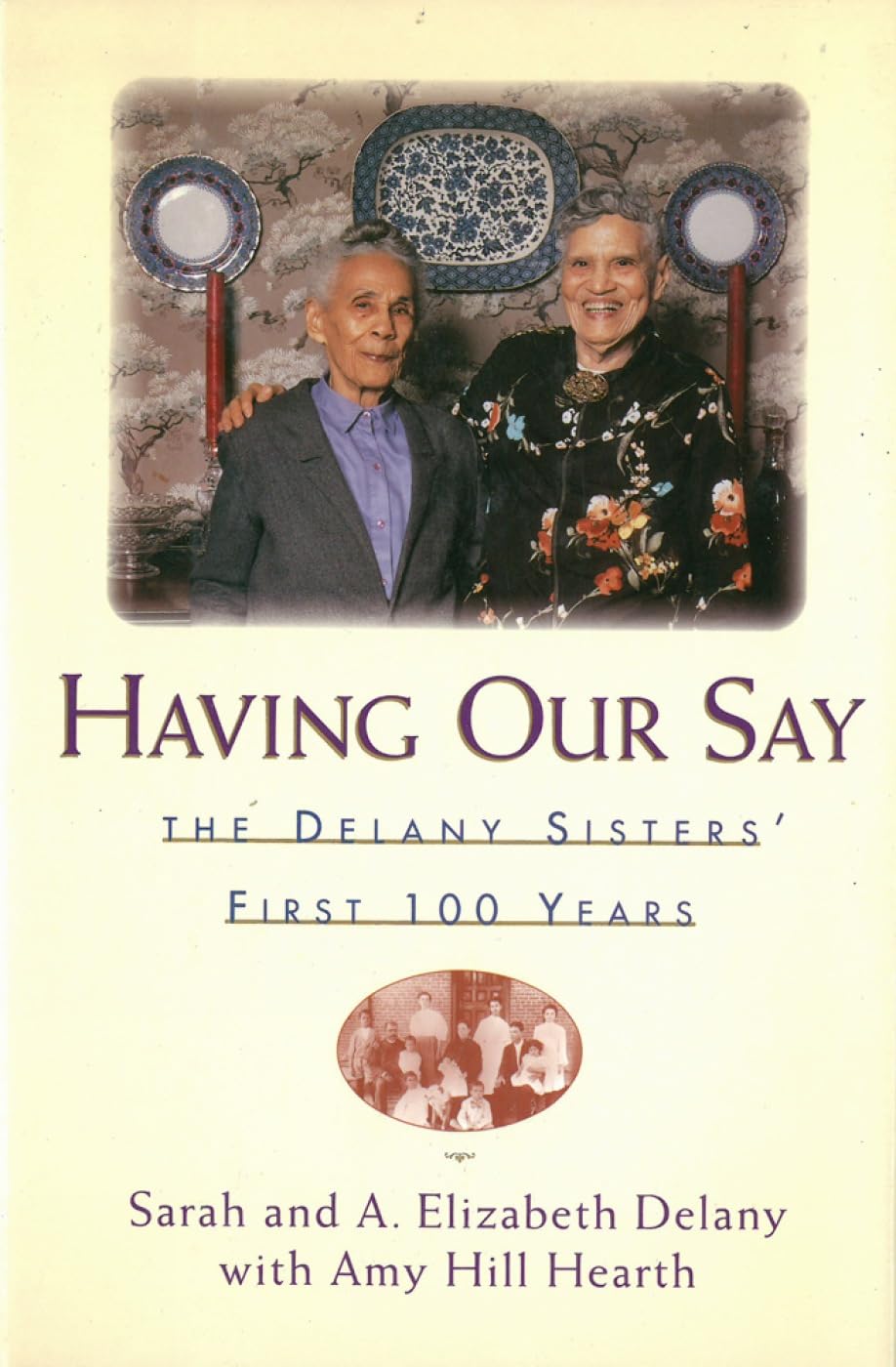



"When you get real old, honey," says Bessie Delany, "you lay it all on the table. There's an old saying: Only little children and old folks tell the truth." In Having Our Say Bessie, age 101, and her sister Sadie, age 103, do just that-and then some. Filled with humorous and poignant anecdotes, this inspiring dual memoir offers a rare glimpse of the birth of black freedom- and the rise of the black middle class-in America. It is a chronicle of remarkable achievement. Sadie and Bessie Delany recall growing up with eight other siblings in turn-of-the-century North Carolina: their father was born in slavery, yet became the nation's first elected black Episcopal bishop; their mother could have "passed" for white but chose not to. With irrepressible pluck, the sisters confronted the first days of Jim Crow and legal segregation, and took part in the World War I-era migration North, rising to professional prominence during the heyday of Harlem. Along the way they met such legendary figures as black leaders Booker T. Washington and W. E. B. Du Bois and entertainers Cab Calloway and Lena Home. Both sisters favored careers over marriage, despite many opportunities. Later, they settled in the still partly-rural Bronx, then integrated a suburban neighborhood in the '50s. Each has triumphed in her own way: "Queen Bess" with feistiness; "Sweet Sadie" with quiet determination. Though warmly skeptical of each other's style, they remain devoted. "She may be one- hundred-and-one years old, comments Sadie, "but she's still my little sister." Today they are fragile, yet fiercely independent. They still live alone in their own house. They make their own peach preserves and their own soap, and don't own a telephone ("it's the biggest nuisance invented by mankind"). Radio keeps them informed-and their opinions on current events are to be reckoned with. Sadie and Bessie Delany's lifelong insights provide us with a priceless oral history of our nation's past century. And what they "have to say" shows us, as no one else can, where we've been, how far we've come...and how far we have to go. The Delany sisters' story is a collective meditation on American life since Sadie's birth in 1889 and Bessie's in 1891 in Raleigh, North Carolina. As daughters of a black Episcopal bishop, they experienced the multifarious damage and distance of class and race in the segregated South. The sisters migrated to New York City's Harlem in the 1910s and in the 1950s to the suburb of Mt. Vernon, New York. The assertive Bessie battled racism and sexism as the only black female member of her Columbia University Dental School class in the 1920s. The more reticent Sadie became the first black domestic science teacher in the New York City high schools. Through the prism of poignant, personal episodes, these honest, thoughtful reminiscences illuminate two individual lives and a multitude of encounters along gender and color lines. Recommended for general collections on African Americans, women, and 20th-century America. - Brenda Brock, SUNY-Buffalo Copyright 1993 Reed Business Information, Inc. In a memoir that's as much a historical record as a testimony to two extraordinary women, the Delany sisters recall their remarkable lives, spanning more than a century of the African- American experience. Daughters of the nation's first black Episcopal bishop, Sadie and Bessie Delany, born in 1889 and 1891 respectively, are a living record of the seismic changes that have affected black America since Emancipation. Their father was born in slavery; their mother was the daughter of an ``issue-free negro'' and a white Virginian farmer who, though prohibited by law from marrying his beloved Martha Logan, treated her and his children as his lawful family. Raised in the sheltered environment of St. Augustine's School near Raleigh, where their father was the principal, the two girls were expected, like their eight other siblings, to excel both academically and morally. An idyllic childhood was followed by the introduction of Jim Crow legislation that soon made life in the South intolerable, prompting the sisters to move to Harlem. In New York, Sadie graduated from Pratt and became a high-school teacher, while Bessie, graduating from Columbia, became a dentist. The two were soon prominent in Harlem, befriending the black elite (Booker T. Washington, Cab Calloway, Adam Clayton Powell) and actively fighting racial discrimination. Today, looking back, they continue to reflect the wisdom, humor, and feistiness that enabled them to triumph over racism and sexism--the latter, in their opinion, not as corrosive as the former. The Delanys aren't optimistic about the future of race relations, believing that the momentum of the civil- rights struggle was taken away by the Vietnam War. An uplifting and delightful introduction to two splendid women of remarkable good sense and grace--and a fascinating chapter of history as well. (Thirty b&w photographs--not seen) (First print