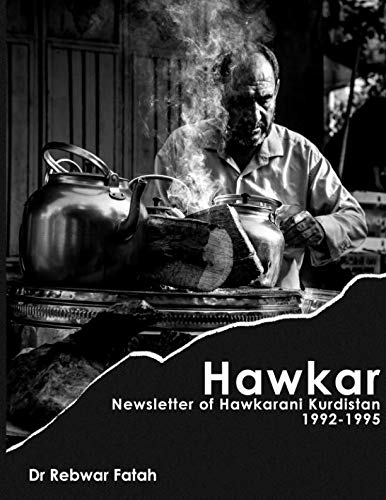
Hawkar: Newsletter of Hawkarani Kurdistan 1992 - 1995 (Diaspora Organisations & publications)
$20.00
by Dr Rebwar Fatah



Hawkarani Kurdistan was a pressure group that was founded in 1992, a year after the establishment of the Kurdistan Regional Government. It was made up mostly of Kurdish intellectuals and professionals working in London.In that same year, both a Kurdish-run government and parliament were elected into power in Kurdistan, via the first ever Kurdish general election. This had been set up in areas where Saddam Hussein had lost control, as a result of numerous successful political revolts against his regime, which was still suffering from the defeat of the Gulf War in 1991. Very soon after the inception of Hawkarani Kurdistan, it became an influential organisation, gaining the respect of British civil organisations and activists. Their aim was to be a ‘pressure group that lobbied in the UK and Kurdistan for justice, peace, and environmental protection and development within Kurdistan’. At the time, it was the first and only of its kind. Most notably, the organisation conducted meetings and seminars to discuss different aspects of Kurdish society. They also issued a monthly newsletter called Hawkar, which mainly reported and analysed the news. Only twenty-one issues were ever published and due to lack of resources, a few of the issues were duplicated. Hawkarani Kurdistan was active from 1992 until late 1995, which was also an important time in the history of Kurdistan, Iraq and bordering territories. During its active life, it had some serious proposals for the socio-political changes in Kurdistan. In addition, they highlighted grave human rights violations under the rule of the Kurdistan Democratic Party (KDP) led by Masoud Barzani and the Patriotic Union of Kurdistan led by the late Jalal Talabani. Subsequently, Hawkarani Kurdistan was perceived as a threat by both the PUK and KDP.Both political parties lacked even the most fundamental understanding of democratic rule & culture. They were established upon tribal bases and abhorred criticism but most importantly, their objectives were, and still is, to have monopoly over the socio-political power and resources of the region. They saw Kurdistan as their own and the clans’ project, and to rule unopposed, where no one else would have the power to intervene in their political and financial business. They chiefly labelled Hawkarani Kurdistan as a threat to ‘national security’. Their meetings and seminars were boycotted by supporters of the political parties and the parties themselves attempted to dismiss Hawkarani Kurdistan’s activities and minimise them. The first issue of the Hawkar newsletter was published in 1992 and the last one was Issue 21, February 1995. Each issue was four pages long, except for issue 5 in February 1993, which was much more extensive in order to address the scandal Iraq-gate.This book contains almost all of the issues of Hawkar, except for the first issue. In the appendices, I have provided almost all of their published literature; these were the organisation’s stance on Kurdish related affairs at the time; and also included their constitution.