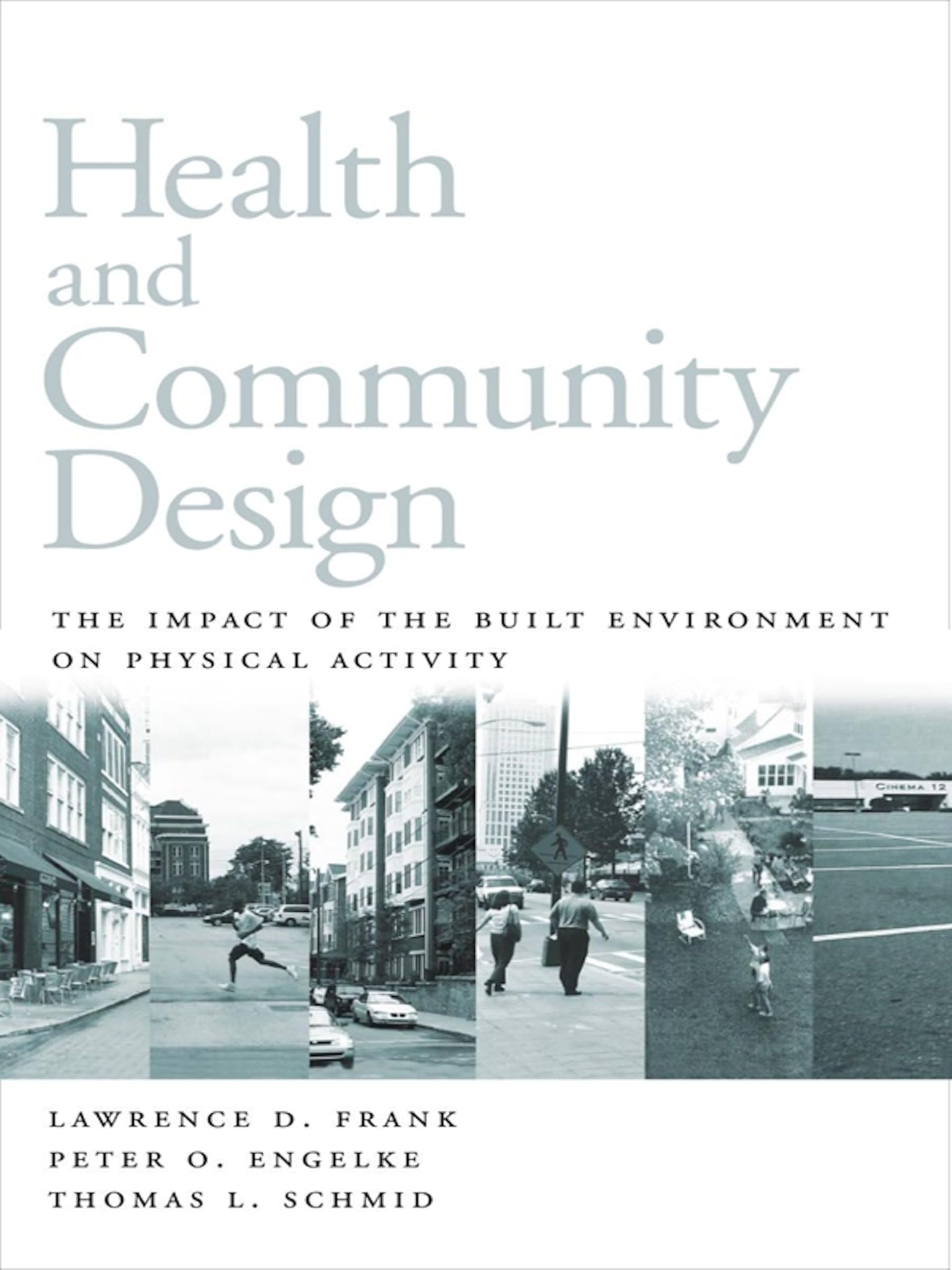
Health and Community Design: The Impact Of The Built Environment On Physical Activity
$25.99
by Lawrence Frank



Health and Community Design is a comprehensive examination of how the built environment encourages or discourages physical activity, drawing together insights from a range of research on the relationships between urban form and public health. It provides important information about the factors that influence decisions about physical activity and modes of travel, and about how land use patterns can be changed to help overcome barriers to physical activity. Chapters examine: • the historical relationship between health and urban form in the United States • why urban and suburban development should be designed to promote moderate types of physical activity • the divergent needs and requirements of different groups of people and the role of those needs in setting policy • how different settings make it easier or more difficult to incorporate walking and bicycling into everyday activitiesA concluding chapter reviews the arguments presented and sketches a research agenda for the future. "The book is highly recommended for urban planners and anyone serious about fighting obesity in this country, which clearly is no longer an odd pairing." ― Chicago Tribune Larry Frank is Bombadier Chair in Sustainable Transportation Systems at the School of Community and Regional Planning at the University of British Columbia. He recently left the Georgia Institute of Technology where he was an assistant professor in the City Planning Program. He is a registered landscape architect and holds a master in Civil Engineering Transportation Planning and a Ph.D. in Urban Design and Planning from the University of Washington. Peter Engelke is Research Associate in the City Planning Program, College of Architecture, Georgia Institute of Technology. Tom Schmid is Coordinator of the Active Community Environments (ACEs) team in the Division of Nutrition and Physical Activity at the National Center for Chronic Disease Control and Health Promotion, Centers for Disease Control and Prevention. Health and Community Design The Impact of the Built Environment on Physical Activity By Lawrence D. Frank, Peter O. Engelke, Thomas L. Schmid ISLAND PRESS Copyright © 2003 Lawrence D. Frank and Peter O. Engelke All rights reserved. ISBN: 978-1-55963-917-0 Contents ABOUT ISLAND PRESS, Title Page, Copyright Page, Table of Figures, List of Tables, PREFACE AND ACKNOWLEDGMENTS, CHAPTER ONE - Introduction, CHAPTER TWO - Public Health and Urban Form in America, CHAPTER THREE - Physical Activity and Public Health, CHAPTER FOUR - Physical Activity, CHAPTER FIVE - Physical Activity, CHAPTER SIX - Understanding the Built Environment, CHAPTER SEVEN - Transportation Systems, CHAPTER EIGHT - Land Use Patterns, CHAPTER NINE - Urban Design Characteristics, CHAPTER TEN - Application of Principles, CHAPTER ELEVEN - Conclusion, APPENDIX - Summary of Selected Traffic Calming Studies, ENDNOTES, GLOSSARY, REFERENCES, ABOUT THE AUTHORS, INDEX, ISLAND PRESS BOARD OF DIRECTORS, CHAPTER 1 Introduction We ought to plan the ideal of our city with an eye to four considerations. The first, as being the most indispensable, is health. ARISTOTLE, Politics (ca. 350 B.C.) Community design influences human behavior. The ways that cities, suburbs, and towns are designed and built impact the people who work, live, and play in them. The placement, layout, and design of transportation systems, of office complexes, of parks, and of the countless physical elements that make up communities result in real places that have real significance in terms of how we spend our time and what activities we engage in. Where people live, where they work, how they get around, how much pollution they produce, what kinds of environmental hazards they face, and what kinds of amenities they enjoy are a direct product of how communities are designed. This book is about how our communities influence one important type of behavior, physical activity, and the health outcomes that are associated with it. Unfortunately, the great majority of Americans do not get enough physical activity to maintain their health over the long run. Physical inactivity is an enormous health problem in this country, contributing to, among other things, premature death, chronic disease, osteoporosis, poor mental health, and obesity. The environments in which most people spend their time—the modern American city and the suburbs and exurbs that have been the dominant form of development in this country for over a half century—are an important contributor to this problem. The cities and suburbs that we inhabit are not now, and have not been for a long time, places that encourage some critically important forms of physical activity. In short, our physical environment inhibits many forms of activity, such as walking, and has become a significant barrier to more active lifestyles. A century ago, American cities were highly walkable places. They were compact. Commercial, retail,