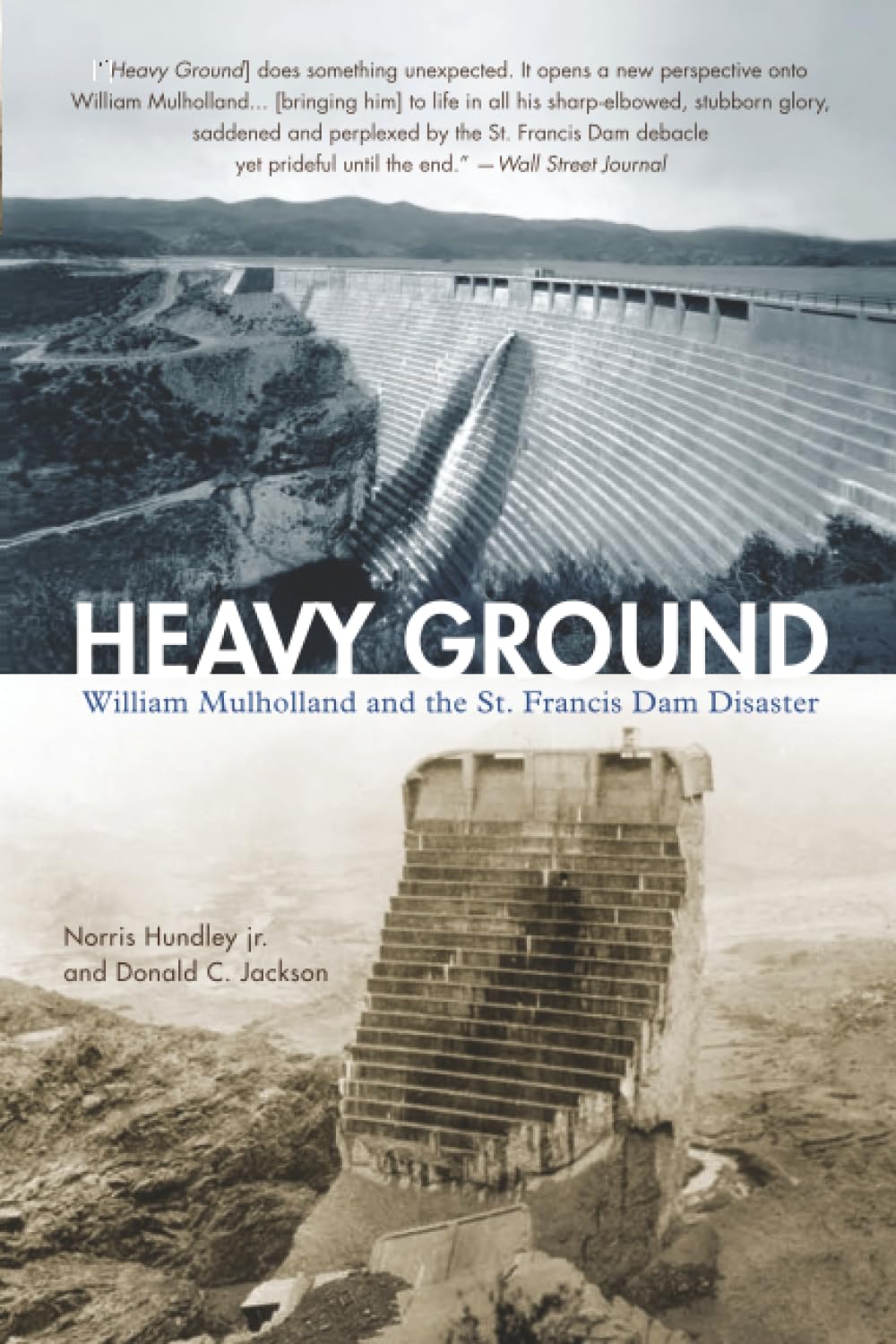



Heavy Ground explores the social, political, and technological history of the St. Francis Dam Disaster in California, the worst civil engineering disaster in twentieth-century American History. Approximately 400 people died in March 1928, when the concrete gravity dam built by Los Angeles engineer William Mulholland suddenly and tragically collapsed, releasing over 12 billion gallons of water into the Santa Clara River Valley. "[ Heavy Ground ] does something unexpected. It opens a new perspective onto William Mulholland... [bringing him] to life in all his sharp-elbowed, stubborn glory, saddened and perplexed by the St. Francis Dam debacle yet prideful until the end." — Wall Street Journal “A meticulously researched… case study of the catastrophic failure north of Los Angeles in March 1928 of the St. Francis Dam that killed 400-450 people… [ Heavy Ground ] is exemplary for its use of previously unavailable original sources, particularly the L.A. Coroner’s Inquest report.” — Pacific Historical Review “A gripping account of this ill-fated dam and the person most directly responsible for its flawed design: William Mulholland.” — T e chnology and Culture "Carefully-crafted, exhaustively-researched, liberally-illustrated, and engagingly-written... an important and welcome addition to the pantheon of scholarship on California Water History." — Southern California Quarterly “Above all, [Hundley and Jackson] tell the story of the tragedy itself, the testimonies and recollections of survivors, the arguments over reparations for property damage and lives lost. Forget about Chinatown . This book sets a standard for scholarship that scholars will have to meet in their own research into Los Angeles’ controversial water history.” — Western Historical Quarterly “For its lucid explanation of the politics surrounding the [St. Francis] disaster, its minute-by-minute description of the dam’s final moments, and ensuing tidal wave that murderously swept down the valley, and its meticulous and careful analysis of the dam’s design, construction, and failure, Heavy Ground joins the list of [Hacker Prize] books displaying “exceptional scholarship” while reaching for readers “beyond the academy.” Additionally, the book superbly integrates the history of technology with social, cultural, and economic contexts.” — Sally Hacker Prize citation Norris Hundley (1935–2013) was an author and leader in the history of the American West and in the nascent field of water history. He was a was long time member of the History Department at UCLA and served as president of both the Western History Association and the Pacific Coast Branch of the American Historical Association. Donald C. Jackson is the Cornelia F. Hugel Professor of History at Lafayette College in Easton, Pennsylvania. He has authored many books and articles on the history of dams and hydraulic engineering. CHAPTER ONE Mulholland: A Man and an Aqueduct One of many sad truths about the St. Francis Dam disaster is that residents of the Santa Clara Valley—the people who bore the brunt of suffering and death—played essentially no role in the Conception or operation of the dam. Th e vast bulk of the floodwater was artificially fed into the Santa Clara River watershed with no intention that it would ever benefit citizens of the valley. True, some water in the reservoir originated within the thirty-seven square miles of foothills lying above the dam, but far more fell to earth as rain and snow 200 miles to the north, along the lofty eastern slope of the Sierra Nevada. This imported water entered San Francisquito Creek through an astounding feat of human ingenuity and technological bravado, underwritten by individuals with little interest in the people or prosperity of the Santa Clara Valley. To them, the valley was a mere corridor and way station for an aqueduct carrying water to Los Angeles. The use of San Francisquito Canyon for a major reservoir was largely an accident of history, a by-product of decisions and initiatives undertaken by Los Angeles officials over a period of twenty years. St. Francis The dam was but one component of a much larger project—the Los Angeles Aqueduct—designed to slake the thirst and light the homes of the rapidly growing city. Stretching over 230 miles from the Owens Valley to the San Fernando Valley, the Los Angeles Aqueduct still holds great prominence in the public mind because of its role in defining the political economy of Southern California’s premier city. To appreciate how the St. Francis Dam came to be built requires an understanding of both the Los Angeles Aqueduct and the man most responsible for its construction. As the aqueduct’s chief engineer and its public face, William Mulholland stood as a colossus over early twentieth-century Los Angeles. Diverting the flow of the Owens River across desert wasteland and through mountain escarpment, the aqueduct created the hydraulic Fo