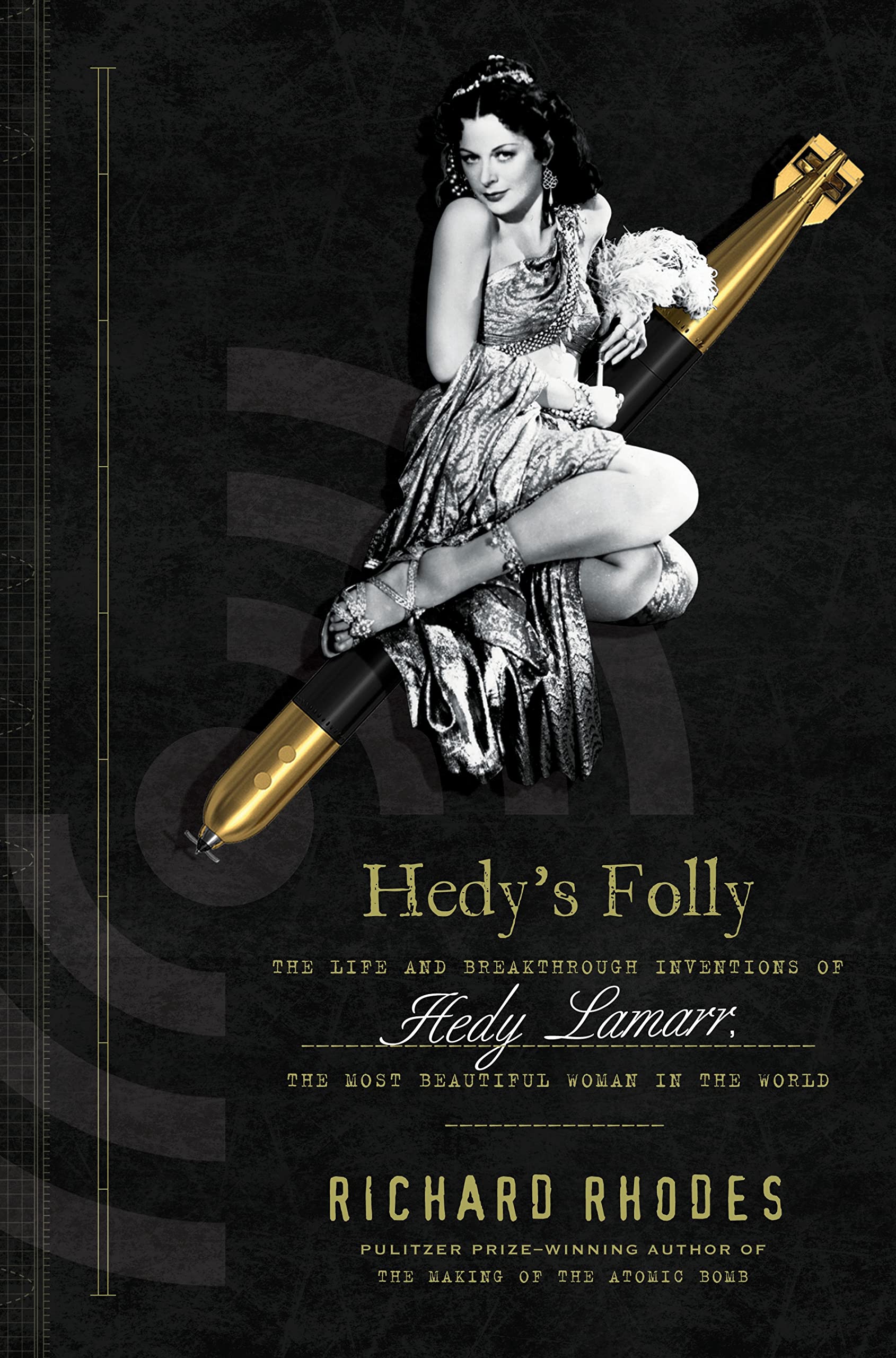
Hedy's Folly: The Life and Breakthrough Inventions of Hedy Lamarr, the Most Beautiful Woman in the World
$16.35
by Richard Rhodes



What do Hedy Lamarr, avant-garde composer George Antheil, and your cell phone have in common? The answer is spread-spectrum radio: a revolutionary invention based on the rapid switching of communications signals among a spread of different frequencies. Without this technology, we would not have the digital comforts that we take for granted today. Only a writer of Richard Rhodes’s caliber could do justice to this remarkable story. Unhappily married to a Nazi arms dealer, Lamarr fled to America at the start of World War II; she brought with her not only her theatrical talent but also a gift for technical innovation. An introduction to Antheil at a Hollywood dinner table culminated in a U.S. patent for a jam- proof radio guidance system for torpedoes—the unlikely duo’s gift to the U.S. war effort. What other book brings together 1920s Paris, player pianos, Nazi weaponry, and digital wireless into one satisfying whole? In its juxtaposition of Hollywood glamour with the reality of a brutal war, Hedy’s Folly is a riveting book about unlikely amateur inventors collaborating to change the world. Amazon Best Books of the Month, December 2011 : Hedwig (Hedy) Kiesler may be one of the greatest unsung heroes of twentieth century technological progress. An opportunistic Austrian immigrant driven by curiosity and a desire to make it as a Hollywood actress in the early years of World War II, Hedy worked with avant-garde composer George Antheil to create the technology that we depend upon today for cell phones and GPS: frequency hopping. Though Richard Rhodes presents details about everyone involved in the separate experiences that the two inventors drew upon to make their breakthrough in Hedy’s Folly , the invention itself takes center stage, driving the remarkable story with precision. Rhodes skillfully weaves together all the disparate parts of the story, from how Hedy learned about Nazi torpedoes to why George’s knowledge of player pianos was key to the invention, in order to create a highly readable genesis of the technology that influences billions of lives every day. --Malissa Kent Hedy's Folly is one of the Huffington Post 's Best Film Books of 2011! Praise for Hedy's Folly : “ Rhodes’s talent is making the scientifically complex accessible to the proverbial lay reader with clarity and without dumbing down the essentials of his topics … along the way he expertly weaves social and cultural commentary into his narrative …. Behind the uniqueness of this story lie deeper themes that Rhodes touches upon : the gender biases against beautiful and intelligent women, the delicate interpersonal politics of scientific collaboration and…the neverending, implacable conflict between art and Mammon in American culture.”—John Adams, front page of the New York Times Book Review " It’s to Mr. Rhodes’s credit that he gently makes this implausible story plausible ." — Dwight Garner, New York Times " This is a smart, strange and fascinating book, which deserves to find an audience .... Rhodes is particularly good when describing intellectual milieus , whether Vienna in the first years of the 20th century, the Paris of James Joyce, Ezra Pound and Sylvia Beach and — for that matter — the permanent bureaucracy of the Pentagon. Many will have forgotten the brutal Soviet attack on Finland in 1940, but Rhodes sums it up poignantly and succinctly in three pages about the death of Antheil’s brother Henry. Finally, Rhodes is one of those few writers capable of explaining complicated scientific ideas to the general public, invariably with clarity and precision and sometimes wit and poetry as well. " — Prof. Tim Page, Washington Post " In Hedy's Folly , Rhodes weaves a fascinating...account of Lamarr's journey into scientific exploration and the political machinations of war, mixing thorough techno research with Hollywood glam ." — Bill Deskowitz, USA Today "Hedy Lamarr, Hollywood starlet and inventor of a torpedo guidance system during World War II? Who knew? Richard Rhodes, the Pulitzer-winning author of The Making of the Atomic Bomb , drops quite a bombshell with this revelation in his new book ." — Weekend Picks, USA Today " Richard Rhodes...unites the social history of Vienna, the classic era of Hollywood film, Paris in the ’20s, experimental music, weapons design, the niceties of patent law and the technology of information transmission — a real grab bag of elements — in this short, charming and remarkably seamless book . He makes a rigorous effort to establish exactly what Lamarr contributed.... 'She deserved better,' Rhodes writes, than to be judged by that spectacular face alone, and now, at last, she is ." — Laura Miller, Salon "Actresses often long to turn director, but how many of them yearn to turn inventor? Given the success that the screen siren Hedy Lamarr achieved in that realm—revealed in Richard Rhodes’s fascinating biography , Hedy’s Folly —it’s a pity more of them don’t con