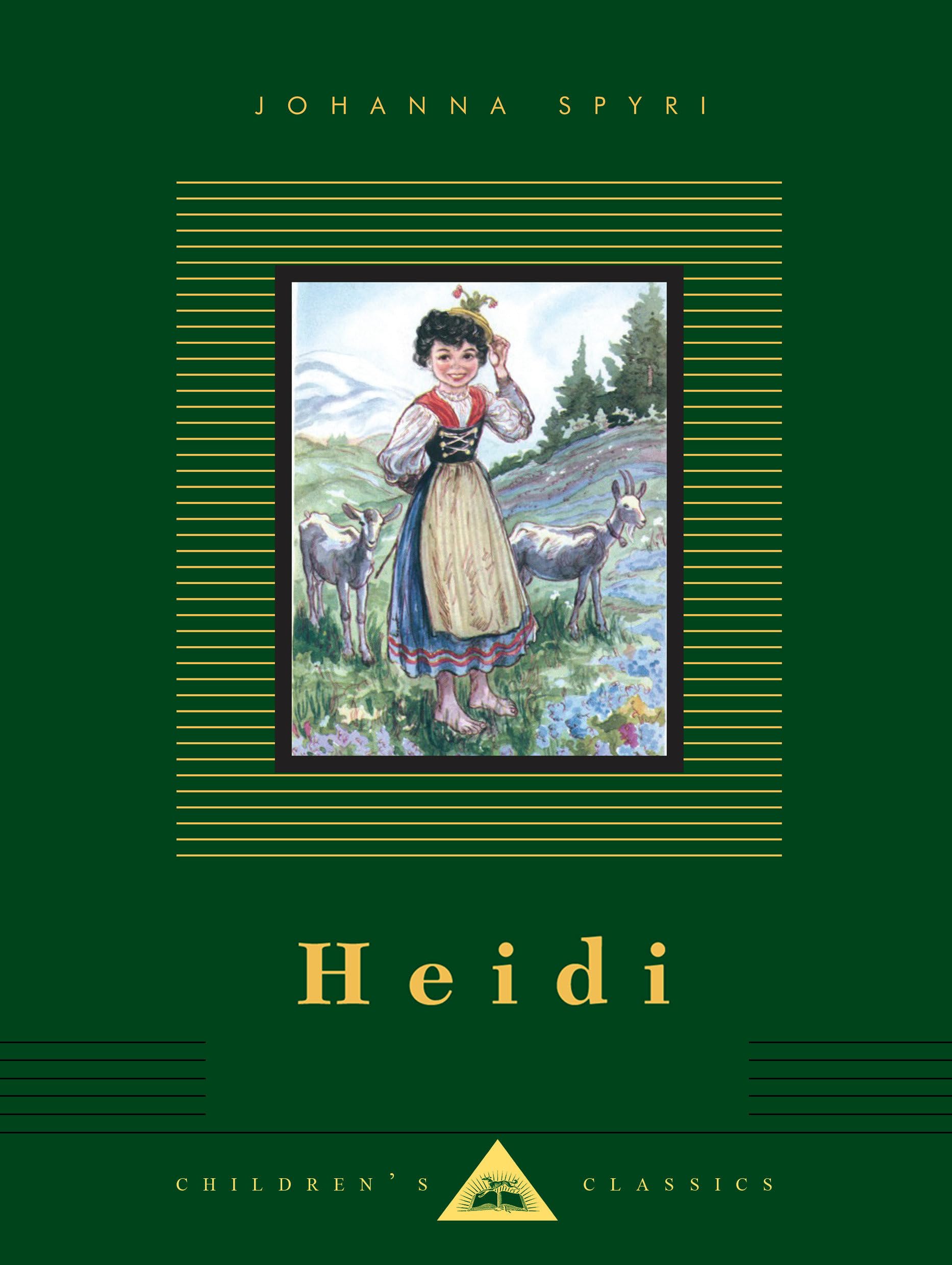



The story of an irrepressible orphan girl in the Swiss Alps, written in 1881, has long been one of the most beloved and best-selling children's classics in the world. This hardcover edition features a gilt spine, a silk ribbon marker, and beautiful full-color illustrations by Austrian artist William Sharp. Heidi's story begins when she is orphaned at the age of five and sent to live with her reclusive, embittered grandfather on a mountainside above a Swiss village. Heidi's grandfather has been estranged from the villagers for years and he resents the child's arrival, but she wins his affection with her enthusiasm and cheer. Her rural idyll is cruelly interrupted, however, when her aunt sends her to the city to be a hired companion to a wealthy girl in a wheelchair. Clara is delighted by her new friend, but the family's strict housekeeper tries to repress Heidi's high spirits and the girl begins to waste away, pining for her mountain home. The resolution of Heidi's dilemma transforms the lives of everyone around her and has entranced readers for generations with its vision of the joys of country life and the power of love and friendship. JOHANNA SPYRI (1827-1901) was a Swiss author. Born in rural Switzerland to a doctor and a poet, she later lived in Zurich with her husband and son. She began writing stories later in life, publishing her most famous novel, Heidi, in 1881. In the last twenty years of her life, Spyri wrote more than fifty novels and stories for adults and children. from CHAPTER 1: The Alm-Uncle FROM THE pleasantly situated old town of Maienfeld a footpath leads up through shady green meadows to the foot of the mountains, which, as they gaze down on the valley, present a solemn and majestic picture. Anyone who follows it will soon catch the keen fragrance of grassy pasture lands, for the footpath goes up straight and steep to the Alps. One bright, sunny June morning, a tall, sturdy looking girl, evidently a native of the mountains, was climbing this narrow path. She led by the hand a little maiden, whose cheeks glowed as if a ruddy flame were under her dark-brown skin. And what wonder? In spite of the hot June sun, the child was bundled up as if for protection against the sharpest cold. She could not have been five years old, but it was impossible to tell anything about her natural figure, for she wore two or three dresses, one over the other, and a big red cotton scarf round her neck; her feet were lost in heavy hobnailed shoes, and the little thing was quite formless as she made her hot and laborious way up the mountain. At the end of an hour of steady climbing the two girls came to the group of houses that lies halfway up the Alm Mountain and is called Dorfli, or the Little Village. Here they were greeted from almost every cottage, and by everyone in the street, for the older of the two girls had reached her home. Nevertheless, she made no pause but hurried on, answering all questions and greetings as she went. At the very end of the hamlet, as she was passing the last of the scattered cottages, a voice from the doorway cried: ‘‘Wait a moment, Dete, I’ll go with you, if you are bound up the mountain.’’ The girl addressed stopped; immediately the child withdrew her hand and sat down on the ground. ‘‘Are you tired, Heidi?’’ asked her companion. ‘‘No, I am hot,’’ replied the little girl. ‘‘We are almost there,’’ said her companion encouragingly. ‘‘You must put out all the strength you have for a little while longer; it won’t take us more than an hour.’’ Just then a large, pleasant-looking woman came out of the cottage and joined them. The little girl jumped to her feet and followed the two women, who had instantly fallen into a lively conversation regarding all the inhabitants of the village and of the neighborhood. ‘‘But really, Dete, where are you taking the child?’’asked the newcomer. ‘‘It is your sister’s little girl, isn’t it—the orphan?’’ ‘‘Yes, it is,’’ replied the other. ‘‘I am taking her up to her grandfather; she will have to stay there.’’ ‘‘What! the little girl is going to live with the Alm- Uncle? You must have lost your senses, Dete! How can you think of doing such a thing? The old man will send you back with such a scheme as that.’’ ‘‘He can’t do it; he’s her grandfather, and it is time for him to look out for her; I have had her till now, and I must tell you, Barbel, that I could not think of letting her hinder me from taking such a place as I have just had offered me. Her grandfather must do his part now.’’ ‘‘That’s very well, if he were like other men,’’ urged Barbel with some indignation. ‘‘But you know what he is. What will he do with a child—especially with such a young one? He won’t hear of such a thing—But where are you going?’’ ‘‘To Frankfurt,’’ said Dete. ‘‘I have an extra good place there. The family was down at the Baths last summer; I had charge of their rooms, and they wanted then to take me back with them. I couldn’t manag