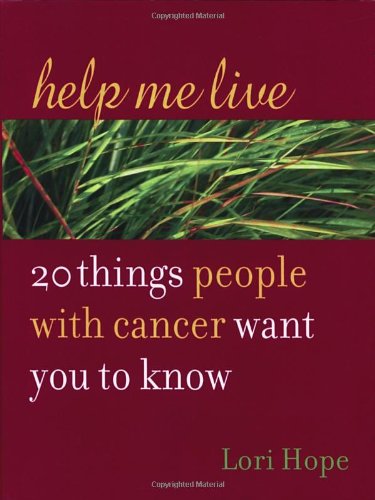



When we hear that someone close to us has been diagnosed with cancer, we want nothing more than to comfort them with words of hope, support, and love. But sometimes we don't know what to say or do and don't feel comfortable asking. With sensitive insights and thoughtful anecdotes, Help Me Live provides a personal yet thoroughly researched account of words and actions that are most helpful. "With grace and good humor, Hope tells us what we all should know about facing this life-altering disease. Extraordinarily moving and helpful, this book is essential reading for cancer patients as well as their families and friends." --Marc Silver, author of Breast Cancer Husband and editor at U.S. News & World Report "What a remarkable book." --Jimmie Holland, MD, Memorial Sloan-Kettering Cancer Center, author of The Human Side of Cancer "Meaningful and valuable to cancer patients, their families, friends, caregivers, physicians, and therapists--as well as any compassionate individual living in a society with other human beings. Lori's hopeful and melodic voice sings throughout." --Jo Ellen Lezotte, past president of The Cancer League, Inc. "Help Me Live is personal, practical, and heartful and makes it easier to navigate the nitty-gritty realities of what to say and do if you want to help." --Jean Shinoda Bolen, MD, author of Close to the Bone: Life-Threatening Illness and the Search for Meaning "Lori Hope's masterful storytelling and clear explanations are invaluable, helping you understand (and forgive) others' hurtful words and actions. . . . This book is a gift." --Wendy S. Harpham, MD, cancer survivor and author of Diagnosis: Cancer *An intimate guide for families, partners, and friends of individuals diagnosed with cancer, detailing 20 messages to help loved ones communicate effectively. *Appendices include specific advice geared toward special circumstances like workplace issues, children, and rare cancers; 15 common words, phrases, and questions that can sting; 15 fabulous things people did and said; 20 movies and books to know about; and more. *HELP ME LIVE does not prescribe behavior; rather it is designed as food for thought: stories unfold, providing examples of words and deeds that have helped and harmed. Lori Hope, a cancer survivor herself, has produced more than 20 documentaries, winning dozens of awards including two Emmys. Currently managing editor of Bay Area BusinessWoman News, Hope has been published in Newsweek and broadcast on radio stations nationwide. introduction It’s all very simple, or else it’s all very complex, or perhaps it’s neither, or both. --Ashleigh Brilliant I awaken in my dormitory-size room at the St. Placid Retreat Center and can hardly wait to peek outside at the thin-limbed maple tree, its wide five-fingered leaves waving slowly up and down as if fanning royalty. The 6 a.m. green grays will soon glow with reflected light from the sky, and coffee calls. What a thrill to be on my own with absolutely nothing to do but finish the final chapter of this book! On a private writing retreat at a wooded monastery in Lacey, Washington, I am high on life, as they used to say in the ’60s. Having survived cancer, I have just returned from “Cancer as a Turning Point,” a free conference that freshened my heart with hope. My nineteen-year-old son, Brett, has recently called on my cell phone to ask if I know anyone who would like a newspaper subscription, which he wants to purchase out of compassion for the lackey outside Safeway who is selling them. And my husband, David, has left a voice mail, saying with love rich as mocha fudge, “I miss you so much.” It doesn’t get much better than this. As I move through the dappled teal-and-purple-carpeted hallway in my slippers, I step gingerly to avoid disturbing the other retreatants sleeping behind doors labeled for Benedictines such as Heloise, Leoba, Mechtild, and Hrotsvit of Gandersheim. In the modern fluorescent-lit communal kitchen that still smells of microwaved popcorn from the night before, I quietly turn a jar-size stainless steel knob next to the faucet. After pumping hot water into the plastic filter to brew my espresso-roasted go-juice, I leave the kitchen, silently shutting the door behind me, and tiptoe back down the hall. Laptop cradled tightly against my left ribs--ribs that were split apart two years ago so a lobe of my lung could be removed--I enter the propped-open door labeled “Parlor” across the hall from the room named for Hadewijch (who, by the way, penned the words, Love conquers all things). I set my computer on the red-checked gingham loveseat and bend to lift the brass doorstop. I close the door so I can tap-tap-tap on my keyboard without disturbing the man in Hadewijch, who is just eight feet away. I have met him and his egg-shape body. His black suspenders hold up gray pants, and a quarter-inch elastic strap attached to his tortoise-shell spectacles reaches around his bald head, s