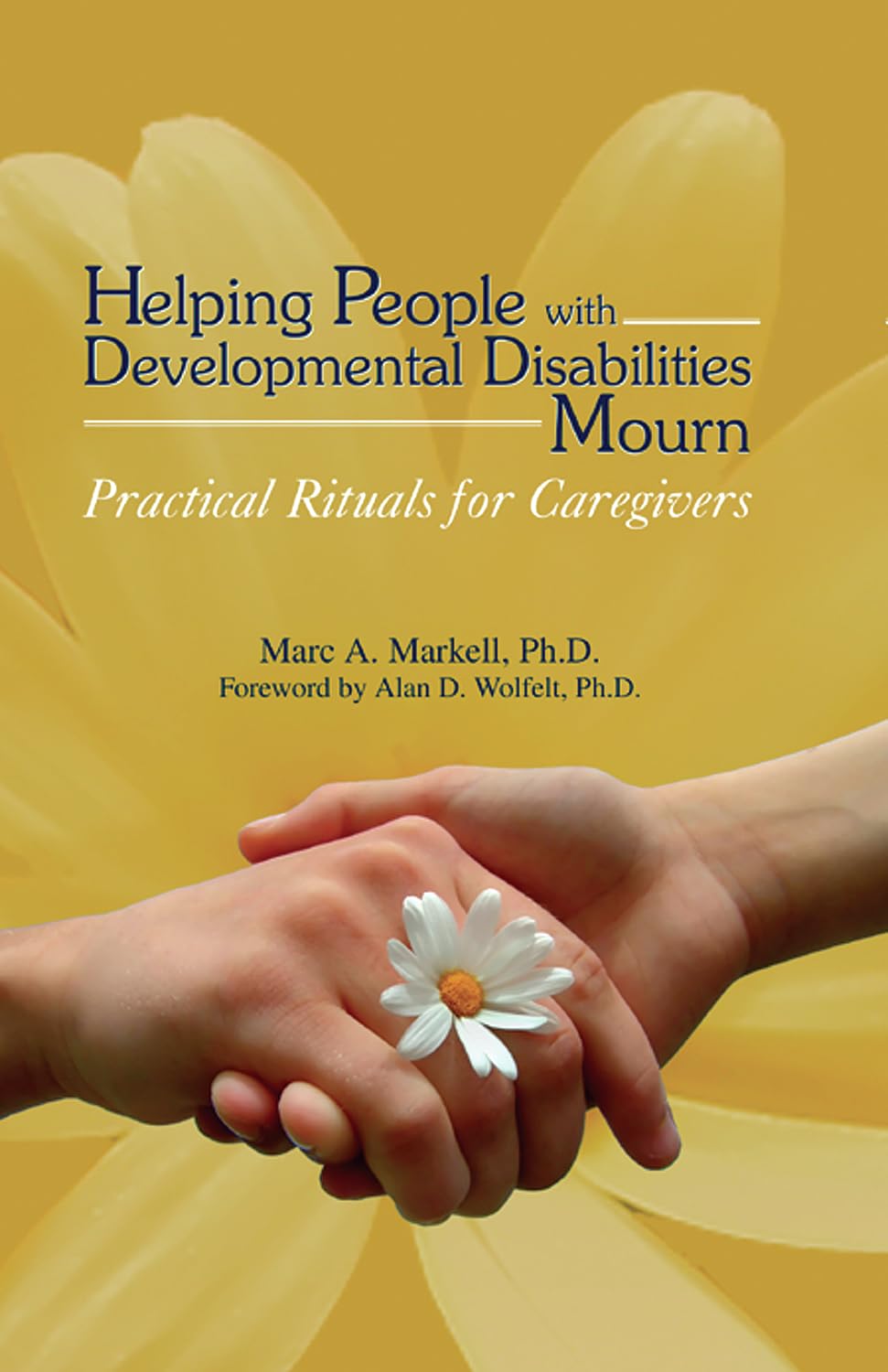
Helping People with Developmental Disabilities Mourn: Practical Rituals for Caregivers
$13.95
by Marc A. Markell PhD



Frequently, people with developmental disabilities are excluded from bereavement ceremonies when a loved one or friend dies, therefore not receiving the special care needed for comprehending their own feelings of loss. Focusing on creating mourning rituals for special needs people, this guide offers specific rituals and techniques for caregivers to use while helping explain death and dying. With more than 20 examples such as the use of pictures and storytelling or drawing and music, these practical tools can substantially lend to the understanding of grief and sadness for intellectually and developmentally disabled adults and adolescents. Marc A. Markell, PhD , is a professor of special education at St. Cloud State University. He frequently presents workshops on grief and loss for schools, churches, community organizations, and at local, state, national, and international conferences; and he conducts grief support groups and provides individual grief counseling. He is also a certified thanatologist through the Association of Death Educators and Counseling and is certified in death and grief education from the Center for Loss and Life Transition. He lives in St. Cloud, Minnesota. Alan D. Wolfelt, PhD , serves as the director of the Center for Loss and Life Transition. He writes the "Children and Grief" column for Bereavement Magazine and has appeared on Larry King Live , The Oprah Winfrey Show , and Today . He is the author of Healing a Teen's Grieving Heart , Healing Your Grieving Heart , and Understanding Your Grief . He lives in Fort Collins, Colorado. Helping People with Developmental Disabilities Mourn Practical Rituals for Caregivers By Marc A. Markell Center for Loss and Life Transition Copyright © 2005 Marc A. Markell, Ph.D. All rights reserved. ISBN: 978-1-879651-46-3 Contents Title Page, Dedication, Copyright Page, Dedication, Foreword, Preface, About the terminology in this book, Introduction, Ritual One - Use of Photographs in Ritual, Ritual Two - Using Storytelling in Ritual, Ritual Three - Use of Memory Objects in Ritual, Ritual Four - Use of a Plant (or Tree) in Ritual, Ritual Five - Use of Drawing in Ritual, Ritual Six - Use of Music in Ritual, Ritual Seven - Use of Writing in Ritual, Ritual Eight - Use of Stones in Ritual, Ritual Nine - Use of Photos of the Death Process, Ritual Ten - Use of Space & Location in Ritual, Ritual Eleven - Use of Daily Objects in Ritual, Ritual Twelve - Use of Daily Memory in Ritual, Ritual Thirteen - Use of Packing Up Belongings in Ritual, Ritual Fourteen - Use of a Pendant or Ornament in Ritual, Ritual Fifteen - Use of a Heart Picture in Ritual, Ritual Sixteen - Use of Light in Ritual, Ritual Seventeen - Use of Burying an Object in Ritual, Ritual Eighteen - Use of a Memory Gift in Ritual, Ritual Nineteen - Use of Play-Doh in Ritual, Ritual Twenty - Use of Food in Ritual, Final Thoughts, CHAPTER 1 Ritual One Use of Photographs in Ritual In brief: Show a photo or photos of the person who has died to the individual with a disability and talk about the person to help the individual mourn the loss. If the individual with a disability is nonverbal, the facilitator can verbalize "for the individual" about the loss. Materials: A photo or photos of the person who died. Directions: If the ritual is done in a classroom environment, have the students and others (with and without developmental disabilities) gather in a circle in the classroom, outdoors or in an environment where the students most often interacted with the person who died. Such environments may include the cafeteria if the person who died was a cook at the school or the music room if the person who died was a music teacher. After the individuals have gathered, pass a photo of the person who died from person to person around the circle. Each person who holds the picture talks about the person while looking at it. Each person could say whatever they are thinking or feeling while looking at the photo. They could also say a word that comes to their mind. If an individual in the circle is unable to verbalize her thoughts and feelings, a person who is able to speak (a facilitator) can "speak for" the individual holding the picture. The facilitator may say something they remember about an interaction between the individual and the person who died. For example, "I remember when Joe (the person who died) helped Elena (the individual with a developmental disability) paint a picture. I also remember Joe and Elena laughing while they painted." If the ritual is done in a home environment, the gathering could be done at a kitchen table, in a family room or outdoors. Again, each person in the group (with and without disabilities) would take a turn holding the photo and talking about the person who died. Example: Kari, a student in a high school class for people with severe and profound developmental disabilities, had lived with severe health complicat