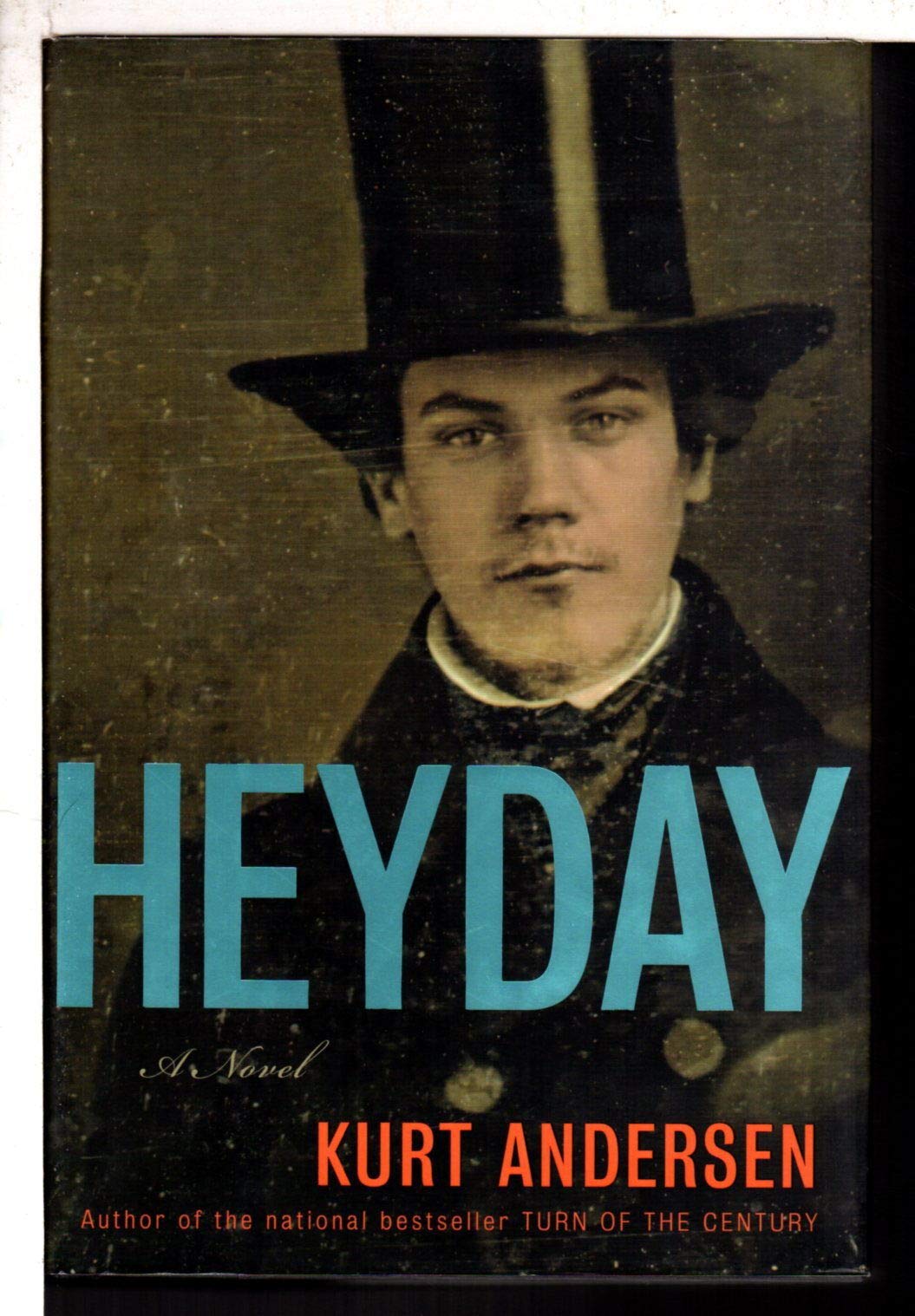



Heyday is a brilliantly imagined, wildly entertaining tale of America’s boisterous coming of age–a sweeping panorama of madcap rebellion and overnight fortunes, palaces and brothels, murder and revenge–as well as the story of a handful of unforgettable characters discovering the nature of freedom, loyalty, friendship, and true love. In the middle of the nineteenth century, modern life is being born: the mind-boggling marvels of photography, the telegraph, and railroads; a flood of show business spectacles and newspapers; rampant sex and drugs and drink (and moral crusades against all three); Wall Street awash with money; and giddy utopian visions everywhere. Then, during a single amazing month at the beginning of 1848, history lurches: America wins its war of manifest destiny against Mexico, gold is discovered in northern California, and revolutions sweep across Europe–sending one eager English gentleman off on an epic transatlantic adventure. . . . Amid the tumult, aristocratic Benjamin Knowles impulsively abandons the Old World to reinvent himself in New York, where he finds himself embraced by three restless young Americans: Timothy Skaggs, muckraking journalist, daguerreotypist, pleasure-seeker, stargazer; the fireman Duff Lucking, a sweet but dangerously damaged veteran of the Mexican War; and Duff’s dazzling sister Polly Lucking, a strong-minded, free thinking actress (and discreet part-time prostitute) with whom Ben falls hopelessly in love. Beckoned by the frontier, new beginnings, and the prospects of the California Gold Rush, all four set out on a transcontinental race west–relentlessly tracked, unbeknownst to them, by a cold-blooded killer bent on revenge. A fresh, impeccable portrait of an era startlingly reminiscent of our own times, Heyday is by turns tragic and funny and sublime, filled with bona fide heroes and lost souls, visionaries (Walt Whitman, Charles Darwin, Alexis de Tocqueville) and monsters, expanding horizons and narrow escapes. It is also an affecting story of four people passionately chasing their American dreams at a time when America herself was still being dreamed up–an enthralling, old-fashioned yarn interwoven with a bracingly modern novel of ideas. "In this utterly engaging novel, the author of Turn of the Century brings 19th-century America vividly to life . . . While this is a long book, it moves quickly, with historical detail that's involving but never a drag on the action; the characters are beautifully drawn. A terrific book; highly recommended." – Library Journal " Heyday is fuled by manic energy, fanatical research, and a wicked sense of humor.... It's a joyful, wild gallop through a joyful, wild time to be an American." -Vanity Fair Kurt Andersen is best known for his previous novel (the irreverent, postmillennial Turn of the Century ), his role as cofounder and editor of the now-defunct Spy magazine, and as host of public radio's Studio 360 . Heyday , Andersen's second novel, recalls the work of Gore Vidal, T. C. Boyle, Thomas Mallon, and even Charles Dickens. Critics agree that while the author's vision is grand and his execution ambitious, Knowles's adventures too often get bogged down in the minutiae of the period at the expense of storytelling (Janet Maslin deems the effect "compulsive pedantry"). Fans of books that set forth Big Ideas ( Heyday very much differs from Turn of the Century ) will revel along with Andersen, who clearly enjoys what he's doing here as he celebrates the tumultuous energy and the careless optimism of an America on the move. Copyright © 2004 Phillips & Nelson Media, Inc. In 1848, young English aristocrat Benjamin Knowles, inspired by the regime change he witnessed in France, immigrates to America in search of "vulgarity and strangeness," enlightened attitudes, and democracy in action. He finds them all in Manhattan's infamous Bowery district. Ben falls in immediately with three misfits: Timothy Skaggs, alcoholic journalist and photographer; Duff Lucking, troubled firefighter and arsonist; and Duff's sister, Polly, actress and part-time hooker. Ben's tumultuous affair with Polly--and the promise of greater freedom--drives the group's journey westward, where California's gold fields await; meanwhile, a crazed French official crosses the ocean to take revenge against Ben. Andersen's satirical wit is well evident, but he plays fair, offering scenarios to offend nearly everyone. In the tradition of the old-fashioned epic, Heyday presents amazing coincidences, lengthy digressions, and myriad descriptions of mores and vices. Although the amount of irrelevant historical detail overwhelms the plot, this overstuffed parody of a Victorian novel makes some serious points: it succeeds in exposing the peculiarities and ridiculousness of nineteenth-century society--and contemporary reverence for it. Sarah Johnson Copyright © American Library Association. All rights reserved Kurt Andersen is the author of Turn of the Cen