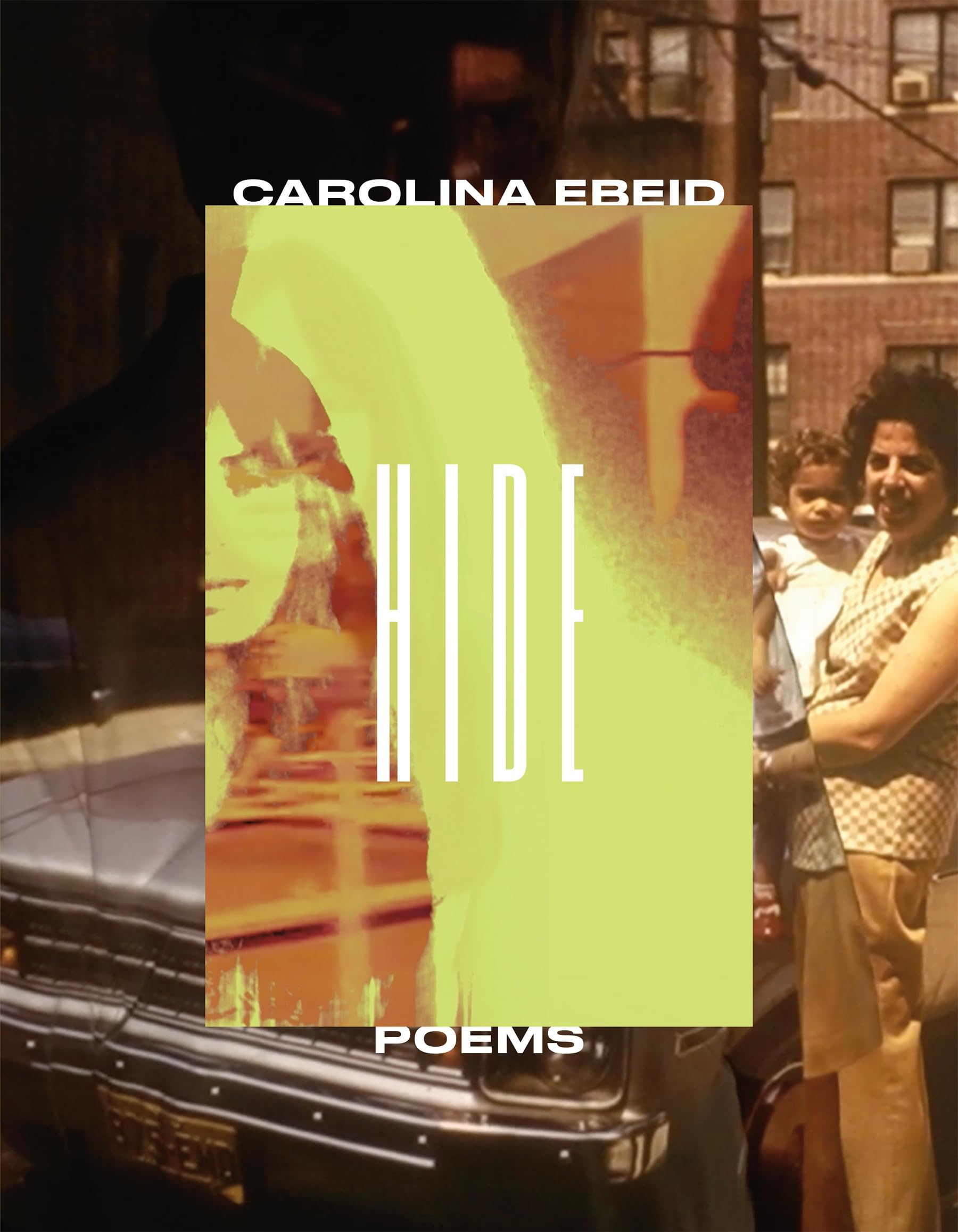



A reinvention of visual poetry and personal history charting exile’s impact on memory, identity, and futurity Intellectual and intimate, Carolina Ebeid's Hide gathers shreds of memory, dream, and the ordinary artifacts of diaspora, as the poet casts a sounding line into her patrilineal and matrilineal histories in Palestine and Cuba. With the hum of cassettes and the glow of projectors, these poems superimpose voice upon voice, image upon image, a here upon a there , to disclose the choral noise inside postmemory. Hide is a restless innovation of form and multimodal expression breaking open words across Arabic, English, and Spanish to release hidden meanings. Poems trace the letter M back to the Phoenician pictograph of waves, while technological “glitches” are portals that summon oracular voices across the family archive. In swirling “spell” poems, Ebeid conjures Cuban American artist Ana Mendieta, whose Siluetas write the human shape upon the earth. Ebeid’s title is prismatic: Hide as in concealment, as in animal skin, as in to secret oneself away. Hide commands attention like a whispering voice, prompting readers to lean in, to listen for transmissions from ancestors and futurity both. “ Hide is ‘the elsewhere of photographs,’ the skin of memory that cites the soul’s movements between Palestine, Iraq, and Cuba―father and mother. Carolina Ebeid’s astonishing, meditative cinepoetics is heliotropic across the blood-brain barrier: a glitch that ‘has memorized something about radiance.’ She tells time by measuring shadows on her grandmother’s clothes in a picture. She reads a homeland in a hand on someone’s shoulder. She auscultates a dispossession and smells rosemary. In Hide , you’re reading a film by the artist who transforms the M into meem into ?. Don’t be afraid of the paradise in her ear.” ―Fady Joudah, author of […] “When history is that thing that entangles us in the inexplicable madness of human time, how do I read the labyrinth of dislocation which is the world? Oh, but I can’t―because it’s not possible. What I can do is listen with my eyes and heart and brain to Carolina Ebeid’s Hide , where the words are warning flowers that feel the failures of our world not by dislocating themselves from their roots but by revealing themselves to be entirely responsive, adaptable, as if each seed syllable were its own telepathy machine that delicately―most delicately―manages to hold the beauty and wonder of this world up to our faces.” ―Eleni Sikelianos, author of Your Kingdom “With Hide , Carolina Ebeid dissolves the borders constraining poetry and what it can be, invites us to swim together in the dissolution and glimpse what it might make possible. This is a book of deep and abiding mystery, beckoning us toward the moments ‘when terror breaks / into something brighter and the brighter / thought cocoons the mind.’ An image of a father standing in front of the projected image of the city from which he was exiled; a mother whose namely M becomes a gateway to many other mothers, a pathway ‘to fly over the ocean / a grieve ability, a grave able place’; the distance between Cuba and Palestine unraveled, collapsed. Through land, exile, cinema, performance, grief, anger, myth, these poems make a new home for ancestors both given and chosen. ‘I go on to make my work upon the earth, / to go on is victory,’ wrote Ana Mendieta. The work of Carolina Ebeid goes on, is victory; to experience it is to be challenged to go on ourselves. May we all accept that challenge. May we all be changed by this book.” ―Fargo Nissim Tbakhi, author of TERROR COUNTER “‘Books are states of consciousness,’ Carolina Ebeid notes, and her book of poems, Hide , unfolds like a series of lucid dreams in which language circles itself and its origins. The title whispers a command, or discloses a possible skin, ‘I’m assembling the animal memory,’ she confides. In these inventive poems, memory is excavated and reassembled through overlays of sound, image, and language, until ‘it begins to waste / like a bar of soap / turned in your hand / the repeated word.’ What remains in the silence after image and its negatives are woven and unwoven in a ‘marketplace of voices,’ in the American English, Palestinian Arabic, and Cuban Spanish of her own histories? Ebeid’s poems are at once spare and charged, humming to the reader: ‘sing with your seeing organ.’” ―Lena Khalaf Tuffaha, author of Something About Living “Facing the waves of Arabic, Spanish, and Englishes, we wade into a sensorium carried in a chorus of memories. We are welcomed there even as strangers. This is the great hospitality of Carolina Ebeid’s Hide . You are welcome to live in the assemblage of ‘animal memory: / hide of sheep, ibis feet, organ pumping wine-dark waves.’ You are even welcome to hide. Because of the arresting intellect and gossamer music in these poems, I felt an unmooring from my own habits of attention, and could hear the scrape of the iron wrec