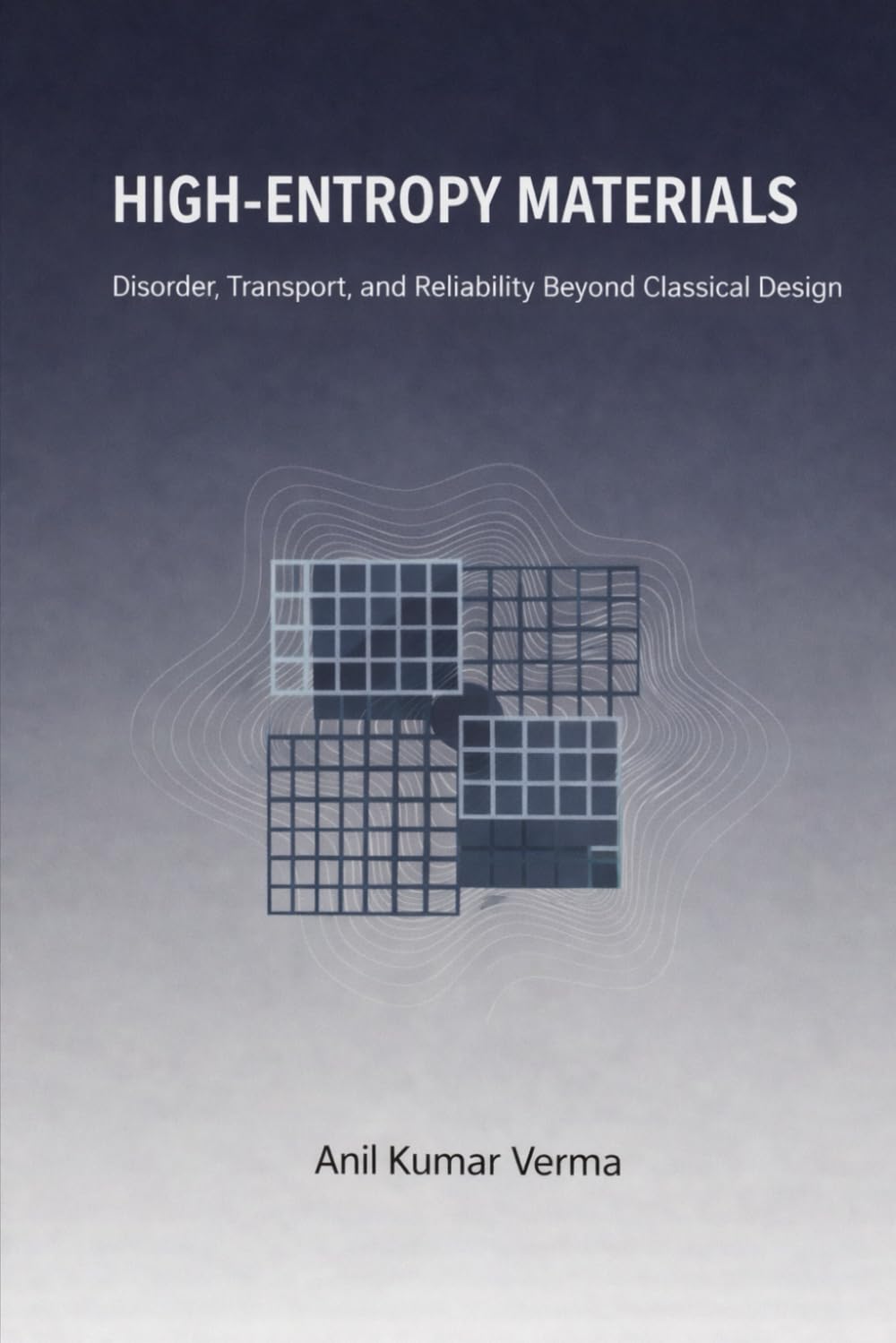
High-Entropy Materials: Disorder, Transport, and Reliability Beyond Classical Design
$9.99
by Dr Anil Kumar Verma



High-Entropy Materials: Disorder, Transport, and Reliability Beyond Classical Design examines what fundamentally changes when chemical complexity becomes intrinsic rather than incidental in materials design. For decades, materials science advanced by simplification—isolating dominant mechanisms, reducing compositional variables, and optimizing around primary elements. High-entropy materials challenge that paradigm. By placing multiple principal elements at the center of alloy and ceramic systems, they reshape how phase stability, diffusion, deformation, transport, and failure must be understood. This book does not treat high-entropy materials as trend-driven curiosities or universal solutions. Instead, it develops a physically grounded framework for interpreting chemical disorder as a design variable. Thermodynamics, kinetics, mechanical response, transport phenomena, and reliability are examined as interconnected consequences of complex energy landscapes and statistical variability. Emphasis is placed on conceptual clarity rather than encyclopedic coverage. Mechanisms are evaluated critically, common narratives are scrutinized, and robustness replaces optimization as the central design objective. Written for graduate students, researchers, and practicing materials scientists, this monograph provides a rigorous foundation for understanding high-entropy systems beyond slogans—clarifying both their promise and their limitations.