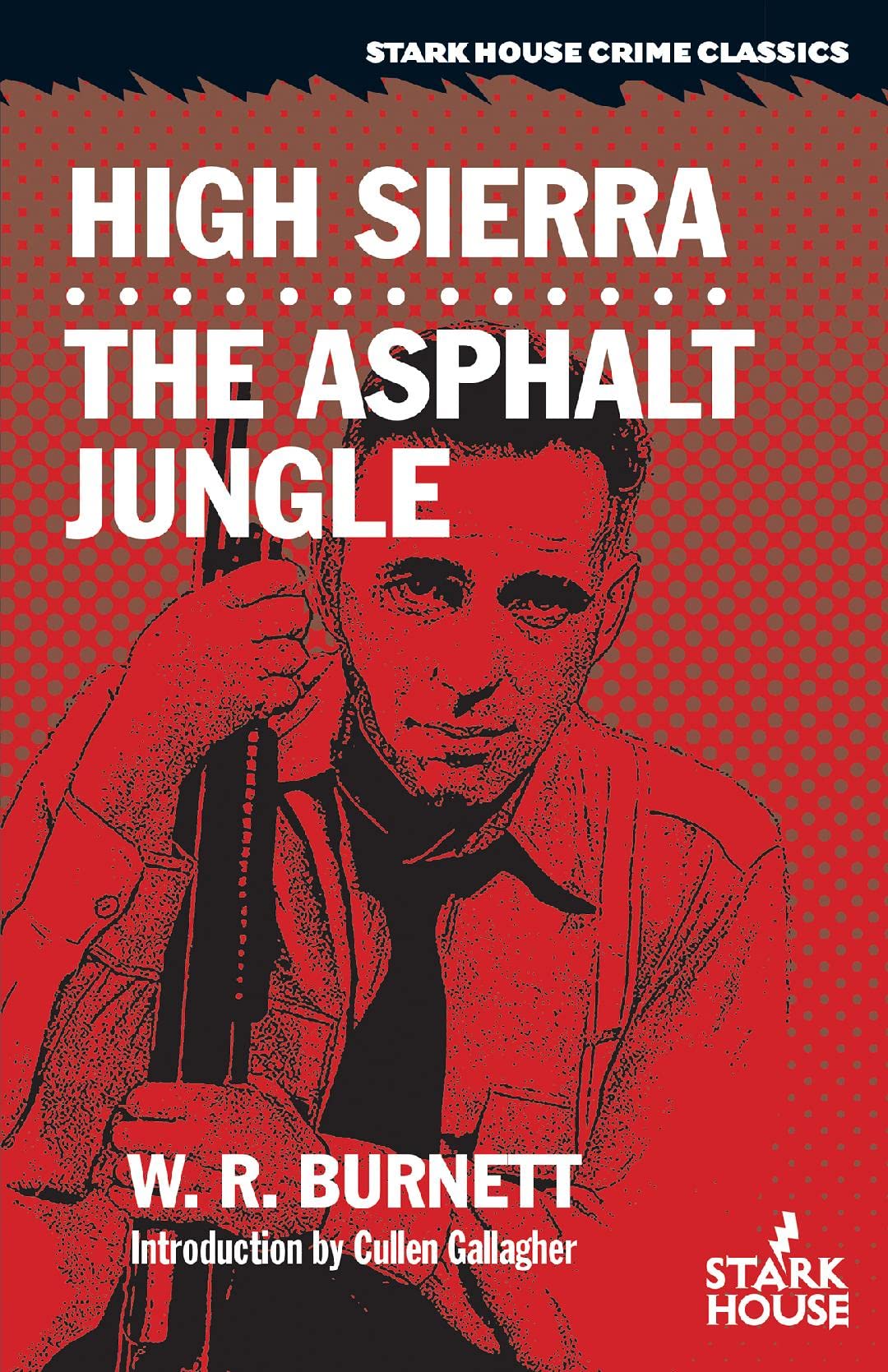



HIGH SIERRA Big Mac buys Roy Earle’s pardon because he needs a gunman on a heist job in California. There are three of them in on it besides Roy: Red, Babe and Louis, the inside man. But Roy didn’t figure on Marie, Babe’s girl. At first Roy wants Marie out of there, but he soon realizes that she’s got more brains than the other three put together. Besides, she makes good company. But Roy’s heart already belongs to Velma, a club-footed girl he meets on the road. She reminds him of his youth, and better days… before life hardened his heart. But Velma’s heart belongs to another. And Roy’s got a job to do. And now Babe’s out of the picture, and it’s just Roy and Marie… THE ASPHALT JUNGLE When Riemenschneider is released from prison, he heads right to Cobby the bookie. Riemenschneider has the plans for the perfect jewel heist, a place ripe for the picking. Cobby has got the connections. But first of all, they need cash. And that’s where Emmerich comes in. Emmerich, a smooth criminal lawyer, has always got plenty of both. So they pull in Gus as the driver, Bellini as the safe man, and Dix as strongarm. This could be the perfect crime. Except that Emmerich is broke and desperate—and that’s where everything starts to go wrong. "His novels are not mysteries, but crime novels, powerful, accurate cynical explorations of criminals in their own environment: at their best they are important additions to the honor roll of hard-boiled fiction." --George Grella, 20th Century Crime & Mystery Writers “Quintessential books about America, particularly the conflict of idealism and the way things really work behind closed doors, where corruption and disillusionment run rampant.” --Cullen Gallagher, Pulp Serenade “Equaling his best… this is a sustained and relentless story of the planning and execution of a foolproof crime, the robbery of a jewelry store in a middle western city... In its accuracy, its intensity, this is pretty hard to beat.” --Kirkus Reviews on The Asphalt Jungle William Riley Burnett was born November 25, 1899 in Springfield, Ohio. Moving to Chicago in 1927, he developed an interest in gangsters which prompted him to write his first noir novel, Little Caesar, in 1929. Soon after that overnight success, Burnett moved to Los Angeles, eventually writing 36 novels―including High Sierra and The Asphalt Jungle―and 60 screenplays, as well as songs, plays and short stories. Nominated twice for an Academy Award, he received both the MWA Grand Master award and an O. Henry Memorial Award. Burnett died on April 25, 1982.