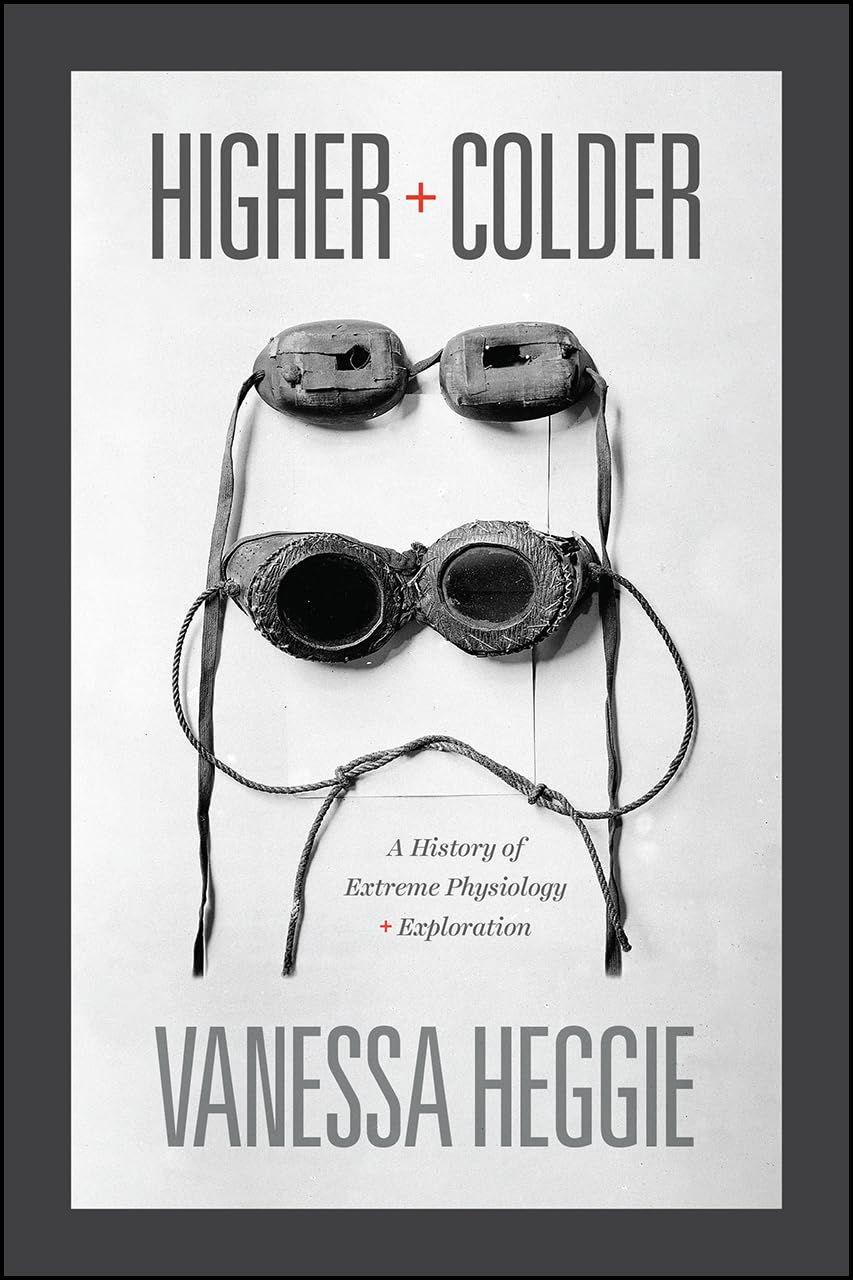
Higher and Colder: A History of Extreme Physiology and Exploration
$43.00
by Vanessa Heggie



During the long twentieth century, explorers went in unprecedented numbers to the hottest, coldest, and highest points on the globe. Taking us from the Himalaya to Antarctica and beyond, Higher and Colder presents the first history of extreme physiology, the study of the human body at its physical limits. Each chapter explores a seminal question in the history of science, while also showing how the apparently exotic locations and experiments contributed to broader political and social shifts in twentieth-century scientific thinking. Unlike most books on modern biomedicine, Higher and Colder focuses on fieldwork, expeditions, and exploration, and in doing so provides a welcome alternative to laboratory-dominated accounts of the history of modern life sciences. Though centered on male-dominated practices—science and exploration—it recovers the stories of women’s contributions that were sometimes accidentally, and sometimes deliberately, erased. Engaging and provocative, this book is a history of the scientists and physiologists who face challenges that are physically demanding, frequently dangerous, and sometimes fatal, in the interest of advancing modern science and pushing the boundaries of human ability. " Higher and Colder will prove essential reading for historical geographers working on histories of expeditions, travel and field science, and useful for any scholar interested in the relationships between place and the production of knowledge. It raises provocative questions about why for over a century, some researchers have been willing to put human bodies – their own and others' – at risk in the pursuit of science." ― Journal of Historical Geography "Heggie’s much-anticipated history of 'extreme physiology' does not disappoint. Higher and Colder takes historians of twentieth-century biology and medicine on a journey well beyond specific diseases and beyond laboratory walls to 'whole-body physiology'—a highly networked, multisited, field-based biological science. . . . The genius of Higher and Colder is its organization. What could have been just a chronological narrative of adventurous European men over time is instead a series of chapters that tackle crucial themes in the history of twentieth-century biology: gender and expertise, military and industrial competition, imperialism and indigeneity, and epistemologies of difference. . . . Heggie’s thematic organization helps transcend the constraints of her source material, again pushing the history of physiology in welcome directions. . . . The empirical details, careful insights, and bold arguments of Higher and Colder are immediately valuable, not only for historians of twentieth-century biology and medicine but also for environmental historians, labor historians, and historians of technology." ― Isis: A Journal of the History of Science Society "Extreme physiology remains an important aspect of study as we set our sights ever outward (to polar regions), upward (to the Moon and Mars), and downward (to the deep ocean). With Higher and Colder , Heggie reminds us that such work can offer extraordinary stories about how science is practiced while challenging the scientific community to consider adopting institutional changes that ensure that everyone can participate and is recognized for their contributions." ― Science "Heggie aims high and succeeds in mastering a huge topic and presenting a very dense but highly readable text. Furthermore, she stirs new research questions for bodies in the wilderness and exploration medicine, psychological fieldwork, the nexus between indigenous non-temperate bodies and evolutionary theory cum racial science, and lastly, the history of homeostasis. Looking at bodies in crisis or bodies under extreme conditions adds to a specific twentieth-century notion of homeostatic bodies. In Higher and Colder , the mostly utterly abstract history of homeostasis reaches ground level and takes the shape of everyday gadgets and truly felt limitations of human bodies." ― Gesnerus "An excellent historical backdrop to extreme physiology research, this well-documented text will be of considerable interest to wilderness travelers and a new generation of biomedical researchers. . . . Recommended." ― CHOICE "Heggie has produced an innovative and stimulating contribution to the history of science with her investigations into extreme physiology and exploration. . . . She takes the reader out of the laboratory and into the real world to show how our understandings about the effects of extreme environments upon explorers were many times learned the hard way—on the mountain tops and across the Arctic ice, often with dire consequences. . . . Heggie’s close examination of the history of extreme physiology thus adds to a wealth of fascinating stories about how scientists have lived and died in the most challenging environments in order to advance their scientific knowledge and experience the thrill of adventure. . . . [S