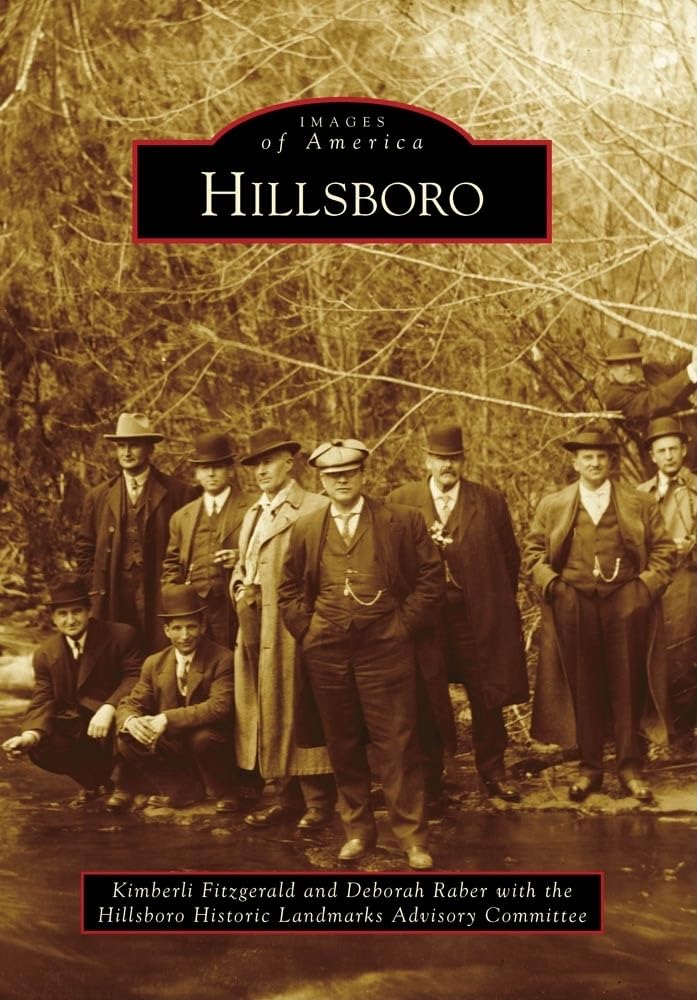



Hillsboro began as a crossroads for the Native American Atfalati, retired trappers, missionaries, and land-hungry settlers whose collection of farms became East Tualatin Plains. These earliest residents were drawn to the rich valley land between the forested creeks. As the missionary influence waned and the railroads arrived in the 1870s, the town, by then called Hillsborough, was dubbed "Sin City." Farmers and merchants quenched their thirst and gambled in saloons and placed bets on horse races down Main Street. Throughout the early 20th century, Hillsboro became predominantly a conservative, family town. Residents enjoyed their town bands, theaters, and Carnegie Library. Then and now on the Fourth of July, proud farmers drive their state-of-the-art farm equipment in the downtown parade, and fireworks light up the sky at the County Fairgrounds. Today the crossroads is one of agriculture and high technology, as people from around the world become new residents of Hillsboro, drawn to the Tualatin River plain as were their predecessors. Title: 'Hillsboro' book authors set library signing event Dec. 12 Author: Staff Writer Publisher: The Hillsboro Argus Date: 12/8/09 Local authors Debbie Raber and Kimberli Fizgerald will hold a a book signing event at the Hillsboro Main Library on Saturday, Dec. 12, at 1 p.m. Their book, "Hillsboro," is a pictorial book of Hillsboro's history and one of Arcadia Publishing's latest additions to the "Images of America" series. Fitzgerald, a preservation planner and consultan,t and Debbie Raber, a project manager for the City of Hillsboro Planning Department, are longtime Hillsboro residents who donated their time to assemble the book. With the help of the Hillsboro Historic Landmarks Advisory Committee, the authors selected vintage images provided by Hillsboro residents and the Washington County Historical Society & Museum. "Hillsboro" will be on sale at the event with proceeds going to the Hillsboro Downtown Business Association (HDBA) to help support Main Street preservation programs. The book may also be purchased from the HDBA, at local retailers, or online from the publisher at www.arcadiapublishing.com. Royalties will be donated to the city for historic preservation. "Hillsboro" is available at the Hillsboro Library, along with a variety of other local history resources including the Hillsboro Argus from its first issue in 1894 to the present. An accompanying obituary index covering one hundred years is unique in Washington County. A 100-year history of the Hillsboro Chamber of Commerce, 43 years of Hillsboro High yearbooks, the Index of Oregon Land Claims, and Sandborn maps can all be found at the Main Library. A library card also provides free access to the most popular online genealogy resources - Ancestry Library's more than four billion records in census data, vital records, directories and photos, and Heritage Quest with more than 7 million digitized local history pages, and bank and Revolutionary War records. A panel from the Oregon Historical Society's "Oregon is Indian Country" exhibit is also on display at the main library through Jan. 3. Title: Authors document Hillsboro's history in photo-filled book Author: Casey Parks Publisher: The Oregonian Date: 12/3/09 For months, Kimberli Fitzgerald and Deborah Raber have been living with ghosts. There's Mary Ramsey Wood, the state's oldest resident in 1907 at a reputed 120 years. There's Harold Wass Ray, the racetrack owner. There's Thomas Tongue, the attorney turned mayor. Since Fitzgerald and Raber began working on "Hillsboro," a photo-filled history book published last month, they've studied them all. After a while, they said, the people started to seem real. "I can remember walking down Main as we were writing the book," Raber says. "It was a funny feeling. You get a sense of everything that was." Documenting what was is important for a city such as Hillsboro, whose population has doubled in the past 15 years. Many of today's 90,000 residents are relative newcomers. As the city plans what it will become, the authors say, it first has to know what it has been. "Cities grow; they change," says Raber, 55, a Hillsboro planner. "Like any growing thing, if you don't have strong roots, you don't grow as well." The book is part of Arcadia Publishing's "Images of America" series, which already has featured volumes on West Linn and Portland, among others. It uses historic photographs and brief captions to tell of towns' early industries, notable citizens and civic institutions. The paperback is filled with photos -- 198, to be exact. In them, downtown's famous sequoias grow from seedlings to towering giants. Farmlands become neighborhoods. For the authors, who volunteered their time, writing the book had personal significance. "I didn't grow up here, so I need to know the history of a place to feel rooted," says Fitzgerald, 43, a private consultant on historic pr