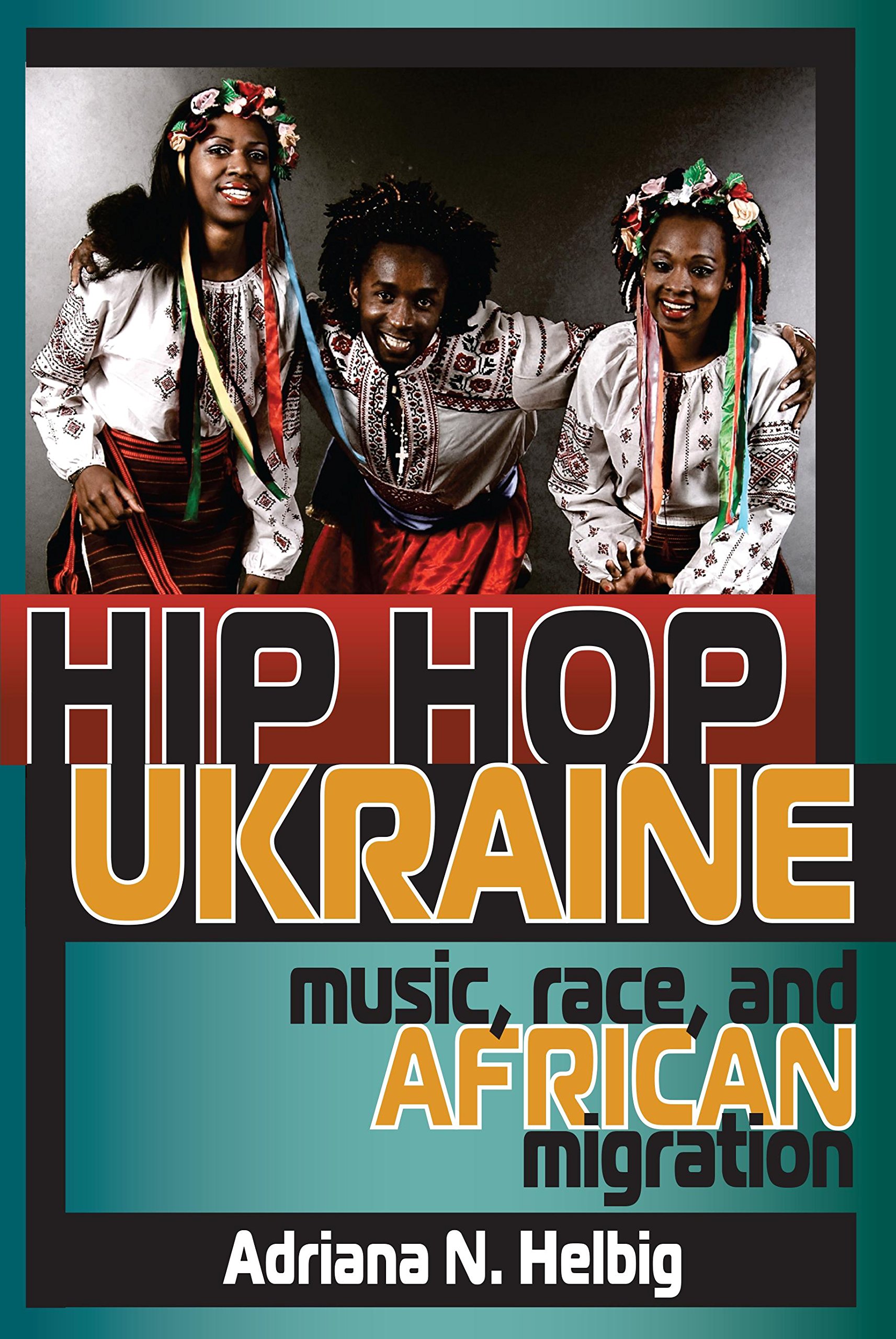
Hip Hop Ukraine: Music, Race, and African Migration (Ethnomusicology Multimedia)
$25.00
by Adriana N. Helbig



In Hip Hop Ukraine , we enter a world of urban music and dance competitions, hip hop parties, and recording studio culture to explore unique sites of interracial encounters among African students, African immigrants, and local populations in eastern Ukraine. Adriana N. Helbig combines ethnographic research with music, media, and policy analysis to examine how localized forms of hip hop create social and political spaces where an interracial youth culture can speak to issues of human rights and racial equality. She maps the complex trajectories of musical influence―African, Soviet, American―to show how hip hop has become a site of social protest in post-socialist society and a vehicle for social change. "Hip Hop Ukraine portrays the music as a forceful influence on worldwide social and cultural expression. Its origins in the American dispossessed gave a voice to many who identified with a similar race/class/ethnic experience, which has become tailored to local contingencies. Nevertheless, as Helbig suggests, despite the complexity that is hip hop, at times the music is in practice the expression of an individual voice and about how that voice is used to silence others. Thus Hip Hop Ukraine also speaks to that which can become lost in translation."― Slavonic and East European Review "This is a unique and admirable book that traces a complex trail from hip hop created by African migrants in Ukraine through remote African-American infl uences to their origins in Uganda and back again."― Slavic Review "A well-conceived study of the role and significance of hip hop in Ukraine. It joins the ranks of other very timely chronicles on the impact of hip hop in various societies around the world."―Allison Blakely, Boston University A well-conceived study of the role and significance of hip hop in Ukraine. It joins the ranks of other very timely chronicles on the impact of hip hop in various societies around the world. -- Allison Blakely ― Boston University Adriana N. Helbig is Assistant Professor of Music at the University of Pittsburgh and an affiliated faculty member in Cultural Studies, Women's Studies, Global Studies, and at the Center for Russian and East European Studies. She is author (with Oksana Buranbaeva and Vanja Mladineo) of The Culture and Customs of Ukraine . Hip Hop Ukraine Music, Race, and African Migration By Adriana N. Helbig Indiana University Press Copyright © 2014 Adriana N. Helbig All rights reserved. ISBN: 978-0-253-01204-3 Contents ETHNOMUSICOLOGY MULTIMEDIA SERIES PREFACE, ix, ACKNOWLEDGMENTS, xiii, Introduction, 1, 1 Music and Black Identity in the Soviet Union, 33, 2 Music and Black Experiences in Post-Soviet Ukraine, 64, 3 Commercial and Underground Hip Hop in Ukraine, 98, 4 Afro-Ukrainian Hip Hop Fusion, 135, 5 Hip Hop in Uganda, 165, Epilogue, 190, GLOSSARY, 195, NOTES, 199, BIBLIOGRAPHY, 207, INDEX, 219, CHAPTER 1 MUSIC AND BLACK IDENTITY IN THE SOVIET UNION People who move to former Soviet spaces from the African continent face specific challenges that cannot be compared with experiences of other immigrants, due to the historical relationships between the Russian Empire (and later the Soviet Union) and Africa that continue to influence attitudes toward blackness and race. This chapter offers a brief overview of the changing attitudes toward Africans and African Americans in the Russian Empire and the Soviet Union. It analyzes the root of certain stereotypical representations and ideas relating to the construction and performance of black identity through music. Drawing on the experiences of public artists such as Ira Aldridge, Taras Shevchenko, Alexander Pushkin, and Mark Twain, this chapter analyzes the ways in which the spoken and written word codify and embody certain attitudes regarding blackness, slavery, and an imagined Africa. Significant attention is paid to the experiences of Paul Robeson and the role his musical output and political ideologies had in shaping attitudes regarding African Americans in the Soviet Union. It also draws on personal memoirs of African Americans living in the Soviet Union to point to the disparities between official Soviet rhetoric on racial equality and the realities of being black in the USSR. SLAVERY AND SERFDOM IN THE RUSSIAN EMPIRE: IRA ALDRIDGE AND TARAS SHEVCHENKO By the time Peter the Great ascended to power, the Atlantic slave trade had been active for well over a century. Colonial expansions in the Russian Empire differed from those in Europe in that they did not extend into the Americas or the African continent. Russia's attempts to establish a relationship with Madagascar grew out of Russia's commercial and strategic interest in India and the Far East (Wilson 1974). The search for allies against the Ottoman Empire also led to tsarist interest in Ethiopia. However, Russians did not succeed in establishing colonies on the African continent due to the already dominant presence of European