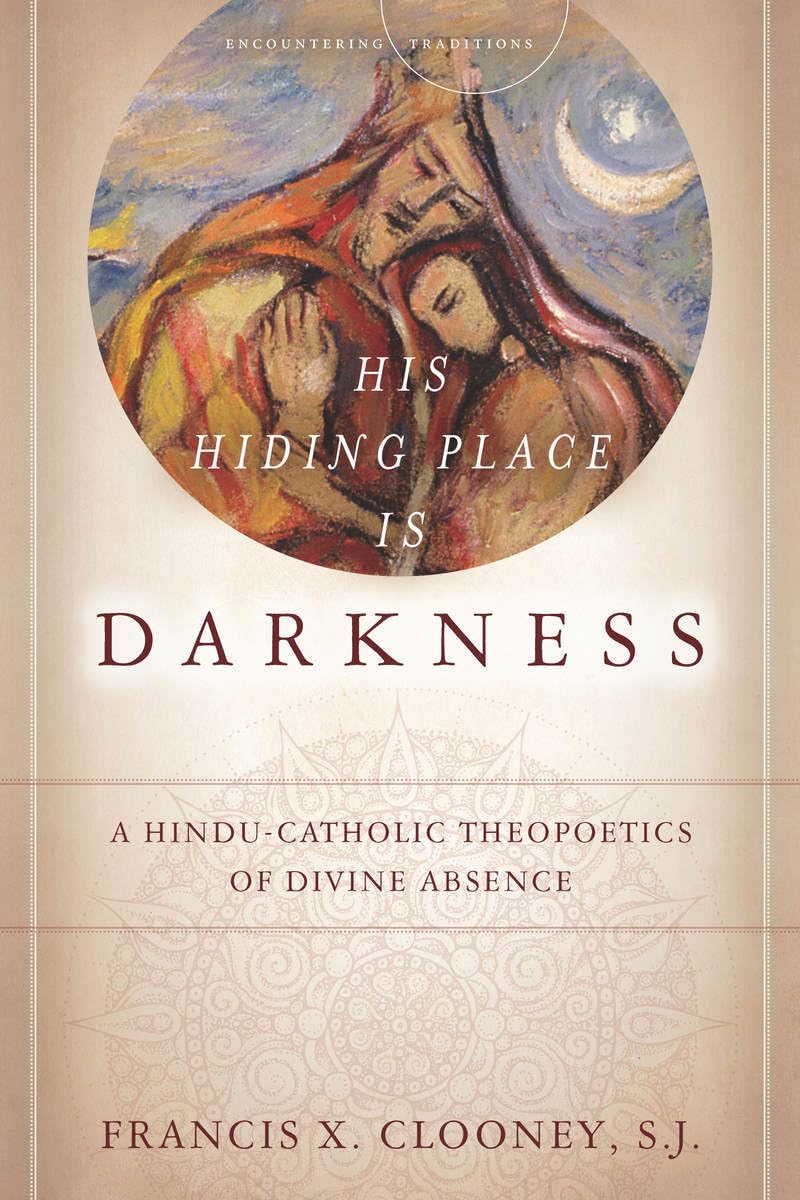
His Hiding Place Is Darkness: A Hindu-Catholic Theopoetics of Divine Absence (Encountering Traditions)
$17.67
by Francis Clooney



His Hiding Place is Darkness explores the uncertainties of faith and love in a pluralistic age. In keeping with his conviction that studying multiple religious traditions intensifies rather than attenuates religious devotion, Francis Clooney's latest work of comparative theology seeks a way beyond today's religious and interreligious uncertainty by pairing a fresh reading of the absence of the beloved in the Biblical Song of Songs with a pioneering study of the same theme in the Holy Word of Mouth (9th century CE), a classic of Hindu mystical poetry rarely studied in the West. Remarkably, the pairing of these texts is grounded not in a general theory of religion, but in an engagement with two unexpected sources: the theopoetics, theodramatics, and theology of the 20th-century Catholic theologian Hans Urs von Balthasar, and the intensely perceived and written poetry of Pulitzer Prize winner Jorie Graham. How we read and write on religious matters is transformed by this rare combination of voices in what is surely a unique and important contribution to comparative studies and religious hermeneutics. "This book is unlike any other I have read. Its distinctiveness resides in its profoundly spiritual theme, erudition, imaginative arrangement and engaging style . . . [S]o deftly does he move backwards and onwards between poetic universes―impeccably integrating a medley of voices . . . [A] careful reading and patient reflection may well transform the reader . . . His Hiding Place is Darkness makes an outstanding contribution to comparative theology and religious hermeneutics." -- Anita C. Ray ― Australian eJournal of Theology "This work is remarkable on many counts. It presents a valuable development of comparative theology . . . It is clear that His Hiding Place is Darkness is richly reflected work, at the conclusion of which one has the impression of an enclyclopaedic treatment . . . The work is scholarly and objective, researched and original In style, but above all it is a pastoral work. In a world where some have no sense of the Divine, and where others seek but do not know what they are seeking or again where others are unable find the object of their quest or where the images of God are no longer effective, Clooney makes the point that the search is as revealing as the finding. In this way he shows that comparative theology is also a work of pastoral care. He goes far beyond the abstractions of religious studies to the needs of the modern world. His Hiding Place is Darkness not only satisfies the mind but also invites us to empathise with the needs of society." -- John Dupunche ― Monastic Interreligious Dialogue "[I]ntersection and absence stand at the heart of this remarkable work, the latest by the Jesuit theologian Francis X. Clooney . . . Those who have followed Clooney across his prolific career will find much that is familiar in this volume: close, careful reading of primary texts in light of commentarial tradition, deep erudition, a post-modern sensibility, disdain for premature generalizations. The prose is crisp, insightful, and on several occasions, genuinely moving; the notes are extensive, detailed, and, in some cases, mildly polemical. The work as a whole, on the other hand, is startlingly original . . . [T]his represents Clooney's most convincing work since Hindu God, Christian God . It will richly reward careful study by students and scholars of comparative theology, theological aesthetics, and spirituality." -- Reid B. Locklin ― Journal of Religion "Francis Clooney, S.J.'s His Hiding Place is Darkness takes us into an entirely different world of experience and expression of divine absence in a biblical and in a Hindu sacred text . . . [I]t is beautifully written in a style flowing with the texts he reads." -- Catherine Cornille ― America Magazine: The National Catholic Review "One of the great contributions of His Hiding Place is Darkness is that it is a text that skillfully and beautifully draws the reader into understanding that 'loving God is always a risk' . . . His Hiding Place is Darkness is a beautifully and skillfully written text and should be of interest to a wide variety of readers." -- Rico G. Monge ― Journal of Hindu-Christian Studies "Clooney's book is rich in covering a number of topics in relatively few pages while remaining eminently readable. Its engaging quality is brought about, in part, by a structure that echoes its central argument: theology must wait upon and be generated from the experience of a poetic and dramatic encounter . . . It is a proposal of and a propaedeutic to a particular mode of doing theology; it pleads for patient waiting, slow reading across traditions, and attention to the dramatic and poetic. As such, it is a worthwhile addition to the perennial debates―especially in the context of Catholic theology in North America―about what theology is and how it should be done." -- Jennifer L. Benedict ― Theological Studies "In h