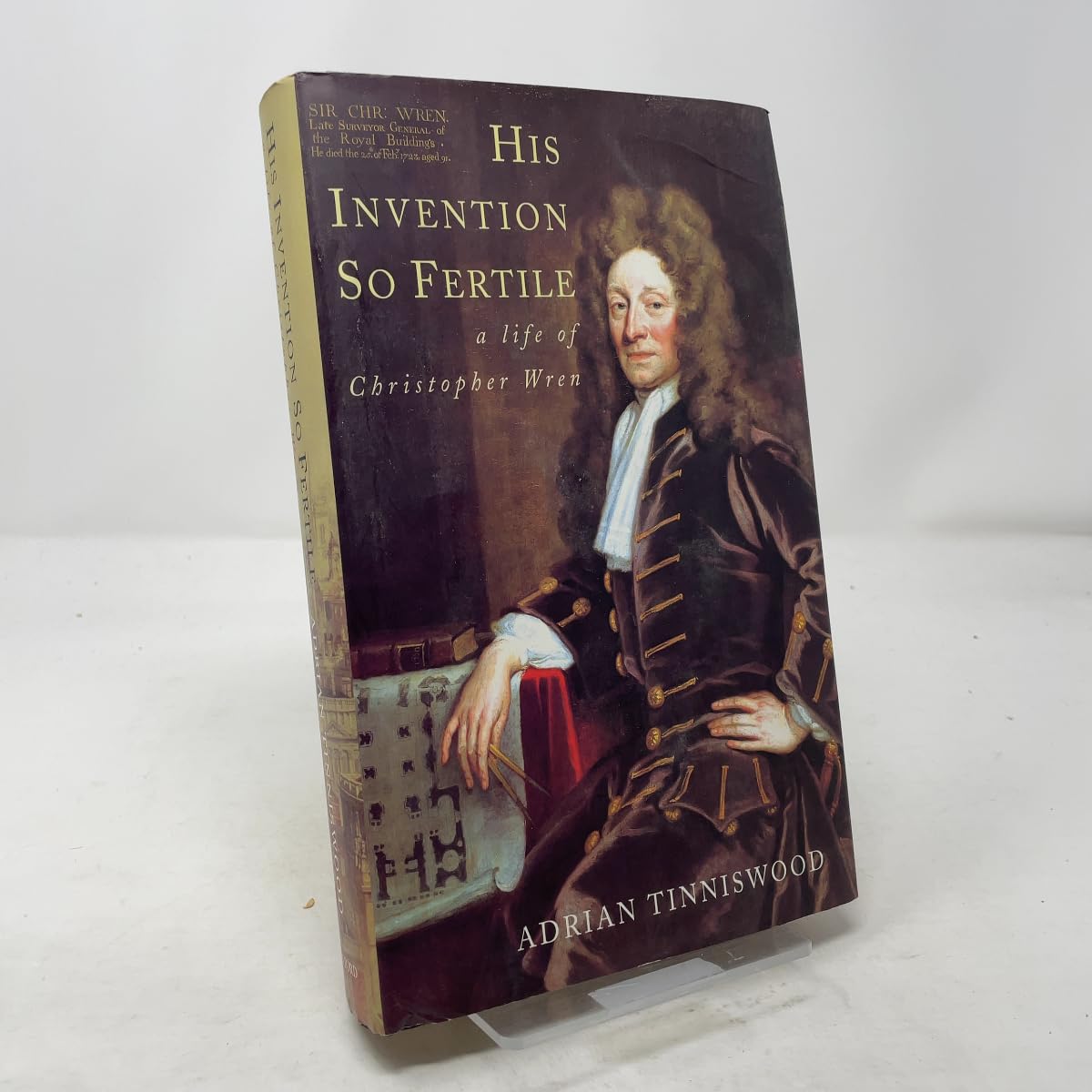



In His Invention So Fertile , Adrian Tinniswood offers the first biography of Christopher Wren in a generation. It is a book that reveals the full depth of Wren's multifaceted genius, not only as one of the greatest architects who ever lived--the designer of St. Paul's Cathedral--but as an influential seventeenth-century scientist. Tinniswood writes with insight and flair as he follows Wren from Wadham College, Oxford, through the turmoil of the English Civil War, to his role in helping to found the Royal Society--the intellectual and scientific heart of seventeenth-century England. The reader discovers that the great architect was initially an astronomer who was also deeply interested in medicine, physics, and mathematics. Family connections pulled him into architecture, with a commission to restore the chapel at Pembroke College, Cambridge. Tinniswood deftly follows Wren's rise as architect, capturing the atmosphere of Restoration London, as old Royalists scrambled for sinecures from Charles II and Wren learned the art of political infighting at court, finally becoming Surveyor of the Royal Works-the King's engineer. Most important, the author recounts the intriguing story of the building of St. Paul's. The Great Fire of 1666--vividly recreated in Tinniswood's narrative--left London a smoldering husk. Wren played a central role in reshaping the city, culminating with St. Paul's, his masterpiece--though he had to steer between King and cathedral authorities to get his radical, domed design built. As the Enlightenment dawned in England, Wren's magnificent dome rose above London, soon to become an icon of London and world architecture. One of the most influential architects in history, Christopher Wren comes vividly to life in this fittingly grand biography. "If you seek his monument, look around," commands Adrian Tinniswood in his scholarly but elegantly entertaining biography of Christopher Wren (1632-1723). "As an architect, he changed the face of England and the course of architectural history." Tinniswood describes with appreciation and discernment Wren's greatest buildings: "the bubble of unexampled lightness that is St. Stephen Walbrook" church, the additions to Hampton Court, and of course London's majestic St. Paul's Cathedral, a symbol of British faith and courage throughout the centuries. These structures were political as well as architectural achievements, and Tinniswood nicely captures the discretion, ruthlessness, and carefully cultivated connections that enabled Wren to survive the Civil War, get himself named Royal Surveyor, hang on to the job under five monarchs, and get designs approved and money wheedled out of a reluctant parliament. Tinniswood pays equally intelligent attention to Wren's early career as an esteemed Oxford astronomy professor and charter member of the Royal Society (and its president from 1681-3). He writes wittily about the quirks of Wren and such peers as Newton and Bernini, capturing the intensely personal nature of 17th-century public culture, and he (sparingly) offers his opinions in a way that enhances our understanding of the period. "I want my heroes to be people, not ideas," Tinniswood writes, after describing a squabble at the Royal Society. This sparkling biography reveals Wren as a human being without detracting from the heroic nature of his accomplishments. --Wendy Smith Though Christopher Wren (1632-1723) began his career as an astronomer also interested in mathematics, physics, and medicine, he is among the most noted British architects of the Baroque period. Having won the commission to rebuild St. Paul's Cathedral in London, he employed a mastery of classical principles gained through self-education in architectural treatises and close observation of the work of Inigo Jones and Baroque buildings in Paris during a trip in 1665-66. Tinniswood (Visions of Power: Ambition and Architecture from Ancient Times to the Present) turns his talents to biography, offering in full, novelistic detail an account of 17th-century Britain, with its plagues, fires, and royal patron Charles II. The aim here is clearly not a deep examination of the architecture but rather a scholarly, readable portrait of the social and political world in which Wren lived and worked so productively. Unfortunately, there are a few drawbacks. Though clearly rendered, the black-and-white illustrations are grouped in signatures, making them remote from the text. Inconveniently, topics within index entries are arranged sequentially by page number rather than alphabetically, and there are significant omissions, such as an entry for St. Stephen Walbroke. Tinniswood's biography is far more detailed than John Lindsey's Wren: His Work and Times (1952), but it lacks that book's very useful chronological list of works. For larger architectural or biographical collections. Paul Glassman, New York Sch. of Interior Design Lib.interior DesignBy Gayle A. Williamson,Fashion Inst. of Design & Merchandising