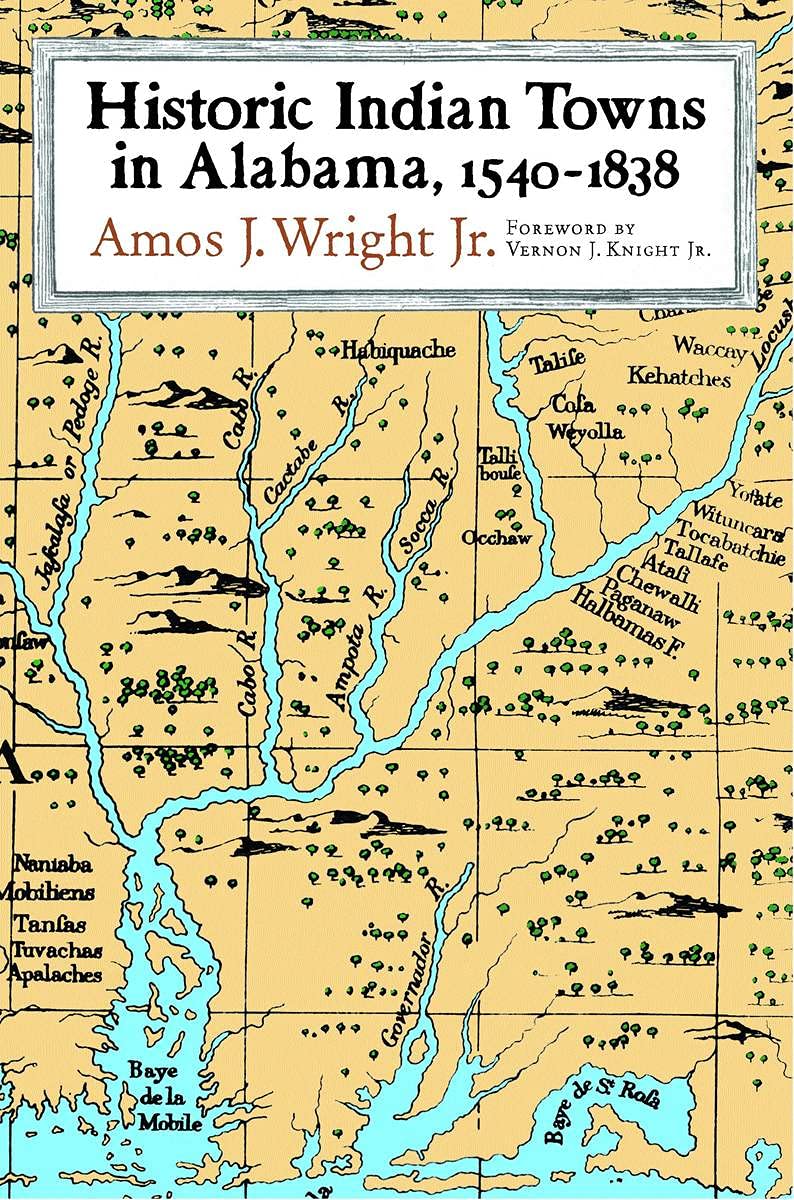



Discover the lost towns that shaped Alabama’s earliest history. This encyclopedic work is a listing of 398 ancient towns recorded within the present boundaries of the state of Alabama, containing basic information on each village's ethnic affiliation, time period, geographic location, descriptions, and (if any) movements. While publications dating back to 1901 have attempted to compile such a listing, none until now has so exhaustively harvested the 214 historic maps drawn between 1544, when Hernando de Soto's entourage first came through the southeastern territory, and 1846, when Indian removal to the Oklahoma Territory was complete. Wright combines the map data with a keen awareness of both previously published information and archival sources, such as colonial town lists, census information, and travel narratives. The towns are listed alphabetically, and the text of each entry develops chronologically. While only a few of these towns have been accurately located by archaeologists, this volume provides a wealth of information for the future study of cultural geography, southeastern archaeology, and ethnohistory. It will be an enduring reference source for many years to come. SAMPLE ENTRY, ALIBAMA TOWN (Alibama) The Alibama consisted of several towns―Mucclassa, Tawasa, Tomopa, Koarsati (Knight 1981, 27:48). Pickett ([1851] 1962:81) adds Ecanchati, Pawokti, and Autauga. The Alibama Town can also be added. Many maps show the Alibama as a group, but one map, 1796 Thomas and Andrews, locates the "Alabama Town"on the east bank of the Coosa just below Wetumpka. Swanton ([1922] 1970a:209) wrote that the Tuskegee at the Alabama forks may have been known as the "Alabama Town"; however, this is unlikely, as Major W. Blue, a removal agent, wrote in July 1835 that Coosada, Alabama Town, and Tuskegee were ready to emigrate and they all lived adjoining each other in Macon County (ASP, Military Affairs 1861,6:731). On 6 July 1838, some twenty-seven towns, including "Alibama" (NA M234 R225), attended the Creek council held in Indian Territory. Thomas Bibb, brother to Alabama territorial govenor William Wyatt Bibb, and others, including Nashville investors, founded the town of Alabama in 1817 at Ten Mile Bluff in Montgomery County (Moser 1980-94, 4:131). The town soon disappeared into history. “Obviously a labor of love, Amos Wright's massive research effort . . . will delight anthropologists, historians, geographers, and citizens of Alabama.” ―Marvin T. Smith, Valdosta State University Retired from Redstone Arsenal (U.S. Army Missile Command) in Huntsville, Alabama, Amos J. Wright Jr. (deceased) has been an avocational archaeologist since 1965. He is author of several research articles and The McGillivray and McIntosh Traders of the Old Southwest Frontier , 1716 to 1815. Vernon J. Knight Jr. is Professor and Chair of Anthropology at The University of Alabama and a coeditor of Archaeology of the Moundville Chiefdom. Historic Indian Towns in Alabama, 1540–1838 By AMOS J. WRIGHT JR. THE UNIVERSITY OF ALABAMA PRESS Copyright © 2003 The University of Alabama Press All right reserved. ISBN: 978-0-8173-1252-7 Contents Preface...................................viiForeword..................................xiMaps Referenced...........................xviAbbreviations.............................xixHistoric Indian Towns.....................1Appendix..................................189References................................225 Chapter One A ABOCOOCHEE (Little Abiehka) (Upper Creek) This Upper Creek town was first listed in the narratives in a 1725 census taken by the South Carolina trader Charlesworth Glover. "Abccoocky" was one of eight towns in the Abiehka district and had a population of 120. The Abiehka district was the northernmost group of the Upper Creeks (Salley 1931, 32:241–42). William Bartram ([1791] 1928:366) wrote in 1776 that the "Abacooche" spoke a Chickasaw dialect and were located on the upper Coosa River. The Chickasaw village of Breed Camp was located nearby. Hawkins ([1848] 1982:41–42) in 1799 described the town: "Aubecooche is on Nauche Creek [Tallaseehatchee Creek] five miles from the river [Coosa] on the north bank of the creek on a flat one mile wide. The town spreads out and is scattered on both sides of the creek. There is a large limestone spring above and below the town, one of the oldest towns in the nation. This town is one of the oldest in the nation; and sometimes among the oldest chiefs, it gives name to the nation, Aubecuch. Here some of the oldest customs had their origin. The law against adultery was passed here, and that to regulate marriages. To constitute legal marriage, a man must build a house, make his crop, and gather it in, then make his hunt and bring home the meat; putting all this in the possession of his wife, ends the ceremony and they are married, or as the Indians express it, 'the woman is bound.'" Hawkins (GAH, Hays 1939