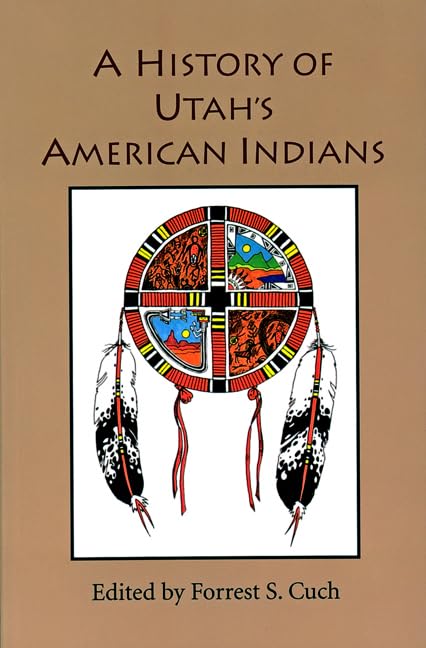



This book is a joint project of the Utah Division of Indian Affairs and the Utah State Historical Society. It is distributed to the book trade by Utah State University Press. The valleys, mountains, and deserts of Utah have been home to native peoples for thousands of years. Like peoples around the word, Utah's native inhabitants organized themselves in family units, groups, bands, clans, and tribes. Today, six Indian tribes in Utah are recognized as official entities. They include the Northwestern Shoshone, the Goshutes, the Paiutes, the Utes, the White Mesa or Southern Utes, and the Navajos (Dineh). Each tribe has its own government. Tribe members are citizens of Utah and the United States; however, lines of distinction both within the tribes and with the greater society at large have not always been clear. Migration, interaction, war, trade, intermarriage, common threats, and challenges have made relationships and affiliations more fluid than might be expected. In this volume, the editor and authors endeavor to write the history of Utah's first residents from an Indian perspective. An introductory chapter provides an overview of Utah's American Indians and a concluding chapter summarizes the issues and concerns of contemporary Indians and their leaders. Chapters on each of the six tribes look at origin stories, religion, politics, education, folkways, family life, social activities, economic issues, and important events. They provide an introduction to the rich heritage of Utah's native peoples. This book includes chapters by David Begay, Dennis Defa, Clifford Duncan, Ronald Holt, Nancy Maryboy, Robert McPherson, Mae Parry, Gary Tom, and Mary Jane Yazzie. Forrest Cuch was born and raised on the Uintah and Ouray Ute Indian Reservation in northeastern Utah. He graduated from Westminster College in 1973 with a bachelor of arts degree in behavioral sciences. He served as education director for the Ute Indian Tribe from 1973 to 1988. From 1988 to 1994 he was employed by the Wampanoag Tribe in Gay Head, Massachusetts, first as a planner and then as tribal administrator. Since October 1997 he has been director of the Utah Division of Indian Affairs. Forrest S. Cuch was born and raised on the Uintah and Ouray Ute Indian Reservation in northeastern Utah. He graduated from Westminster College in 1973 with a bachelor of arts degree in behavioral sciences. He served as education director for the Ute Indian Tribe from 1973 to 1988. From 1988 to 1994 he was employed by the Wampanoag Tribe in Gay Head, Massachusetts, first as a planner and then as tribal administrator. Since October 1997 he has been director of the Utah Division of Indian Affairs. A History of Utah's American Indians By Forrest S. Cuch University Press of Colorado Copyright © 2000 Utah Division of Indian Affairs and the Utah Division of State History All rights reserved. ISBN: 978-0-913738-49-8 Contents Introduction Forrest S. Cuch, Setting the Stage: Native America Revisited Robert S. McPherson, The Northwestern Shoshone Mae Parry, The Goshute Indians of Utah Dennis R. Defa, The Paiute Tribe of Utah Gary Tom and Ronald Holt, The Northern Utes of Utah Clifford Duncan, The White Mesa Utes Robert S. McPherson and Mary Jane Yazzie, The Navajos Nancy Maryboy and David Begay, Conclusion: The Contemporary Status of Utah Indians Robert S. McPherson, Notes to Chapters, Selected Bibliography, Notes on Contributors, Index, CHAPTER 1 Setting the Stage: Native America Revisited Robert S. McPherson The writing of Native American history can be said to have started when Christopher Columbus first waded ashore on San Salvador Island in the Caribbean. It has continued ever since. What preceded his arrival — the prehistoric phase of Native Americans — has generally been left to archaeologists and anthropologists to decipher and explain from physical remains. The initial contact, post-contact, and contemporary phases are the realm of historians, who write in keeping with longstanding conventions of their own trade. In both instances, facts, dates, and interpretation generally are presented from an Anglo American perspective that has evolved over centuries. What this has meant to the Indian people is that rarely, if ever, has their view been predominant, if it has even been known. Calvin Martin, a noted Indian historian, put it this way: "We presume to document and interpret the history of a people whose perception of the world for the most part eludes us, whose behavior, as a result, is enigmatic. ... To ignore the Indian thoughtworld is to continue writing about ourselves to ourselves" This has been especially true until recently. Within the last twenty-five years, there has been a perceptible shift in the tide of writing that now insists on a more balanced treatment of the Indians' view of events. However, this is at times a difficult thing to achieve. Native Americans in the past have been slow to come forth with t