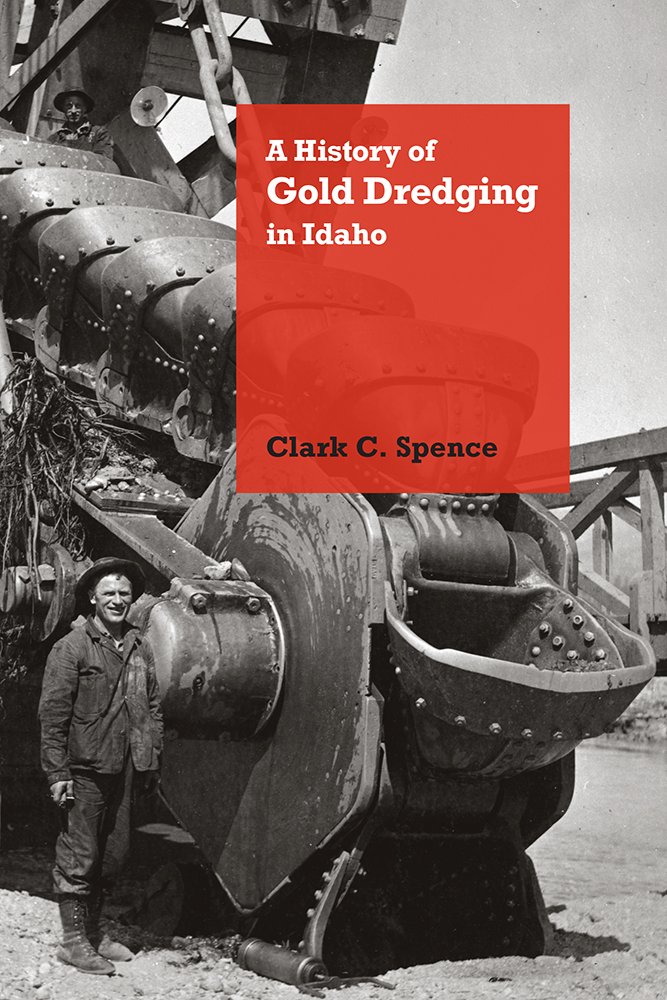



A History of Gold Dredging in Idaho tells the story of a revolution in placer mining—and its subsequent impact on the state of Idaho—from its inception in the early 1880s until its demise in the early 1960s. Idaho was the nation’s fourth-leading producer of dredged gold after 1910 and therefore provides an excellent lens through which to observe the practice and history of gold dredging. Author Clark Spence focuses on the two most important types of dredges in the state—the bucket-line dredge and the dragline dredge—and describes their financing, operation, problems, and effect on the state and environment. These dredges made it possible to work ground previously deemed untouchable because bedrock where gold collected could now be reached. But they were also highly destructive to the environment. As these huge machines floated along, they dumped debris that harmed the streams and destroyed wildlife habitat, eventually prompting state regulations and federal restoration of some of the state’s crippled waterways. Providing a record of Idaho’s dredging history for the first time, this book is a significant contribution to the knowledge and understanding of Western mining, its technology, and its overall development as a major industry of the twentieth century. “Broad, deep, and comprehensive and not likely to be surpassed for a very long time.” —Jay Fell, University of Colorado, Denver "Providing a record of Idaho’s dredging history for the first time, this book is a significant contribution to the knowledge and understanding of Western mining, its technology, and its overall development as a major industry of the twentieth century." —Mining History News "For readers interested in a highly detailed account of the technological and business history of gold dredging in Idaho organized geographically, this book will prove invaluable. Spence has done yeoman’s work on these subjects, and the notes alone will prove a helpful guide for further research." —H-Net Reviews, H-Environment "Clark Spence, correctly labeled 'the Dean of Mining Historians' . . . has completed an almost encyclopedic recounting of dredging attempts, both successful and failed, across Idaho. The book will appeal primarily to specialists in mining history, although the later chapters include useful materials for those interested in environmental history and federal impacts on resource development." —Western Historical Quarterly "This book, clearly the product of years of painstaking research, offers a treasure trove of information about the Gem State's fascinating, but now largely forgotten, history of gold dredge mining. It is sure to be a much-valued resource for mining, western, and Idaho historians, and history buffs, for many years to come." —Pacific Northwest Quarterly Clark C. Spence is professor emeritus of history at the University of Illinois. Known as the dean of mining historians, he has published thirteen books over a career spanning six decades. He was the first president of the Mining History Association and the eighth president of the Western History Association. In 2001 the Mining History Association established the Clark Spence Award, presented to books in mining history that best champion the research, interpretation, and writing skills practiced by Spence throughout his career. A History of Gold Dredging in Idaho By Clark C. Spence University Press of Colorado Copyright © 2016 University Press of Colorado All rights reserved. ISBN: 978-1-60732-474-4 Contents Acknowledgments, Introduction, 1. Early Snake River Boom, 2. The Black Sands Craze, 3. The Burroughs Brothers, 4. Pierce, 5. Florence, 6. Elk City and Newsome, 7. Stanley Basin and Yankee Fork, 8. Salmon City and Leesburg, 9. South and Middle Forks of the Boise River, 10. The Yukon Dredge, 11. Warren, 12. Boise Basin, 13. Dredging Rare Metals, 14. Other Dredge Grounds and Snake-Salmon Rivers, 15. The Struggle for Dredge Control, 16. Aftermath: The Cleanup, 17. Overview, Epilogue, Brief Bibliographic Essay, Index, CHAPTER 1 Early Snake River Boom From its origins on the Continental Divide in the Teton Range in western Wyoming, the Snake River flows southward in a large arc across southern Idaho, then forms that state's western border as far north as Lewiston before it meanders westward to its eventual confluence with the Columbia in southern Washington. Since as early as the 1850s, when soldiers at the old Fort Boise made limited discoveries, gold has been found along most of the 800-mile course through the Gem State. Optimistic bands of prospectors moved south to expand operations in the 1960s, without much success, but in the 1970s many of them located workable placer ground in scattered sites, among them the Shoshone Falls region, the area near J. Matt Taylor's bridge (which became Idaho Falls), the Hagerman Valley, below the Raft River, and west of American Falls. But these were scattered small-s