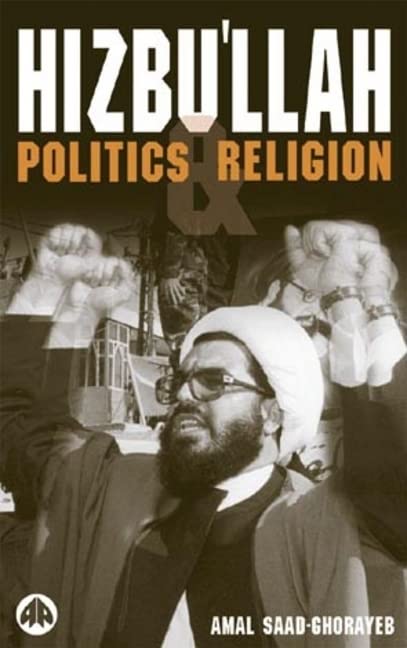
Hizbu'llah: Politics and Religion (Critical Studies on Islam)
$115.00
by Amal Saad-Ghorayeb



Hizbu’llah is the largest and most prominent political party in Lebanon, and one of the most renowned Islamist movements in the world. In this volume, Amal Saad-Ghorayeb examines the organisation’s understanding of jihad and how this, together with its belief in martyrdom, brought about the withdrawal of Israeli occupation forces from Lebanese territory in May 2000. Saad-Ghorayeb explores the nature of the party’s struggle against the West by studying, among other issues, its views on the use of violence against Westerners. Crucially, she also addresses the question of whether Hizbu’llah depicts this struggle in purely political or civilisational terms. The existential nature of the movement’s conflict with Israel is analysed and the Islamic roots of its anti-Judaism is unearthed. The author explores the mechanics and rationale behind the party’s integration into the Lebanese political system, and sheds light on how it has reconciled its national idenitity with its solidarity with the Muslim umma. Until the emergence of bin Laden's al-Qaeda network, Hizbu'llah was probably the most reviled Islamic organization in the world, blamed for everything from kidnapping Americans in the 1980s to the bombing of the Israeli embassy in Argentina. This, the first book-length treatment of Hizbu'llah, tells a somewhat different story of the radical political party. It is something of an against-all-odds tale: a radical political group comprising a religious minority (Shi'a Muslims) manages to drive an occupying force of overwhelming military superiority (the Israelis) out of southern Lebanon. It's the story you are not likely to hear in the West, and Ghorayeb's analysis of Hizbu'llah's political and religious development, and its current structure, is often fascinating. The book was developed from Ghorayeb's doctoral thesis, and unfortunately, with dry writing and the presumption that the reader has a working knowledge of the contemporary Islamic world, it reads like one. Still, more readers are likely to wade into such daunting prose since September 11, making this an appropriate choice for larger collections. John Green Copyright © American Library Association. All rights reserved Amal Saad-Ghorayeb is Assistant Professor at the Lebanese American University. She is currently involved in a 3 part documentary on Hizbu'llah to be broadcast by US NPR, WYNC and BBC radio, amongst others, as part of a series on Living Islam funded by the Ford Foundation and the US National Endowment for the Humanities. Hizbu'llah Politics and Religion By Amal Saad-Ghorayeb Pluto Press Copyright © 2002 Amal Saad-Ghorayeb All rights reserved. ISBN: 978-0-7453-1793-9 Contents Acknowledgements, x, Introduction, 1, Background of the Study, 1, Objectives and Methodology, 3, The Politicisation of the Lebanese Shi'ites and Subsequent Rise of Hizbu'llah, 7, 1 Political Accommodation and Violence in Non-Islamic States, 16, 2 The Islamic State and Democracy, 34, 3 The Concept of the Guardianship of the Jurisprudent, 59, 4 Islamic Universalism and National Identity, 69, 5 The Struggle with the West, 88, 6 The Resistance to the Israeli Occupation of South Lebanon, 112, 7 Anti-Zionism and Israel, 134, 8 Anti-Judaism, 168, Conclusion, 187, Appendix One: Miladi Equivalents to Hijri Years, 192, Appendix Two: List of Hijri Months, 193, Glossary, 194, Notes, 196, Select Bibliography, 235, Index, 243, CHAPTER 1 Political Accommodation and Violence in Non-Islamic States The cornerstone of Hizbu'llah's intellectual structure is the Islamic state ideal. However, the realisation of this fundamental tenet is not actively pursued by the party regardless of its feasibility as a political scheme. Due to the absence of certain social and political circumstances, Hizbu'llah has adopted a strategy of self-preservation, which entails indefinitely postponing the establishment of an Islamic state in Lebanon. Accordingly, much of Hizbu'llah's political thought focuses on the religious and moral bases for political accommodation and political violence in non-Islamic states. While the concept of political violence refers to a wide range of politically motivated violent acts, which are perpetrated by states as well as groups and individuals, the form of political violence I refer to here is insurgency. This chapter, therefore, deals with Hizbu'llah's views on revolution, coups d'état, guerrilla warfare and various forms of terrorist violence practised by groups against secular and unIslamic domestic regimes. Despite the debate over whether all violent acts which target unarmed civilians constitute acts of terrorism, for simplicity's sake, terrorist violence will be treated as one strategy of insurgency which is distinguished from other strategies by its deliberate attempt to terrorise a civilian population for political ends. Accordingly, Hizbu'llah's views on all forms of insurgency, both terrorist and otherwise, will be e