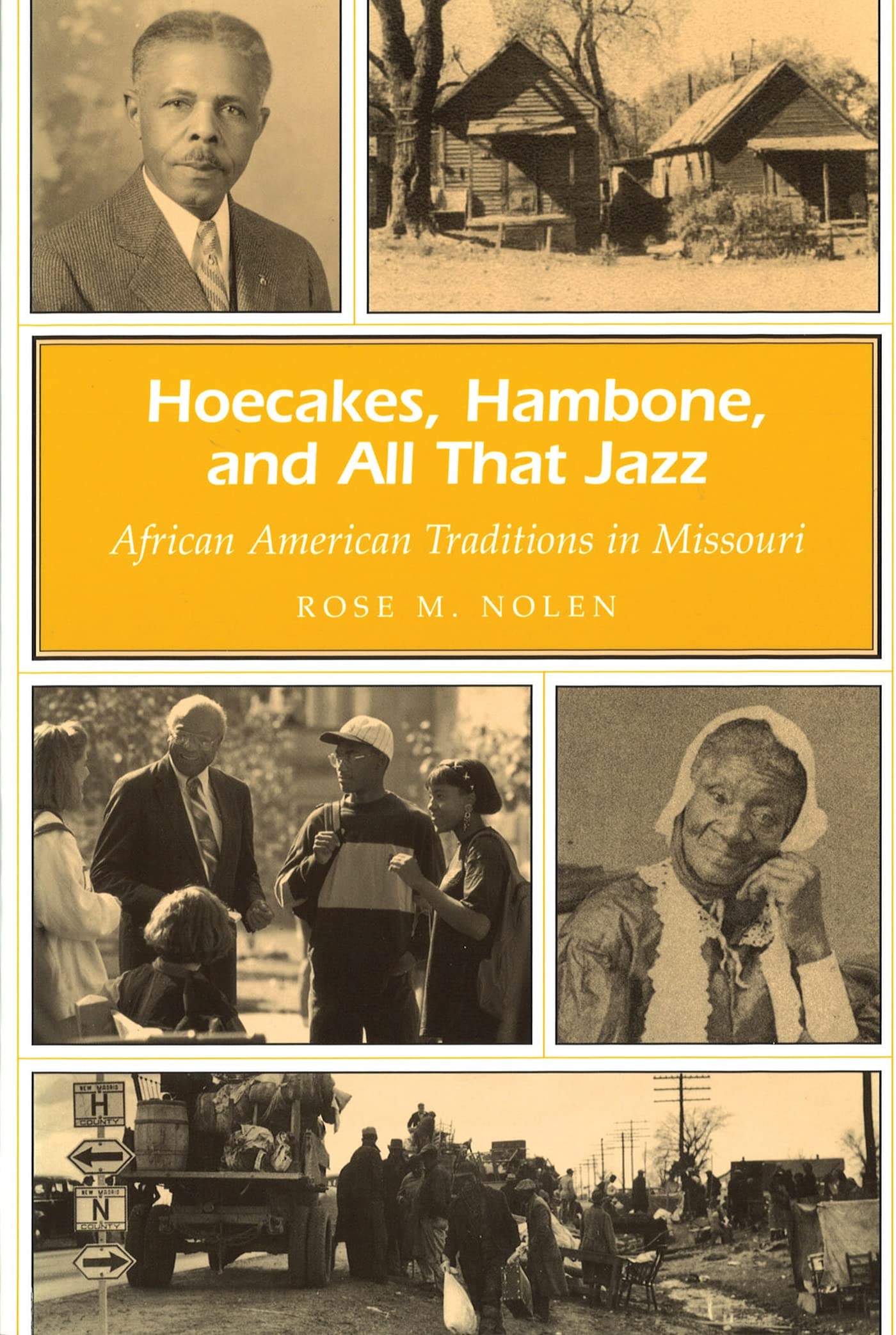
Hoecakes, Hambone, and All That Jazz: African American Traditions in Missouri (Missouri Heritage Readers) (Volume 1)
$16.60
by Rose M. Nolen



Many African Americans in Missouri are the descendants of slaves brought by the French or the Spanish to the Louisiana Territory in the 1700s or by Americans who moved from slave states after the Louisiana Purchase in the 1800s. In Hoecakes, Hambone, and All That Jazz, Rose M. Nolen explores the ways in which those Missouri “immigrants with a difference”—along with other Africans brought to America against their will—developed cultural, musical, and religious traditions that allowed them to retain customs from their past while adapting to the circumstances of the present. Nolen writes, “Instead of the bond of common ancestors and a common language, which families had shared in Africa, the enslaved in the United States were bound together by skin color, hair texture, and condition of bondage. Out of this experience a strong sense of community was born.” Nolen traces the cultural traditions shaped by African Americans in Missouri from the early colonial period through the Civil War and Reconstruction and shows how those traditions were reshaped through the struggles of the civil rights movement and integration. Nolen demonstrates how the strong sense of community built on these traditions has sustained African Americans throughout their history. Nolen focuses on some of the extraordinary Missourians produced by that community, among them William Wells Brown, “the first black man born in America to write plays, a novel, and accounts of his travels in Europe, as well as a ‘slave narrative’”; John Berry Meachum, a former slave who founded a “floating school,” anchored in the Mississippi River and thus exempt from state law, where blacks could be educated; J. W. “Blind” Boone, the celebrated composer and concert pianist; Elizabeth Keckley, who purchased her freedom, started her own business, and became dress designer and confidante to Mary Todd Lincoln; and Lucinda Lewis Haskell, daughter of a former slave, who helped establish the St. Louis Colored Orphan’s Home. Hoecakes, Hambone, and All That Jazz recalls the many advances African Americans have made throughout Missouri’s history and uses the accomplishments of individuals to demonstrate the considerable contribution of African American culture to Missouri and all of the United States. "An important—and highly readable—contribution to the history of African-American life in Missouri."— Arkansas Review Rose M. Nolen is a columnist for the Columbia Missourian . Hoecakes, Hambone, and All That Jazz African American Traditions in Missouri By Rose M. Nolen University of Missouri Press Copyright © 2003 The Curators of the University of Missouri All rights reserved. ISBN: 978-0-8262-1501-7 Contents Preface, Acknowledgments, Introduction, Chapter 1. Early Customs and Traditions, Chapter 2. Dreams of Freedom, Chapter 3. Let My People Go, Chapter 4. Building New Lives, Chapter 5. Living with Jim Crow, Chapter 6. The Slow Death of Jim Crow, Chapter 7. A Charge to Keep, For More Reading, Index, CHAPTER 1 Early Customs and Traditions In 1821, following the Missouri Compromise, Missouri became the twenty-fourth state in the Union. Congress had worked out the compromise to maintain an equal number of slave and free states: Maine joined the Union as a free state, and Missouri was allowed to join as a slave state. As the new state's population grew, the fertile bottomlands of the Missouri River drew more and more farmers until a line of settlements reached across the state to the border with the Kansas Territory. The larger slave populations came to reside in Missouri River counties such as Callaway, Cole, Boone, Cooper, Howard, Moniteau, Chariton, Lafayette, Ray, Clay, and Jackson. An area in central Missouri had so many settlers from the South that it became known as "Little Dixie." Counties along the Mississippi River in northeast Missouri also drew slaveholders seeking new land, most from Kentucky, Virginia, and Tennessee. By 1840 the slave population of Missouri had grown to more than 57,000. One of the state's largest slave owners was Jabez Smith of Jackson County, who owned as many as 165 slaves at one time. Most Missouri slaves lived on farms rather than large plantations, usually in crude cabins on the property of their owners. A typical slave cabin was made of roughly sawn logs, daubed with mud, sometimes not much different from the homes of their owners during early settlement. New settlers used slaves to help clear their land, raise crops, and maintain their property. Since workers were scarce in the newly settled areas, landowners found it easier and cheaper to keep slaves than to hire laborers. Owners could also rent slaves out to others to get extra income. Slaves worked from sunrise to sunset without pay. There were few laws to protect them. Their treatment depended almost entirely on the whims of their owners, who often established rules of behavior based solely on their own best interests. Martha