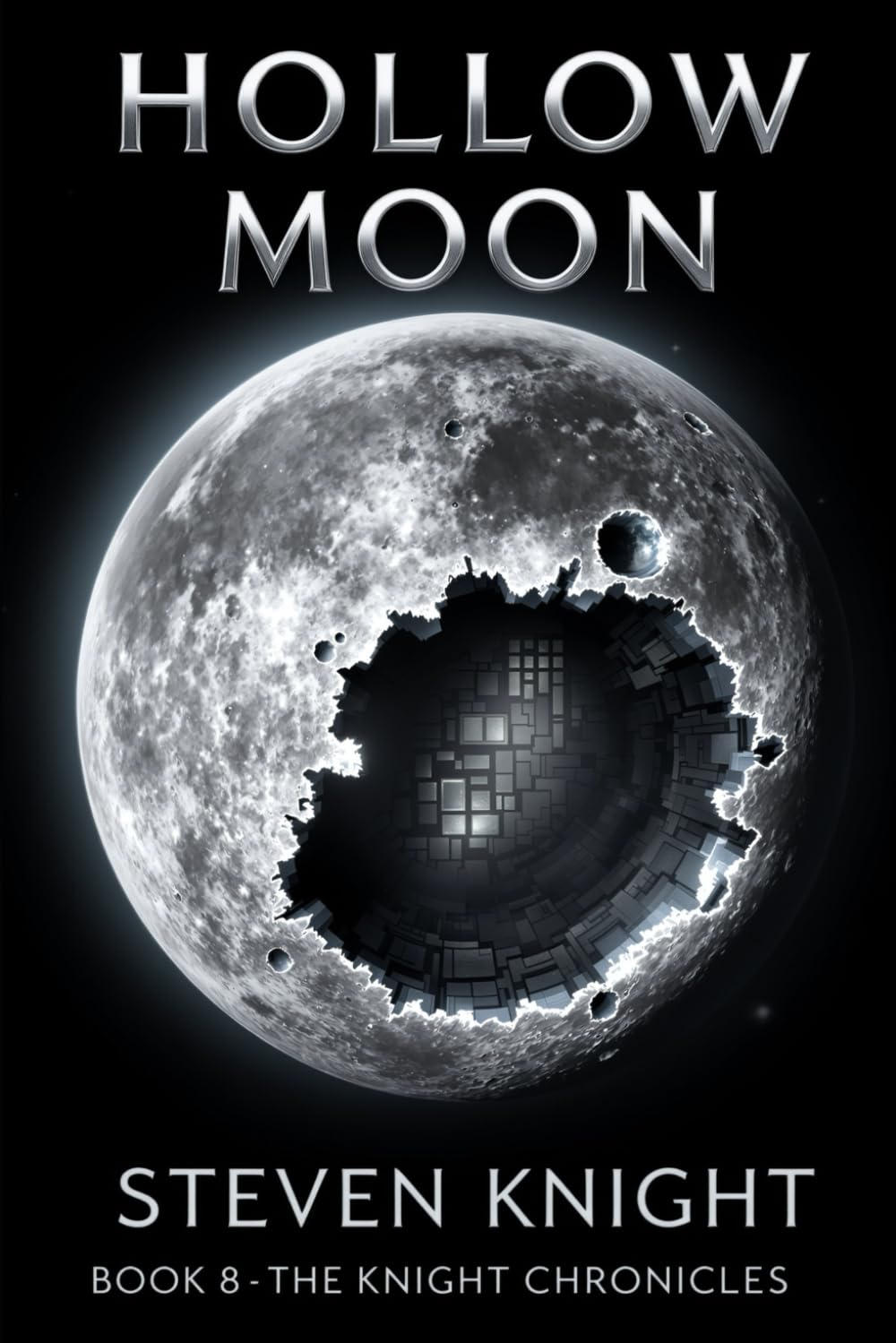



Steven Knight's "Hollow Moon" investigates the theory that Earth's Moon may be hollow and possibly artificial, presenting evidence challenging conventional planetary science. THE SEISMIC DISCOVERY Apollo 12's November 1969 seismic experiment produced shocking results. When the Intrepid Lunar Module impacted the Moon, scientists expected vibrations lasting 7-8 minutes. Instead, the Moon reverberated for 3 hours and 20 minutes—"ringing like a bell," as Dr. Maurice Ewing described it. This was replicated thousands of times, with some impacts exceeding 4 hours. Dr. Clive Neal's analysis revealed the Moon's seismic efficiency is 100 times greater than Earth's, with quality factors of 3,000-5,000—far exceeding any known material. The waves exhibited sustained resonance matching a hollow structure's acoustic signature. SCIENTIFIC ANOMALIES Multiple inexplicable lunar characteristics are documented: • DENSITY PROBLEM: The Moon's mean density (3.34 g/cm³) is impossibly low, suggesting massive internal voids. • PERFECT ECLIPSE: The Moon's size and distance create perfect solar eclipses—Isaac Asimov called this "the most unlikely natural arrangement imaginable." • TIDAL LOCK: The Moon's synchronous rotation defies probability for natural capture. • AGE PARADOXES: Lunar rocks are older than the Moon itself; some predate the solar system. • MAGNETIC MYSTERY: Despite lacking a magnetic field, lunar rocks show remnant magnetism requiring ancient fields far stronger than Earth's. THE ARTIFICIAL SATELLITE HYPOTHESIS Knight examines the 1970 theory by Soviet scientists Vasin and Shcherbakov proposing the Moon as an artificial "ark." Their analysis showed the Moon's orbital mechanics are more consistent with engineering than natural formation. Ancient texts from multiple cultures describe a time "before the Moon," suggesting it arrived in Earth orbit within human memory. COVER-UP AND EVIDENCE Declassified NASA documents reveal internal acknowledgment that "fundamental assumptions about lunar structure require revision." A 1971 report explicitly considered "large-scale void spaces" as explanations, though never publicly emphasized. Apollo astronauts reported structures on the far side—"the Shard," "the Tower," and "the Castle"—visible in NASA photographs but never explained. CONCLUSION Five decades of evidence—Apollo seismic data showing impossible reverberation patterns, density calculations indicating massive voids, orbital mechanics defying natural probability—points toward one conclusion: the Moon is not a natural satellite. Institutional science has avoided this not because evidence is lacking, but because the implications are too profound. If the Moon is artificial, it represents technology millions of years beyond human capability. The data is irrefutable: the Moon rang like a bell for over three hours from a one-ton impact. No natural planetary body exhibits such behavior. Thousands of seismic events across eight years confirmed this anomaly. Standard models cannot explain it without invoking properties never observed in any material. The Apollo experiments detected evidence of large-scale internal structures inconsistent with a solid, naturally formed body. The straightforward interpretation is that significant portions of the lunar interior are hollow—systematically rejected not because better evidence exists, but because accepting it requires acknowledging the Moon was engineered. As Knight concludes: "We don't live under a natural satellite. We live under a hollow Moon. The question isn't whether the evidence exists—it's whether we have the courage to confront what it means."