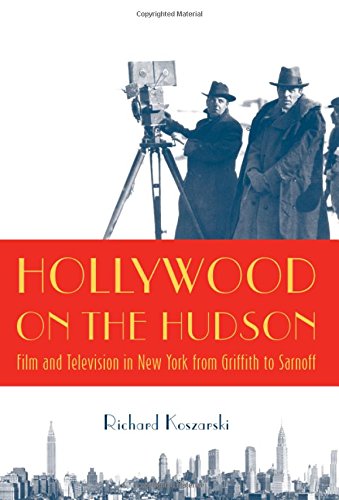
Hollywood on the Hudson: Film and Television in New York from Griffith to Sarnoff
$44.80
by Professor Richard Koszarski



Thomas Edison invented his motion picture system in New Jersey in the 1890s, and within a few years most American filmmakers could be found within a mile or two of the Hudson River. They planted themselves here because they needed the artistic and entrepreneurial energy that D. W. Griffith realized New York had in abundance. But as the going rate for land and labor skyrocketed and their business grew more industrialized, most of them moved out. The way most historians explain it, the role of New York in the development of American film ends here. In Hollywood on the Hudson, Richard Koszarski rewrites an important part of the history of American cinema. During the 1920s and 1930s, film industry executives had centralized the mass production of feature pictures in a series of gigantic film factories scattered across Southern California, while maintaining New York as the economic and administrative center. But as Koszarski reveals, many writers, producers, and directors also continued to work here, especially if their independent vision was too big for the Hollywood production line. East Coast filmmakers-Oscar Micheaux, Rudolph Valentino, Ben Hecht, Charles MacArthur, Paul Robeson, Gloria Swanson, Max Fleischer, and others-quietly created a studio system without back-lots, long-term contracts or seasonal production slates. They substituted "newsreel photography" for Hollywood glamour, targeted niche audiences instead of middle-American families, ignored accepted dramatic conventions, and pushed the boundaries of motion picture censorship. Rebellious and unconventional, they saw the New York studios as laboratories, not factories-and used them to pioneer the development of new technologies (from talkies to television), new genres, new talent, and ultimately, an entirely new vision of commercial cinema. A perfect blend of Hollywood history, film analysis, and New York cultural history. Richard Joscarski is one of the preeminant film historians of our time. -- Jeanine Basinger, Chair of Film Studies, Wesleyan University This is the definitive history of New York filmmaking in the first half of the twentieth century--and this is no small story or accomplishment. -- Steven J. Ross, author of Working-Class Hollywood: Silent Film and the Shaping of Class in America Richard Koszarski is an associate professor of English and film studies at Rutgers University, and the editor-in-chief of Film History: An International Journal. His books include The Man You Loved to Hate: Erich von Stroheim and Hollywood and An Evening's Entertainment: The Age of the Silent Feature Picture. Used Book in Good Condition