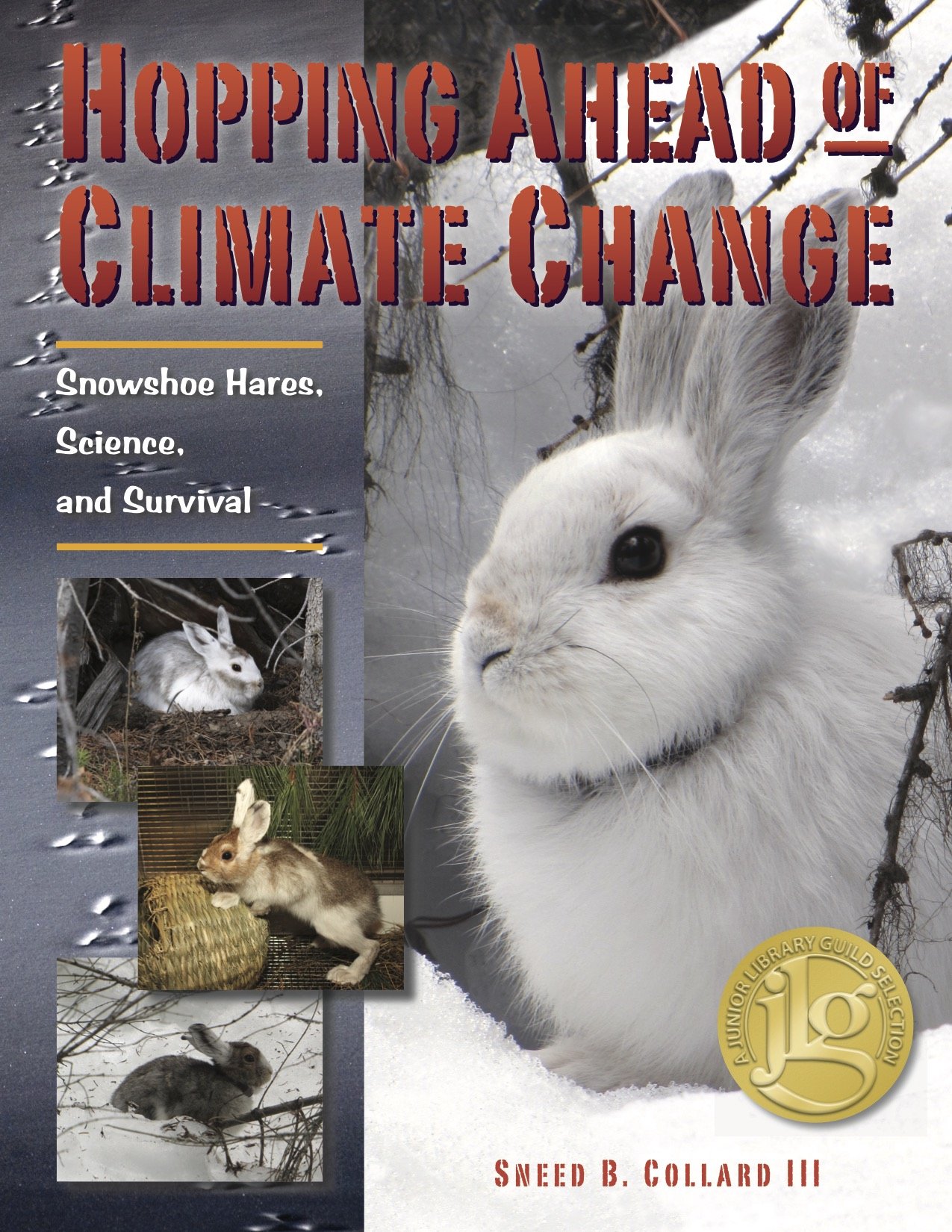
Hopping Ahead of Climate Change: Snowshoe Hares, Science, and Survival
$8.05
by Sneed B. Collard



A snowshoe hare nibbles on spruce and fir buds high in a Rocky Mountain forest. The hare isn�t overly worried about predators because its white fur blends in perfectly with snow. There�s only one problem. This year, there isn�t any snow. As the hare forages, a great horned owl notices. The result? A disaster for the hare�one that is happening more and more frequently across its range. Hopping Ahead of Climate Change describes one of the most intriguing and important studies of our time�the work of biologist Scott Mills, who is trying to answer the critical question: Can animals that change their coat colors with the seasons survive shorter winters caused by climate change? Working with an international team of colleagues and students, Professor Mills has been conducting a range of studies that explore the impacts of a hotter world on animals. In Hopping Ahead of Climate Change, readers learn how Professor Mills studies snowshoe hares, which questions he seeks to answer, and most importantly, what he has discovered. The results are both fascinating and surprising�and have vital implications for the future of our planet. Gr 2–5—This intriguing book examines the relationship between animals that modify their coat colors with the seasons and changes in the environment resulting from global warming. The main focus is on snowshoe hares. Their coat color changes are triggered primarily by the length of the day. Warmer weather means more sun and less snow; thus, white snowshoe hares are more vulnerable to predation. With limited time to adapt to such a drastic alteration in their environment, the species could potentially be on track for extinction. If this process continues to occur, Collard asks, what will happen to the other animals in this newly unbalanced ecosystem? The author's lively text follows the work of a team of scientists led by Scott Mills. Photos of them working in the field and in laboratories are featured along with graphs and informational sidebars. In the back matter, a section is devoted to ways that readers can reduce their carbon footprints. VERDICT Captivating text and a stimulating use of color photographs make this a welcome addition for all environmental collections.—Patricia Ann Owens, formerly at Illinois Eastern Community Colleges, Mount Carmel Snowshoe hares may be nature s cheeseburger, but thanks to the work of biologist Scott Mills, scientists have also learned that they re an example of how climate change impacts species. Snowshoe hares change the color of their coats to protect themselves from predators in the warmer months, they turn brown to match the environment, while during the winter, their coat turns white to blend in with the snow. Mills work shows that as the climate changes, snowshoe hares don t change their coats early enough, often resulting in brown patches on an otherwise snow-white coat. Collard s digestible, clearly written text has enough humorous sidenotes thrown in to make it both entertaining and informative. Full-color photographs, maps, graphs, and topic definitions reinforce the information, and Collard does an excellent job of telling the story of the snowshoe hare, while also keeping stewardship and conservation as the core message. Any budding scientist would find Mills and his team s research fascinating, and this would be a welcomed addition to any middle-grade science class. Erin Linsenmeyer --Booklist A snowshoe hare nibbles on spruce and fir buds high in a Rocky Mountain forest. The hare isn't overly worried about predators because its white fur blends in perfectly with snow. There's only one problem. This year, there isn't any snow. As the hare forages, a great horned owl notices. The result? A disaster for the hare one that is happening more and more frequently across its range. Profusely illustrated with color photography, "Hopping Ahead of Climate Change" accurately describes for young readers (and their parents) one of the most intriguing and important studies of our time the work of biologist Scott Mills, who is trying to answer the critical question: Can animals that change their coat colors with the seasons survive shorter winters caused by climate change? Working with an international team of colleagues and students, Professor Mills has been conducting a range of studies that explore the impacts of a hotter world on animals. In "Hopping Ahead of Climate Change", readers of all ages will learn how Professor Mills studies snowshoe hares, which questions he seeks to answer, and most importantly, what he has discovered. The results are both fascinating and surprising and have vital implications for the future of our planet. Impressively well written, organized and presented, "Hopping Ahead of Climate Change" is unreservedly recommended for family, school, and community library Environmental Studies and Wildlife Studies collections and supplemental studies reading lists. --Midwest Book Review Sneed B. Collard III graduated with honors in mari