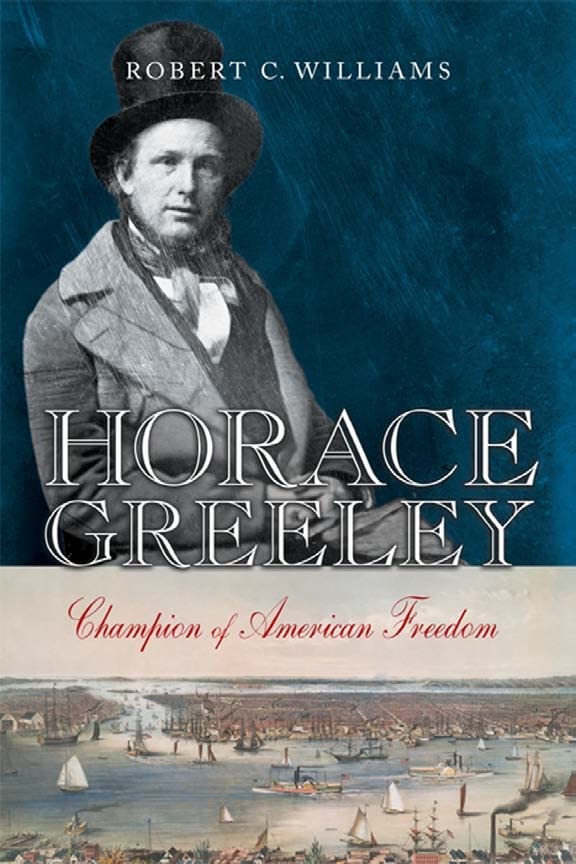



From his arrival in New York City in 1831 as a young printer from New Hampshire to his death in 1872 after losing the presidential election to General Ulysses S. Grant, Horace Greeley (b. 1811) was a quintessential New Yorker. He thrived on the city’s ceaseless energy, with his New York Tribune at the forefront of a national revolution in reporting and transmitting news. Greeley devoured ideas, books, fads, and current events as quickly as he developed his own interests and causes, all of which revolved around the concept of freedom. While he adored his work as a New York editor, Greeley’s lifelong quest for universal freedom took him to the edge of the American frontier and beyond to Europe. A major figure in nineteenth-century American politics and reform movements, Greeley was also a key actor in a worldwide debate about the meaning of freedom that involved progressive thinkers on both sides of the Atlantic, including Margaret Fuller, Ralph Waldo Emerson, and Karl Marx. Greeley was first and foremost an ardent nationalist who devoted his life to ensuring that America live up to its promises of liberty and freedom for all of its members. Robert C. Williams places Greeley’s relentless political ambitions, bold reform agenda, and complex personal life into the broader context of freedom. Horace Greeley is as rigorous and vast as Greeley himself, and as America itself in the long nineteenth century. In the first comprehensive biography of Greeley to be published in nearly half a century, Williams captures Greeley from all sides: editor, reformer, political candidate, eccentric, and trans-Atlantic public intellectual; examining headlining news issues of the day, including slavery, westward expansion, European revolutions, the Civil War, the demise of the Whig and the birth of the Republican parties, transcendentalism, and other intellectual currents of the era. Horace Greeley was America's most famous editor and, with his Tribune, a defining voice in mid-nineteenth-century politics. He was an early promoter of Thoreau, lent money to Poe, and employed as foreign correspondents both Mark Twain and Karl Marx (who described Greeley to Engels as a "jackass with the face of an angel"). Williams gives a straightforward account of Greeley's personal life, which included an unhappy marriage made bleaker by the couple's fascination with utopian communities and dietary fads. To contemporaries, Greeley was a portrait in contradictions: he helped found the Republican Party, then ran for President as a Democrat; was late in becoming an "anti-slavery man," then excoriated Lincoln for moving slowly on emancipation; urged headlong assaults on the Confederacy, then bailed Jefferson Davis out of jail. Williams, however, argues that Greeley unswervingly devoted himself to a single idealAmerican freedomand was, in turn, crucial to its development. Copyright © 2006 The New Yorker - click here to subscribe. A memorable figure in the history of American journalism and politics, Horace Greeley (1811-72) was opinionated, self-made, erratic, and influential. Biographer Williams recounts Greeley's rise from obscurity to prominence, relying for a unifying theme on Greeley's dedication to social reform and personal improvement. The earnest Greeley expounded for decades on public concerns and enthusiasms: he publicized spiritualists, nutritionists, and utopian socialists; promoted Transcendentalist writers; inveighed against slavery; vacillated on secession; and campaigned unsuccessfully for the presidency in 1872. Williams roots Greeley's moral outlook in his Christian belief, and subsequently in promoting liberty whether in a national sense, by supporting Henry Clay, or in individualistic advice encapsulated by the motto "Go west!" (although Greeley denied coining it). Williams detects in Greeley's myriad printed disputations and political pronouncements more ideological consistency than scholars grant. Be that as it may, general readers interested in the who, what, when, where, and how of Greeley have got it all in Williams' stolid presentation. Gilbert Taylor Copyright © American Library Association. All rights reserved "Greeleys was a remarkable life. And Robert Williams paints it in full. . . . [He] does a creditable job relating all of this, and his book is thoroughly researched and ably written. . . . [His] continuing theme of Greeley’s relationship to evolving notions of liberty and freedom is solid. . . . Horace Greeley was unquestionably the dominant journalist, and one of the leading politicians, of the Civil War era. And his story has never been better told than it is here." ― New York Sun "A comprehensive biography of Greeley (181172), deftly analyzing the price he paid to brook no intrusion, partisan or otherwise, on his principles. . . . Powerful portrait of a publisher who became the voice of Middle America during the nation's deepest crisis." ― Kirkus (starred review) "[An] accessible study by a seasone