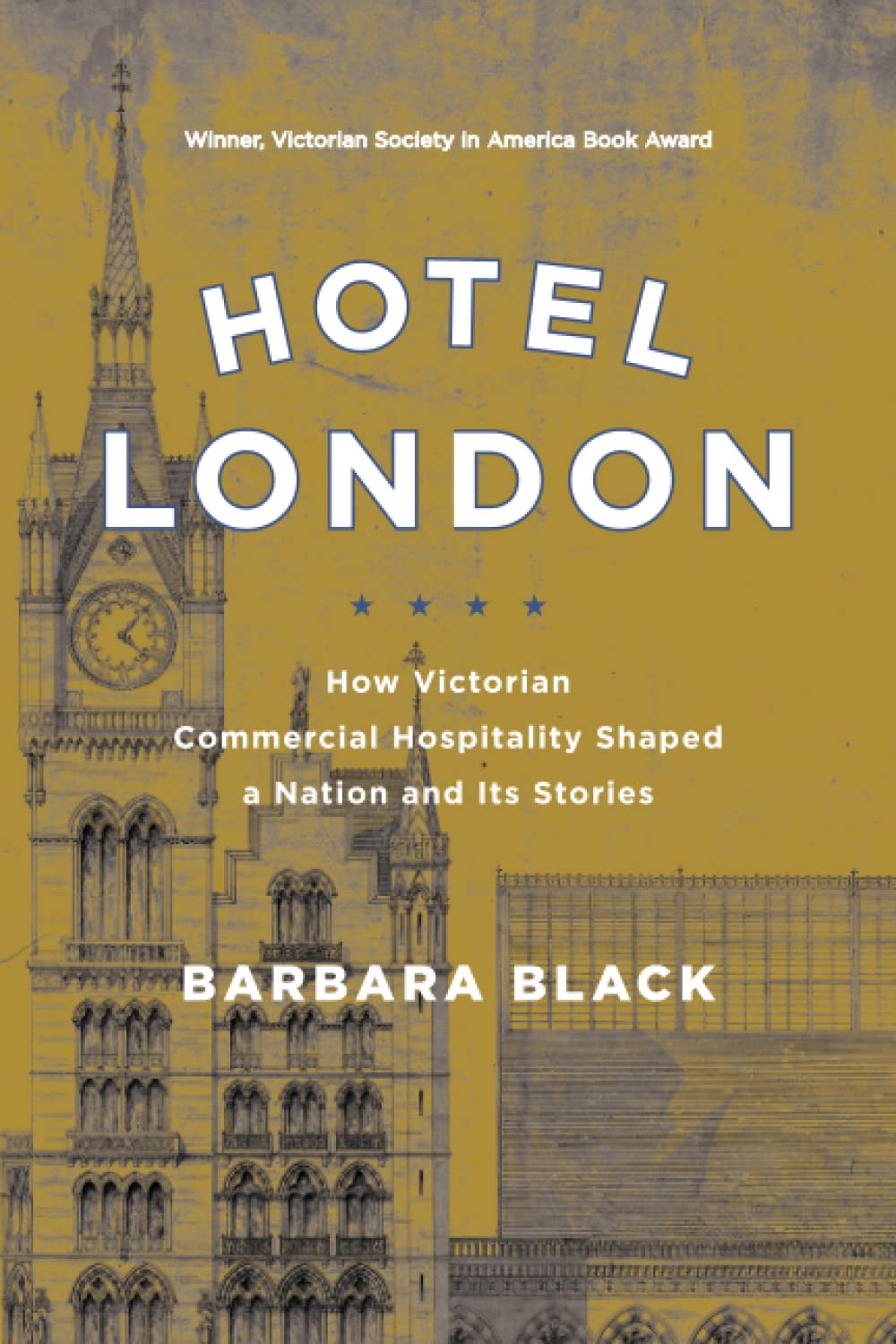
Hotel London: How Victorian Commercial Hospitality Shaped a Nation and Its Stories
$34.95
by Barbara Black



Hotel London: How Victorian Commercial Hospitality Shaped a Nation and Its Stories examines Victorian London’s grand hotels as both an institution and a culture intimately connected to the urban landscape. In her new study, Barbara Black argues that London’s grand hotels provided an essential space for socializing, fashioned by concerns relating to class, gender, and nationality. Rooted in Walter Benjamin’s “new velocities” of the nineteenth century and Wayne Koestenbaum’s hotel theory, Hotel London explores how the emergence of the grand hotel as a physical and metaphorical space helped to construct a consumer economy that underscored London’s internationalism and, by extension, England’s global status. Incorporating the works of Oscar Wilde, Henry James, Wilkie Collins, Arnold Bennett, Florence Marryat, and Marie Belloc Lowndes, as well as contemporary depictions of the hotels in Mad Men, American Horror Story, and The Grand Budapest Hotel, Black examines how the hotel supported a corporate identity that would ultimately assist in the rise of modern capitalist structures and the middle class. In this way, Hotel London exposes the aggravations of class stratifications through the operations of status inside hotel life, giving a unique perspective on Victorian London that could only come from the stories of a hotel. “Black’s skill in combining cultural theory with social and personal history . . . is on full display here. . . . [Her writing] is accessible, even gripping, and deserves a wide audience.” —Jacqueline Banerjee, Times Literary Supplement "[Black] overlays her theoretical reflections with delightful anecdotes and revealing details, and she illustrates the important role hotels play in literature and film...an insightful theoretical study that is also a pleasure to read. Summing up: Highly recommended." ––J. Rosenblum, Choice “Thanks to Black’s masterful interdisciplinarity, Hotel London will provide immense inspiration to any reader or researcher looking to unite literary studies with historical materialism.” —Keith Wagner, Rocky Mountain Review "Black’s linguistic mastery makes for a narrative as rich as the sumptuous facilities she describes, where gleaming lobbies and ballrooms converge with the thrill of new inventions." ––Faith MacNeil Taylor, City "The historian will read [ Hotel London ] with appetite whetted...an innovative and thought-provoking framework for interrogating the hotel life of Victorian London—and many eras and places besides." ––Kevin James, Journal of Tourism History "In Black's account, grand hotels are both paradoxical and transformative. … Even when they disappear, hotels are ghostly presences in the landscape and the cultural psyche. Hotel London brilliantly celebrates their longevity and power." ––Melissa Fegan, Review19 “Black’s willingness to move across spaces and times makes the book feel like an ideal example of what humanistic work should be right now: it is both deeply historically grounded and up to date, pointing its archival discoveries toward their relevance in our own moment.” —Caroline Levine “Black makes an excellent case for adding the grand hotel to the many studies of monumental nineteenth-century spaces. Her book displays an impressive knowledge of hotel lore and paints a vivid picture of the rise of the grand hotel in Victorian London.” —Barbara Leckie Barbara Black is Professor of English at Skidmore College. She is the author of A Room of His Own: A Literary-Cultural Study of Victorian Clubland and On Exhibit: Victorians and Their Museums.