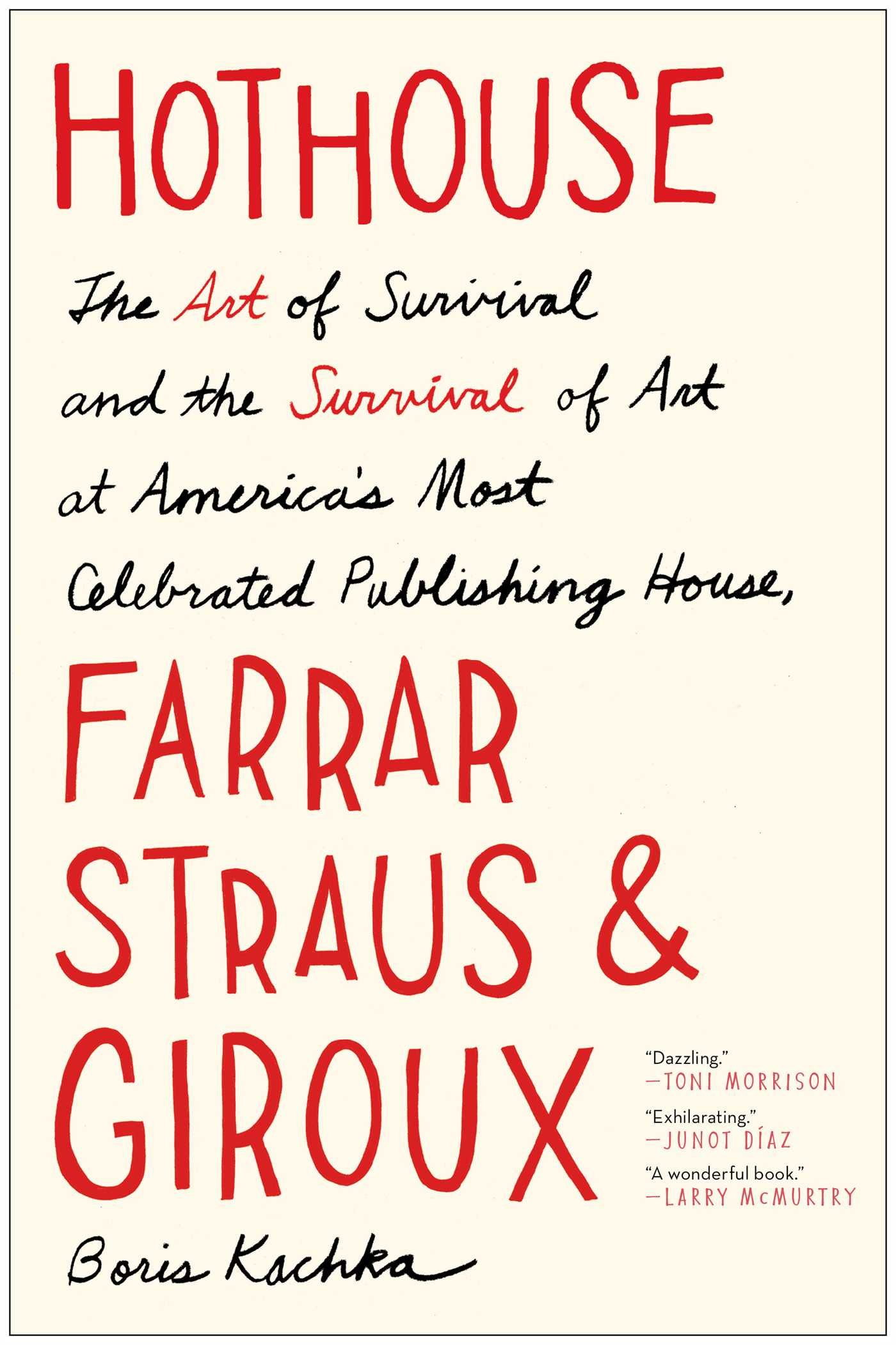
Hothouse: The Art of Survival and the Survival of Art at America's Most Celebrated Publishing House, Farrar, Straus, and Giroux
$13.54
by Boris Kachka



“Mad Men for the literary world.” —Junot Díaz Farrar, Straus and Giroux is arguably the most influential publishing house of the modern era. Home to an unrivaled twenty-five Nobel Prize winners and generation-defining authors like T. S. Eliot, Flannery O’Connor, Susan Sontag, Tom Wolfe, Joan Didion, Philip Roth, and Jonathan Franzen, it’s a cultural institution whose importance approaches that of The New Yorker or The New York Times . But FSG is no ivory tower—the owner's wife called the office a “sexual sewer”—and its untold story is as tumultuous and engrossing as many of the great novels it has published. Boris Kachka deftly reveals the era and the city that built FSG through the stories of two men: founder-owner Roger Straus, the pugnacious black sheep of his powerful German-Jewish family—with his bottomless supply of ascots, charm, and vulgarity of every stripe—and his utter opposite, the reticent, closeted editor Robert Giroux, who rose from working-class New Jersey to discover the novelists and poets who helped define American culture. Giroux became one of T. S. Eliot’s best friends, just missed out on The Catcher in the Rye , and played the placid caretaker to manic-depressive geniuses like Robert Lowell, John Berryman, Jean Stafford, and Jack Kerouac. Straus, the brilliant showman, made Susan Sontag a star, kept Edmund Wilson out of prison, and turned Isaac Bashevis Singer from a Yiddish scribbler into a Nobelist—even as he spread the gossip on which literary New York thrived. A prolific lover and an epic fighter, Straus ventured fearlessly, and sometimes recklessly, into battle for his books, his authors, and his often-struggling company. When a talented editor left for more money and threatened to take all his writers, Roger roared, “Over my dead body”—and meant it. He turned a philosophical disagreement with Simon & Schuster head Dick Snyder into a mano a mano media war that caught writers such as Philip Roth and Joan Didion in the crossfire. He fought off would-be buyers like S. I. Newhouse (“that dwarf”) with one hand and rapacious literary agents like Andrew Wylie (“that shit”) with the other. Even his own son and presumed successor was no match for a man who had to win at any cost—and who was proven right at almost every turn. At the center of the story, always, are the writers themselves. After giving us a fresh perspective on the postwar authors we thought we knew, Kachka pulls back the curtain to expose how elite publishing works today. He gets inside the editorial meetings where writers’ fates are decided; he captures the adrenaline rush of bidding wars for top talent; and he lifts the lid on the high-stakes pursuit of that rarest commodity, public attention—including a fly-on-the-wall account of the explosive confrontation between Oprah Winfrey and Jonathan Franzen, whose relationship, Franzen tells us, “was bogus from the start.” Vast but detailed, full of both fresh gossip and keen insight into how the literary world works, Hothouse is the product of five years of research and nearly two hundred interviews by a veteran New York magazine writer. It tells an essential story for the first time, providing a delicious inside perspective on the rich pageant of postwar cultural life and illuminating the vital intellectual center of the American Century. John Farrar (1896–1974), a quick-to-anger “High Episcopalian editor,” and Roger Straus (1917–2004), a wealthy, charismatic “Jewish prep-school jock,” joined forces in 1946 to launch a New York publishing house. In 1955, Straus hired the immensely talented editor Robert Giroux (1914–2008), a working-class “Jersey City Jesuit.” Journalist Kachka tells Farrar and Giroux’s intriguing stories with zest, but Straus is the sun around which this scintillating history revolves. Possessed of “lordly benevolence and canny calculation,” Straus ran a cosmopolitan, intellectual, if shabby kingdom where sex was the currency of the realm, a CIA connection opened doors to overseas writers, parties served as publicity campaigns, and the prestigious literary house of Farrar, Straus & Giroux published a record-making 25 Nobel laureates. Writing with vigor, skill, and expertise and drawing on dozens of in-depth interviews, Kachka shares risqué gossip and striking insider revelations and vividly profiles the house’s world-shaping writers, including Flannery O’Connor, Tom Wolfe, and Susan Sontag. Kachka’s engrossing portrait of an exceptional publishing house sheds new light on the volatile mixture of commerce, art, and passion that makes the world of books go round. --Donna Seaman For anyone with a sweet tooth for the book world or a thought and a care for American culture after the Second World War, Kachka's book is a brightly lit, well-stocked candy store. Its pages are stuffed with tales of book parties and Nobel Prizes, of Edmund Wilson meeting Susan Sontag at a dinner with Straus, of former employees looking back on their time there, of good