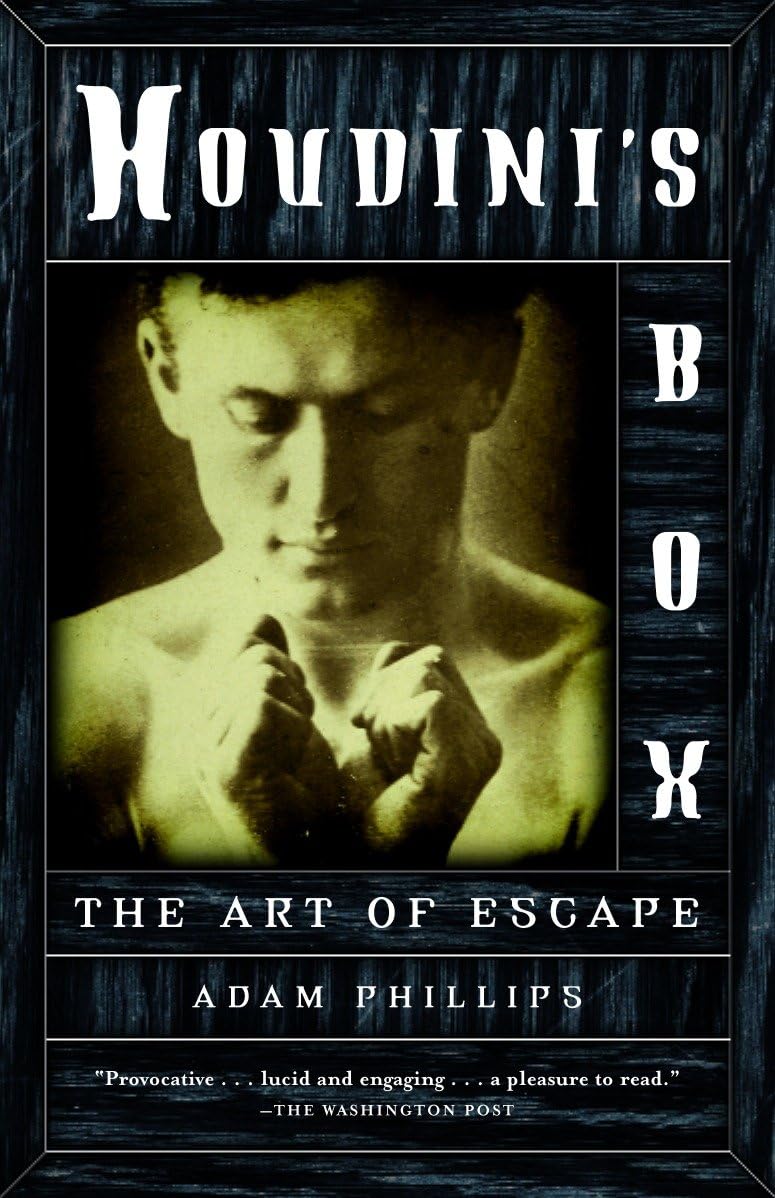



In this uniquely brilliant and insightful book, an acclaimed essayist and psychoanalyst analyzes four escape artists—including Harry Houdini and Emily Dickinson—to meditate on the notion of escape in our society and in ourselves. "Provocative ... lucid and engaging ... a pleasure to read." — The Washington Post No one can escape the desire and need to escape. By analyzing four examples of escape artists—a young girl who hides from others by closing her eyes; a grown man incapable of a relationship; Emily Dickinson, recluse extraordinaire; and Harry Houdini, the quintessential master of escape—Phillips enables readers to identify the escape artists lurking within themselves. Lucid, erudite, and audacious, Houdini's Box is another scintillating and seminal work by one of the world's most dazzlingly original thinkers. “Provocative ... lucid and engaging ... a pleasure to read.” — The Washington Post “A rare achievement—as remarkable a piece of tightrope walking as Houdini ever performed himself.” — London Daily Telegraph “Illuminating and intriguing.” — BookPage “Fascinating.” — Entertainment Weekly uely brilliant and insightful book, acclaimed essayist and psychoanalyst Adam Phillips meditates on the notion of escape in our society and in ourselves. No one can escape the desire and need to escape. By analyzing four examples of escape artists a young girl who hides from others by closing her eyes; a grown man incapable of a relationship; Emily Dickinson, recluse extraordinaire; and Harry Houdini, the quintessential master of escape Phillips enables readers to identify the escape artists lurking within themselves. Lucid, erudite, and audacious, Houdini's Box is another scintillating and seminal work by one of the world's most dazzlingly original thinkers. In this uniquely brilliant and insightful book, acclaimed essayist and psychoanalyst Adam Phillips meditates on the notion of escape in our society and in ourselves. No one can escape the desire and need to escape. By analyzing four examples of escape artists--a young girl who hides from others by closing her eyes; a grown man incapable of a relationship; Emily Dickinson, recluse extraordinaire; and Harry Houdini, the quintessential master of escape--Phillips enables readers to identify the escape artists lurking within themselves. Lucid, erudite, and audacious, Houdini's Box is another scintillating and seminal work by one of the world's most dazzlingly original thinkers. ADAM PHILLIPS is the author of Winnicott ; On Kissing, Tickling, and Being Bored ; On Flirtation ; Terrors and Experts ; Monogamy ; The Beast in the Nursery ; Darwin’s Worms ; and Promises, Promises . Formerly the principal child psychotherapist at Charing Cross Hospital in London, he lives in England. Chapter One A five-year-old girl comes into my room ready to play another round of her favorite game, hide-and-seek, a game she has been playing with me twice a week for several months. It is the way, down to the smallest detail, we always begin our time together. In the room there is an armchair, a table, and a chair. She stands in the middle of the room, closes her eyes, and says, “Start looking.” I have watched her, as usual, walk into the room and simply close her eyes. But in her mind she is now hiding. And quite quickly getting impatient. “Look!” she says. “Start looking!” Of course I am looking—what else could I be doing?—but I don’t seem to be playing the game. It occurs to me, for once, that perhaps I should close my eyes, which I do. And then she says a bit crossly, “OK, I’ll give you a clue. I’m not behind the chair.” I say to her, not too plaintively, “How will I ever find you?” “Just keep looking,” she says blithely, clearly wanting to be helpful. Then, a bit more frantic, a bit more Alice in Wonderland, “I can’t escape, I can’t escape . . . I must be here somewhere.” “No one can look everywhere,” I say. “We can’t escape, we’re doing that,” she replies thoughtfully, as though this was the most sensible, least histrionic of acknowledgments. She waits, eyes squeezed shut, while I keep failing to do what it looks like I’ve already done. So what I have found—indeed can’t help seeing: her in the middle of the room, hiding—is obviously not what she wants me to look for. “Will it be dangeroos when I find you?” I ask. (Her mother would read the sign at the zoo as “Do not feed these animals, they are dangeroos,” so “dangeroos” is her word for it.) “You’ll die,” she replies. Then there’s a pause, and she says in her most world-weary voice, “I give up.” It is as if the rehearsal is over, and we can now resume, after another failed attempt at something, our ordinary life in the room. There is a drama, a tableau that she has to show me, that we are both trapped in. This is what we have to take for granted, she seems to be saying, this is what we need to do together, to get things started. And the sign of our entrapment is that she never changes; whate