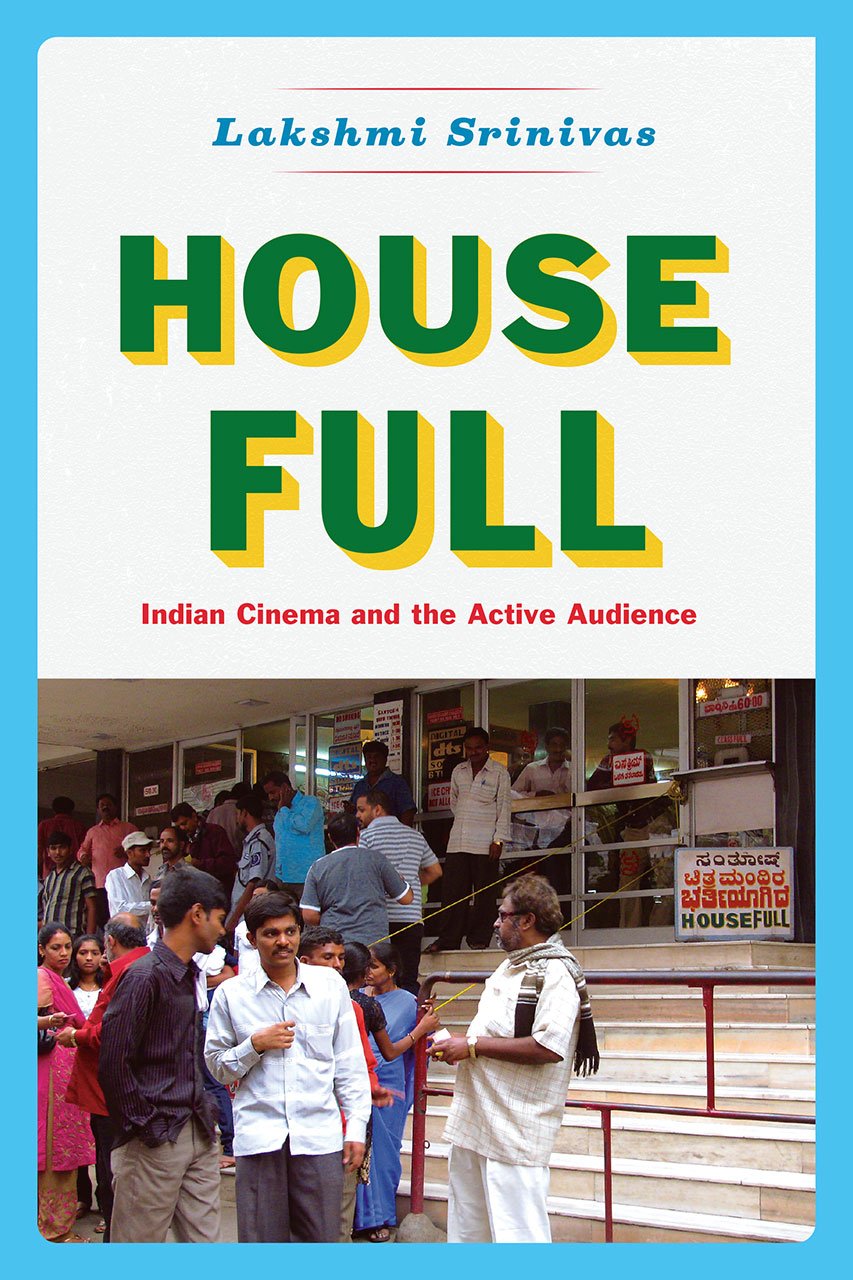
House Full: Indian Cinema and the Active Audience (Fieldwork Encounters and Discoveries)
$123.41
by Lakshmi Srinivas



India is the largest producer and consumer of feature films in the world, far outstripping Hollywood in the number of movies released and tickets sold every year. Cinema quite simply dominates Indian popular culture, and has for many decades exerted an influence that extends from clothing trends to music tastes to everyday conversations, which are peppered with dialogue quotes. With House Full , Lakshmi Srinivas takes readers deep into the moviegoing experience in India, showing us what it’s actually like to line up for a hot ticket and see a movie in a jam-packed theater with more than a thousand seats. Building her account on countless trips to the cinema and hundreds of hours of conversation with film audiences, fans, and industry insiders, Srinivas brings the moviegoing experience to life, revealing a kind of audience that, far from passively consuming the images on the screen, is actively engaged with them. People talk, shout, whistle, cheer; others sing along, mimic, or dance; at times audiences even bring some of the ritual practices of Hindu worship into the cinema, propitiating the stars onscreen with incense and camphor. The picture Srinivas paints of Indian filmgoing is immersive, fascinating, and deeply empathetic, giving us an unprecedented understanding of the audience’s lived experience—an aspect of Indian film studies that has been largely overlooked. A most enjoyable and even fun read (rare in sociology) that provides both an acutely immersive and profoundly empathetic rendering. . .Drawing from a small, but potent, body of work on ethnographic studies of film reception, Srinivas formulates an impressive research design in Bangalore, India. . .House Full is an impressive, necessary, and innovative study that pushes conventional sociological renderings of media toward their social realities. ― American Journal of Sociology “Srinivas’s book is a refreshing contribution to the study of popular south Asian film, by its acknowledgement of the ways in which different actors, including the audiences, make films, but also by its focus on the social spaces that go beyond the theater itself. It offers a rich ethnographic account on the practices and experiences that surround cinemagoing and its social situatedness. The book knits together rich fieldwork data, personal experiences, theory and analysis and shows how the trivia of cinemagoing do matter. One of the most innovative points made in the book is how spatial cultures define cinemagoing, something barely touched upon in earlier accounts on cinema in South Asia and beyond. Taking this together the book offers a range of material and observations to reflect on the cultural production of film.” ― Visual Anthropology “That such practices of reception, even in darkened cinema halls of the late twentieth century, remained quite ‘normal’ for a significant segment of humanity has been richly documented by sociologist Lakshmi Srinivas in House Full , her engaging study of the ‘active audience’ of South Asian popular cinema. Based on extensive fieldwork, primarily in the late 1990s, in the burgeoning metropolis of Bangalore (now officially Bengaluru) in Karnataka state, Srinivas’s book turns its focus away from the ‘reading’ of films as ‘texts’—the predominant mode of cinematic analysis, which, she argues, is itself a byproduct of the learned discipline of silent, individualized reading—to look seriously at audience reception and its attendant practices, permitting her to conceptualize and examine the presentation of films as collectively-staged ‘performance events.’ . . . The examination of . . . messages must remain, in my view, a desideratum of comprehensive film studies, though additional and supplemental research on the context of film reception—so excellently pioneered in House Full —should be equally welcomed.” -- Philip Lutgendorf ― Asian Ethnology “ House Full is a welcome addition to research on Indian cinema in general and audiences in particular. This is the most detailed record yet of an important moment in the history of cinema and urban cultures in India. . .The book is well-researched and is accessible to scholars and students alike.” ― Economic and Political Weekly “Srinivas powerfully demonstrates that in India, cinema-going is foremost a social event undertaken and experienced in often large groups. The book has eight captivating chapters that offer the reader detailed observations of the organization of making and consuming Indian films as well as a discussion of the theoretical contribution of the study to a sociology of cinema-going in particular and a sociology of film in general. . . . Also fascinating is Srinivas’s treatment of the importance of space and locality for the film experience. In short, the book provides a deluge of resources to fundamentally rethink reception as conceived by scholars in media and cultural studies that thus far have often focused on the individual viewer of film as a