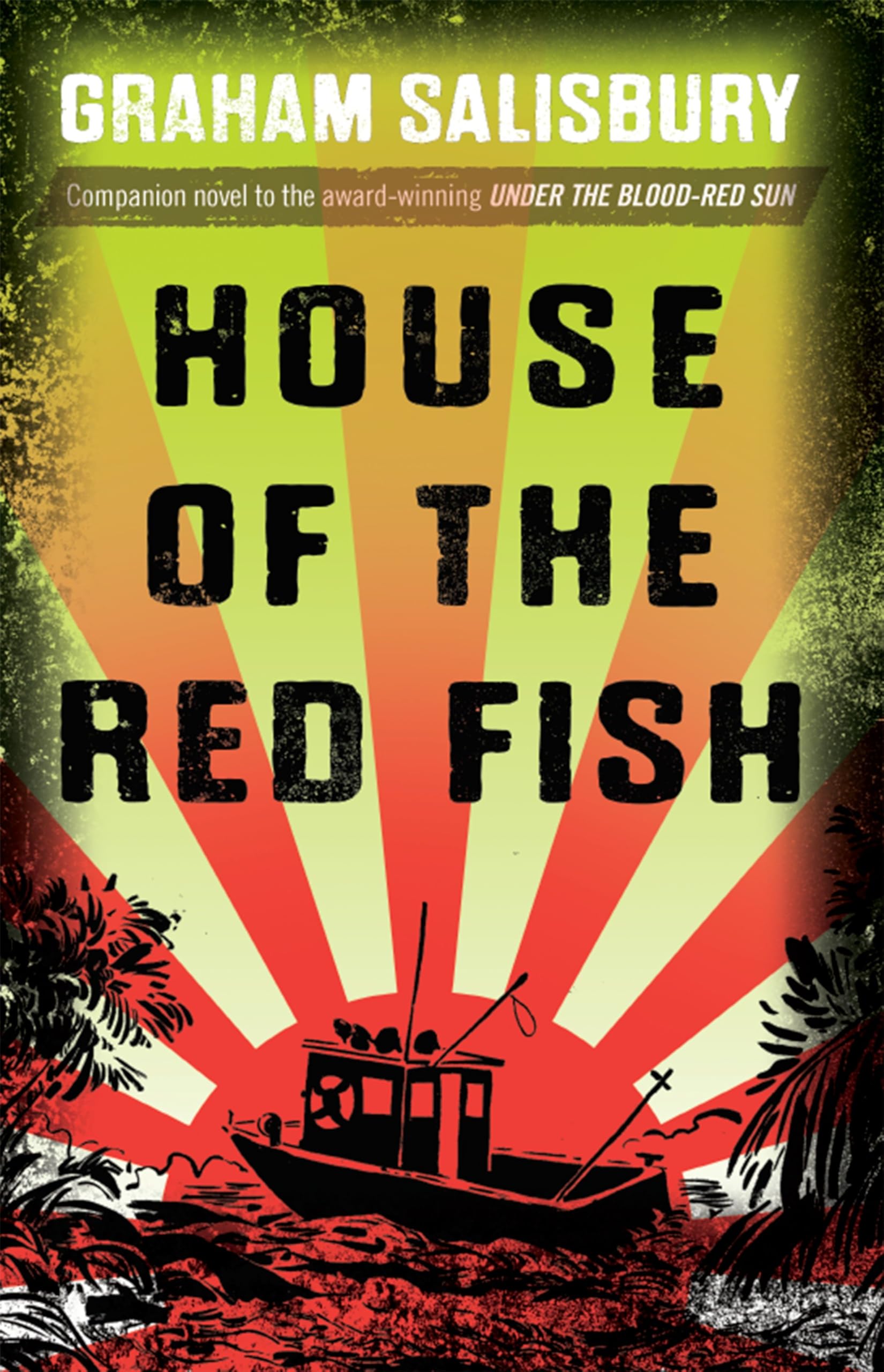



1943, one year after the end of Under the Blood-Red Sun , Tomi’s Papa and Grandpa are still under arrest, and the paradise of Hawaii now lives in fear—waiting for another attack, while trying to recover from Pearl Harbor. As a Japanese American, Tomi and his family have new enemies everywhere, vigilantes who suspect all Japanese. Tomi finds hope in his goal of raising Papa’s fishing boat, sunk in the canal by the Army on the day of the attack. To Tomi, raising Papa’s boat is a sign of faith that Papa and Grandpa will return. It’s an impossible task, but Tomi is determined. For just as he now has new enemies, his struggle to raise the boat brings unexpected allies and friends. “Salisbury paints the tropical setting with vivid details. He writes with balance of the ways in which war touches people, creating characters with fully realized motivations. It is not necessary to have read the first book, as the author seamlessly brings his audience up to date.”–School Library Journal “Many readers, even those who don’t enjoy historical fiction, will like the portrayal of the work and the male camaraderie.”–Booklist Graham Salisbury is the author of several novels. He lives in Portland, Oregon. in the before time One Saturday morning in September 1941, three months before the Japanese bombed Pearl Harbor, the islands lay on the ocean as warm and peaceful as cats sleeping in the sun. Life was still good then, and I’d just started eighth grade at Roosevelt High School. I woke with a jolt, threw on a pair of shorts and a shirt, and ran out of the house, letting the screen door slap behind me. “You need to eat something!” Mama called, coming up to peer through the screen. “Later,” I said, turning to jog backwards. She waved me off and sank back into the darkness of the house. Papa was coming in today. He and his deckhand, Sanji, had been gone for a week, fishing for tuna somewhere beyond the blue horizon. I jumped on a city bus and headed down to Kewalo Basin, the harbor where Papa kept his boat. When I got there the Taiyo Maru sat motionless alongside the pier, its fish unloaded and Papa and Sanji hosing down a week’s worth of fish slime. She was a beautiful boat, bright white to match her name—the Sun—a Japanese-style fishing sampan thirty-eight feet long. “Heyyy,” Sanji said as I jogged up. “Look who’s here, boss. Better put um to work, ah? Make um more fast for me to get home to see my girls.” He meant Reiko, his wife, and their three-year-old daughter, Mari, the two people he lived for. Sanji was only nineteen, by far the youngest father I knew. “Tomi,” Papa said, a big grin on his face. “We cleaning up. Come aboard.” That was exactly what I wanted to do. To work with Papa and Sanji on the Taiyo Maru was one of my dreams. That and playing baseball. In all of life, what else was there besides boats and baseball? Papa stood with his feet spread, coiling a rope. Dark brown from a lifetime on the sea, short haircut, baggy khaki pants. And that grin. “You catch much?” I asked. He wagged his eyebrows. “Best haul we ever had.” “Ho, really?” “Got lucky, this time. The guy counting us our money right now.” Sanji tossed me a scrub brush. An hour later, the boat was squeaky clean. All the equipment was stored in the hold, and the deck was free of fish slime and smelling good again. Sanji jumped off onto the pier and untied the lines. He tossed them over to me. “You know what to do with this ropes?” “Pfff,” I said. “As good as you, any day.” He laughed. “You dreaming, cockaroach.” He looked up at Papa, still on the boat. “Hey, boss, try go get the small glass ball. I forgot um in the drawer by the deckhouse.” Papa dug it out and held it up. “That’s for you,” Sanji said to me. “I foun’ um about ten miles pas’ Kauai. Keep um. I give you.” Papa handed me the glass ball. “Ho, thanks, Sanji.” I held the green net float from Japan up to the sun. Every time I touched one I thought of that faraway country my family came from—Japan, trapped inside the glass, its mystery magnified by the sun. Every now and then you could find them in the ocean, or washed up on the beach. If this one had been covered with barnacles like usual, Sanji had cleaned them off. “Like a good-luck charm,” he said. While Sanji went over to warm up his fish-stinky truck for the ride home, Papa and I walked the boat out into the harbor and tied it to its mooring, a white float chained to a giant block of concrete on the sand below. Papa untied the small skiff he kept secured upside down on the bow. It made a plopping sound when he dropped it down onto the water. I eased over the side into it and set the glass ball on the floorboards. Papa handed me the wooden pigeon crate. He’d taken six of his pigeons to sea. “They all come home?” he asked. “Right on time.” Papa smiled and lowered himself into the skiff, rocking it gently. Every time he went to sea he’d take some of his racing pigeons a few miles out and turn