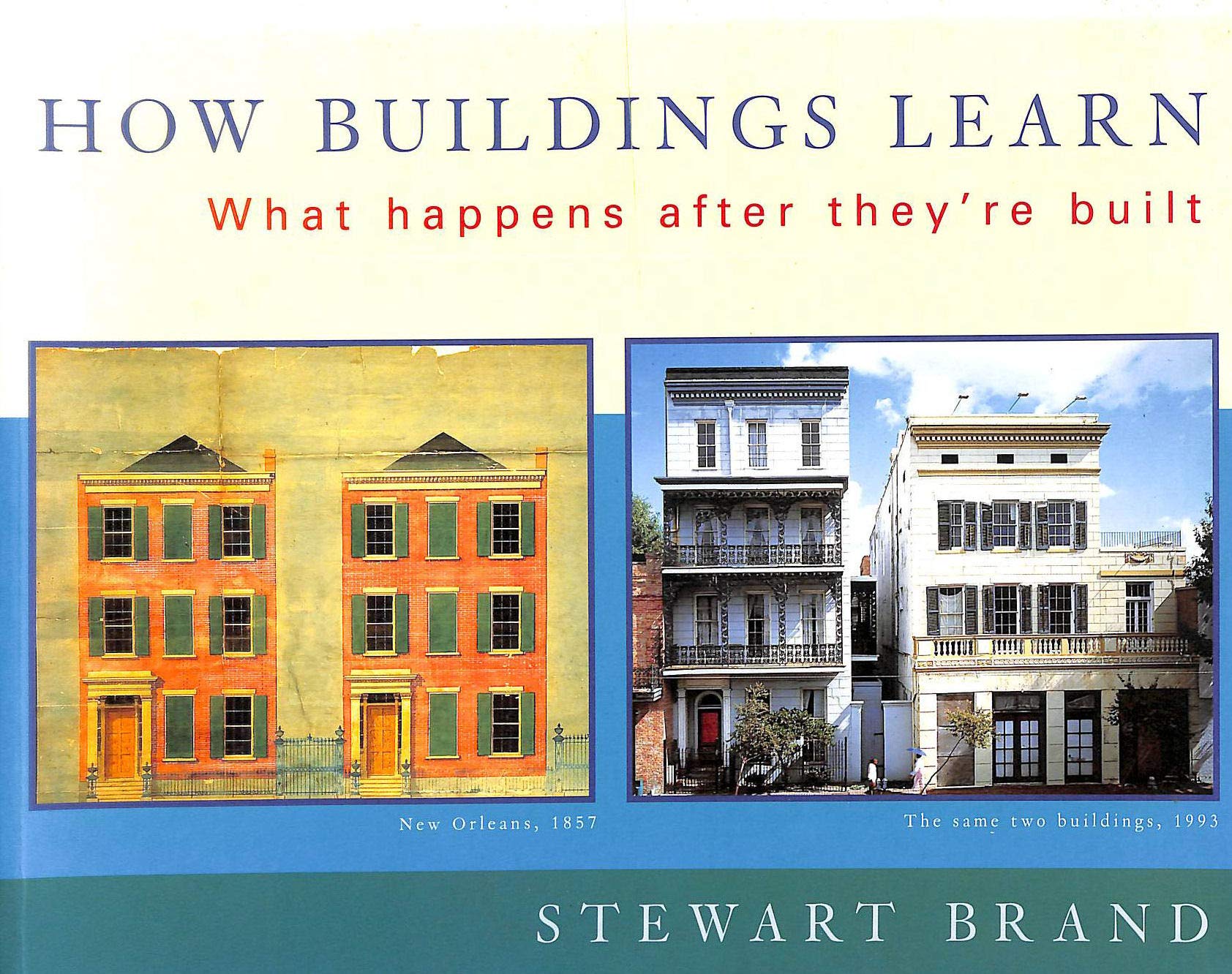



This book on buildings asks the question why so many buildings punish and restrict us because almost none of them adapt well. In real use, buildings need to adapt because their uses are constantly changing. All buildings are predictions, and yet more high-style buildings are designed not to change, not to accommodate new use. A good portion of how buildings learn will be a natural history of how buildings change with time and what things work to make buildings adapt gracefully, what building layouts allow easy redefinition of space and building code considerations that permit remodelling. This practical book aims to integrate all the different aspects of the fragmented design and construction process, so that buildings can be seen as embodying a functional, yet aesthetic and capacious vision, not the conflicts, compromises and conveniences of clients, architects, engineers and contractors, all working in their interests, not the buildings. Though honored as a writerwith the National Book Award for the Whole Earth Catalog , Eliot Montroll Award for The Media Lab , Golden Gadfly Award for his years as editor of CoEvolution Quarterly Steward Brand is primarily an inventor/designer. Trained as a biologist and army officer, he was an early multimedia artist. He has created a number of lasting institutions, including New Games Tournaments, the Hackers Conference, and The WELL, a bellwether computer conference system. He is co-founder of Global Business Network, a futurist research organization fostering "the art of the long view." Brand founder of The Whole Earth Catalog and CoEvolution Quarterly, launches a populist attack on rarefied architectural conventions. A hippy elder statesman (once one of Ken Kesey's Merry Pranksters), Brand argues that a building can ``grow'' and should be treated as a ``Darwinian mechanism,'' something that adapts over time to meet certain changing needs. His humanistic insights grew out of a university seminar he taught in 1988. Catchy anti- establishment phrases abound: ``Function reforms form, perpetually,'' or ``Form follows funding.'' Thomas Jefferson, a ``high road'' builder, is shown to have tinkered his Monticello into a masterpiece over a lifetime. Commercial structures, Brand says, are ``forever metamorphic,'' as a garage-turned-boutique demonstrates. Photo spreads with smart and chatty captions trace the evolutions of buildings as they adopt new ``skins.'' Pointedly, architects Sir Richard Rogers (designer of the Pompidou Centre in Paris) and I.M. Pei (the Wiesner Building, aka the Media Lab at MIT) are taken to task for designing monumental flops that deny occupants' needs. Later sections track the social meanings of preservationism and celebrate vernacular traditions worldwide (e.g., the Malay house of Malaysia; pueblo architecture; the 18th- century Cape Cod House). Brand also documents his own unique habitats. He lives with his wife in a converted tugboat and houses his library in a metal self-storage container. Here, as throughout, Brand's self-reliant voice rings true--that of an engaging, intellectual crank. Brand makes a case for letting people shape their own environments. His crunchy-granola insights bristle with an undeniable pragmatism. -- Copyright ©1994, Kirkus Associates, LP. All rights reserved. "It's about time somebody wrote this book. This quirky, thoughtful volume, bursting with curiosity and intelligence, may make our everyday world more visible to more Americans. Architecture is too important to be left to architects alone." Mixed Media "A stunning exploration of the design of design
How Buildings Learn will irrevocably alter yor sense of place, space, and the artifacts that shape them." Michael Shrage, Wired "Penetratingly original." Philip Morrison, Scientific American "An extremely attractive volume that will forever alter the way we respond to the buildings around us. We may also hope it will alter the way architects design buildings." Harold Gilliam, San Francisco Chronicle "A fascinating and indefinable book
How Buildings Learn is a hymn to entropy, a witty, heterodox book dedicated to kicking the stuffing out of the proposition that architecture is permanent and that buildings cannot adapt." Stephen Bayley, The Times (London) "The book's diagnosis is clear and to the poiny, and its illustrations of how buildings change are both fascinating and instructive. This is, in short, one of the rare books that every architect should read." Thomas Fisher, editor, Progressive Architecture "A book of good sound-bites and laser-sharp insight
No architecture students should complete their preliminary studies without reading it from cover to cover." Patric Hannay, The Architects' Journal