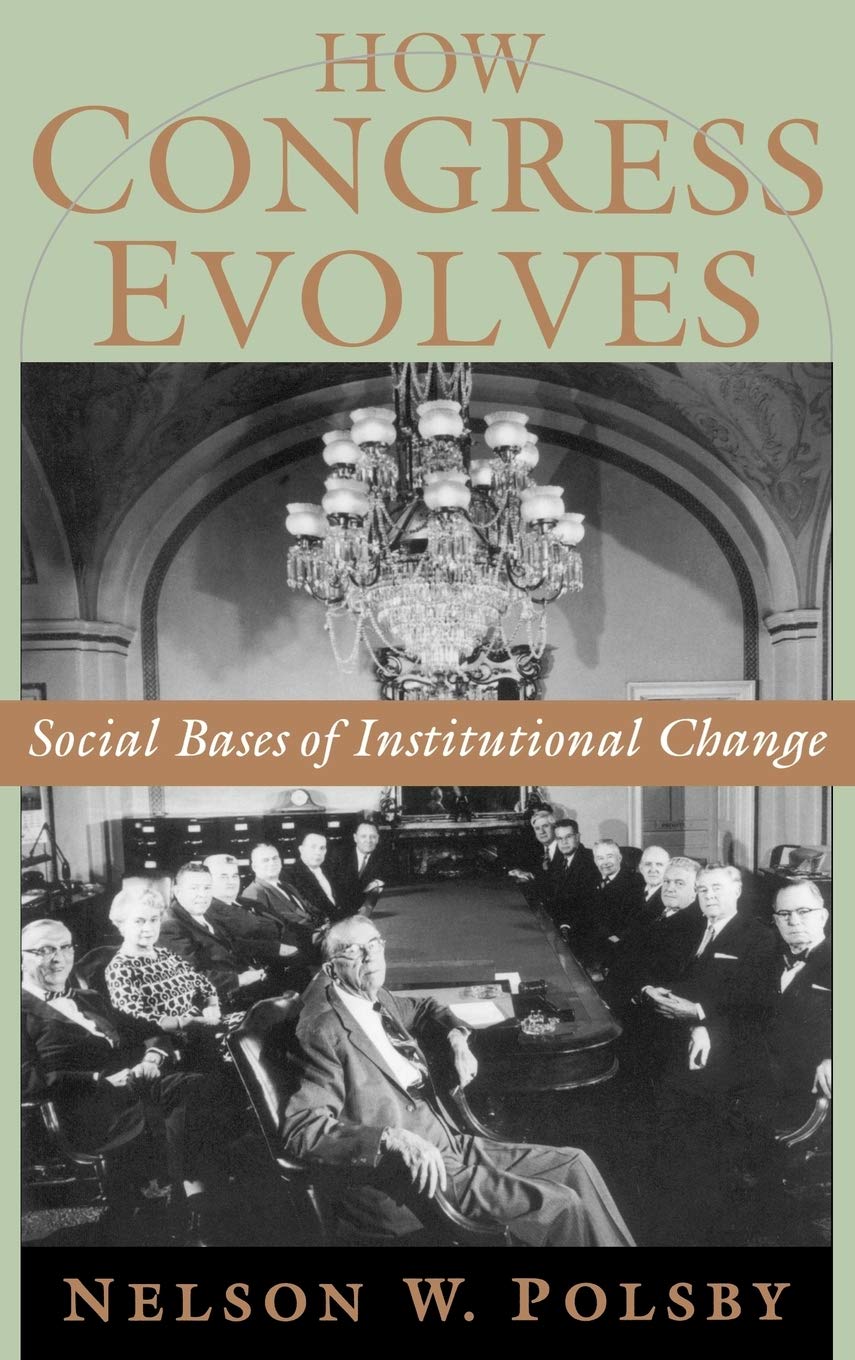



From the end of the New Deal until quite recently, the U.S. House of Representatives was dominated by a conservative coalition that thwarted the Democratic majority and prevented the enactment of measures proposed by a succession of liberal Presidents. Today Presidents aren't necessarily liberal and the House of Representatives is not necessarily the graveyard of presidential proposals. What happened? Congress evolved. It all began with airconditioning. In this entertaining tale of one of our most august institutions, Nelson Polsby describes how the Democratic majority finally succeeded in overcoming the conservative coalition, changing the House. The evolution required among other things, the disappearance of Dixiecrats from the House Democratic caucus. Dixiecrats were replaced by the rise of the Republican party in the south. The Republican party in southern states was strengthened by an influx of migrants from the north, who came south to settle after the introduction of residential air conditioning, which made the climate more tolerable to Northerners. This evolutionary process led to the House's liberalization and concluded with the House's later transformation into an arena of sharp partisanship, visible among both Democrats and Republicans. A fascinating read by one of our most influential political scientists, How Congress Evolves breathes new life into the dusty corners of institutional history, and offers a unique explanation for important transformations in the congressional environment. "A new work on Congress by one of the most prominent scholars of American government in the past half century is a major event.... How Congress Evolves is an intelligent, eminently readable and accessible study that accurately summarizes how Congress has changed in the last half century and the reasons behind that change.... Nelson Polsby has produced another valuable addition to his considerable corpus of scholarship on American government that will assist congressional experts, undergraduate and graduate students, and the politically aware general reader in understanding the contemporary Congress."-- Perspectives on Politics "Polsby's How Congress Evolves is crisply written and argued, moving logically toward an explanation of how Congress changes over time. It should be read by anyone serious about the subject of how political institutions evolve."-- The Weekly Standard "Nelson Polsby always offers a fresh and insightful perspective on Congress. Few observers pull together the historical perspective, and original analysis and trenchant observations as well as Nelson Polsby does." Congressman Lamar Smith (R. Texas) "Nelson Polsby has been studying, reading about and hanging around the U.S. House of Representatives for more than 40 years. In How Congress Evolves , he provides the definitive--and often witty-account of how the House has changed over time, and why." Michael Barone, U.S. News & World Report, co-author, The Almanac of American Politics "Nelson Polsby has given several generations of political scientists and historians a better understanding of that complex body the Congress of the United States. His new book shows us how the House of Representatives has responded to the enormous changes in American life over the past half century. Like its author, it is lively, engaging, and wise." Morton Keller, History Department, Brandeis University "Combining historical breadth and intimate detail, Nelson Polsby explains how and why the U.S. Congress came to change both its ideological makeup and its internal decision-making processes at mid century. An important book by a gifted storyteller, How Congress Evolves is a treatise in its sweep and a memoir in its depth. No other political scientist could have delivered this combination of strengths." Richard Fenno, author of Home Style: House Members in their Districts " How Congress Evolves is Nelson Polsby's magnum opus. Polsby is an institution among congressional scholars and this book will be a classic work on Congress along with the writings of Woodrow Wilson and Richard Fenno. Polsby's wonderful observations from his interviews and deft use of data about stability and change in Congress combined with his humor make the book hard to put down once you start reading it." James A. Thurber, Professor and Director, Center for Congressional and Presidential Studies American University Offers a unique explanation for important transformations in the congressional environment Nelson Polsby is Heller Professor of Political Science at the University of California, Berkeley where he has taught American politics and government since 1967. A close Congress watcher for more than 40 years, he is the author of, among others, Congress and the Presidency , and Presidential Elections (with Aaron Wildavsky, 10th edition.) He is editor of the Annual Review of Political Science and writes often for the Op-ed pages of the LA Times, Boston Globe, New York