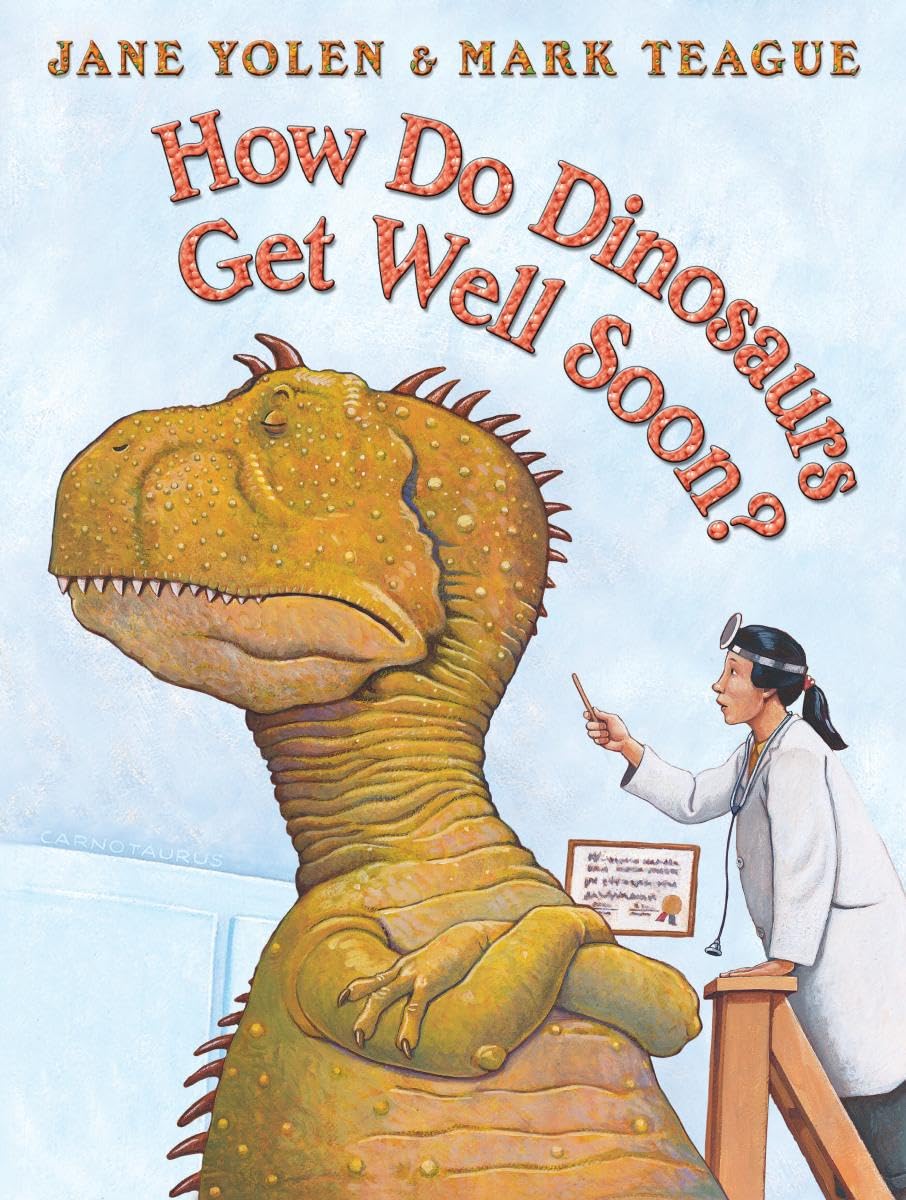



The bestselling, award-winning team of Yolen and Teague are back with another playful dinosaur tale--this time about a sick dinosaur child who catches the flu and must go to the doctor. What if a dinosaur catches the flu?Does he whimper and whine between each "At-choo"?Does he drop dirty tissues all over the floor?Does he fling his medicine out of the door?Just like kids, little dinosaurs hate being sick. And going to the doctor can be pretty scary. How DO dinosaurs get well soon? They drink lots of juice, and they get lots of rest; they're good at the doctor's, 'cause doctors know best. As in their previous book, Yolen and Teague capture children's fears about being sick and put them to rest with playful read-aloud verse and wonderfully amusing pictures. Following up their bestseller How Do Dinosaurs Say Goodnight? , Caldecott Medal winner Jane Yolen and illustrator Mark Teague have penned this instructive lesson on dinosaur health care. Each double-page spread features one enormous dinosaur looking wan and sniffly but mostly cranky, petulant, ornery, sullen, and disagreeable. The human moms and dads are visibly worried and/or frustrated by their sick dinos behaving badly. Witness the nice lady dragging her gigantic Styracosaurus out of the elevator and across the hall to the doctor's office: "What if a dinosaur goes to the doc? Does he drag all his feet till his mom is in shock?" The look on this mom's face will be familiar to anyone who's ever forcibly moved a child, who seems to have suddenly gained a million pounds, from one place to another. And of course, it turns out that dinosaurs don't misbehave when they're sick: "He drinks lots of juice, and he gets lots of rest. He's good at the doctor's, 'cause doctors know best." The rhymes are somewhat forced, especially toward the end of the book, but Teague's marvelous paintings are bright and expressive throughout. Each dinosaur is cleverly labeled, and these aren't your run-of-the-mill dinos; dinosaur-obsessed little ones will crow over Parasaurolophus , Euoplocephalus , and Tuojiangosaurus . They'll also learn a little something about how to behave when they're sick. --Jennifer Lindsay PreSchool-Grade 1-Eleven under-the-weather young dinosaurs are featured in this amusing health-etiquette book, a companion to Yolen and Teague's How Do Dinosaurs Say Good Night? (Scholastic, 2000). Whimpering, littering with dirty tissues, flinging medicine, and tossing covers are presented as questionable at-home activities. At the doctor's office, dragging one's feet, refusing to open one's mouth, screaming, and hiding are all frowned upon. Drinking lots of juice, resting, using a hankie, and taking medicine are positive behaviors. A simple rhyme with many words that beginning readers will recognize moves the text along. Teague's funny, full-color illustrations are dominated by the creatures and lift the lightly didactic to the highly entertaining as human parents care for their dino charges in children's bedrooms filled with toys, clothes, shoes, books, and a nervous cat, or in a doctor's office. As each ailing creature is introduced, readers will look for the name of that species tucked somewhere within the full-page spread. A great addition for dinosaur fans and a reassuring story for young flu and cold victims. Jody McCoy, The Bush School, Seattle, WA Copyright 2003 Reed Business Information, Inc. *Starred Review* PreS-Gr. 1. Kids aren't the only ones who get sick. The dynamic dinos who first appeared in How Do Dinosaurs Say Goodnight? (2000) aren't feeling well, and it's up to their parents, doctors, and nurses to help them mend. The jaunty text begins by cataloging a litany of things a dinosaur might do when it has the flu: "Does he drop dirty tissues all over the floor? Does he fling all his medicine out of the door?" And what if the dino needs to go to the doc? "Does he drag all his feet till his mom is in shock?" The rhyme is basic but effective as it explains what a dinosaur does to get better. Teague, always tops when it comes to mining humor in art, does a great job here. The oversize dinosaurs, vividly colored and dramatically drawn, fill up the room, dwarfing the helpful adults who are trying to bring aid and comfort. The book also gives a nod to kids fascinated by the creatures: each dinosaur's name is tucked somewhere into the picture. The large paintings and short text make this an excellent choice for story hours, but the book may be most enjoyed one on one, especially by listeners experiencing a few coughs and sniffles of their own. Ilene Cooper Copyright © American Library Association. All rights reserved Those scaly overgrown children from How Do Dinosaurs Say Goodnight? return to teach an agreeable lesson in how best to comport oneself when sick. Here, as in the first book, the humor comes from Teague's placement of hulking brachiosaurus, velociraptor, and others into ordinary, kid-size environments. "What if a dinosaur catches the