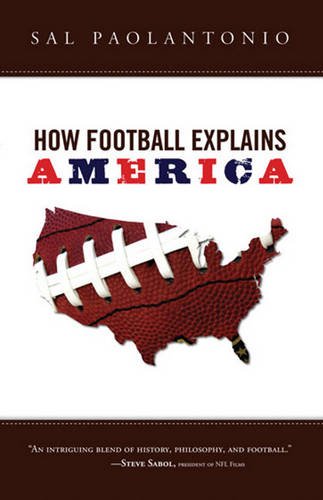



Using some of the most prominent voices in pro sports and cultural and media criticism, How Football Explains America is a fascinating, first-of-its-kind journey through the making of America's most complex, intriguing, and popular game. ESPN’s Sal Paolantonio’s explores just how crucial football is to understanding the American psyche. Interspersed with memorable images from the climax of Super Bowl XLII, Paolantonio tackles varying American themes from Manifest Destiny to “fourth and one” as he goes deep in order to answer the age-old question Why does America love football so much? An unabashedly celebratory explanation of America’s love affair with the game and the men who make it possible, this work sheds light on topics such as how the pioneers and cowboys helped create a game that resembled their march across the continent, why rugby and soccer don't excite the American male like football does, how rule changes are continually made to enhance the dramatic action and create a better narrative, the eternal appeal of the heroic quarterback position, the military lineage from General Douglas MacArthur to the New York Jets’ head coach Eric Mangini, and how the burgeoning medium of television identified and exploited the NFL’s great characters. It is a must read for anyone interested in more fully understanding not only the game but also the nation in which it thrives. Paolantonio, a television football correspondent, opens with an intriguing question: Why does conventional wisdom say that it was television that made football so popular, when other countries that have television are not the slightest bit interested in the game? What if the truth was exactly the opposite—football helped make television? The book relates the evolution of the sport to the evolution of the country: just as America declared its independence from England, so American footballers redesigned the game and made it independent from the British import, rugby. And just as immigrants to the U.S. helped build the country, so various ethnic groups helped build football. The parallels between football and combat are obvious, but Paolantonio doesn’t hammer at them, preferring instead to talk about the way the sport captured the interest of its fans to a degree that few recreational pursuits ever equaled. The hyperbole of its title aside, this volume has surprisingly insightful things to say about football as a sociocultural phenomenon. Expect some interest beyond football fans. --David Pitt "So it turns out that Sal Paolantonio doesn't just talk about football on television, he really thinks about it! His book is a breezy, conceptual tour through the history of America and of football, showing they are, in fact, one and the same. From war to jazz, from racism to integration, from immigrant waves of Scotch Irish to Tonga Islanders, from dioramas in the display windows of newspapers to Monday Night Football, from Jim Thorpe to Eli Manning, the story of the game mirrors the story of our country. Who knew? All those lazy Sunday afternoons on the couch were really anthropological research. I'm giving this book to my wife!" --Mark Bowden, author of The Best Game Ever: Giants vs. Colts, 1958, and the Birth of the Modern NFL and Black Hawk Down: A Story of Modern War "Sal Paolantonio's How Football Explains America is brimming with excellent reporting, intellectual breadth, personal insight, and a deep affection for our real national pastime. This is fascinating stuff." --Mark Kriegel, author of Namath: A Biography, and national columnist, FOXSports.com "I have been a student of football my whole life, and this book gave me a completely original perspective on the game we call our national pastime. Sal Paolantonio has captured the essence of why we love football." --Ron Jaworski, analyst, ESPN's Monday Night Football Sal Paolantonio is a national correspondent for ESPN, covering the NFL for SportsCenter , Sunday NFL Countdown , and ESPN.com. He also hosts ESPN's State Farm NFL Matchup on Sunday mornings. He is a former sportswriter and political correspondent for the Philadelphia Inquirer and served as an officer in the U.S. Navy. He lives with his family in Moorestown, New Jersey.