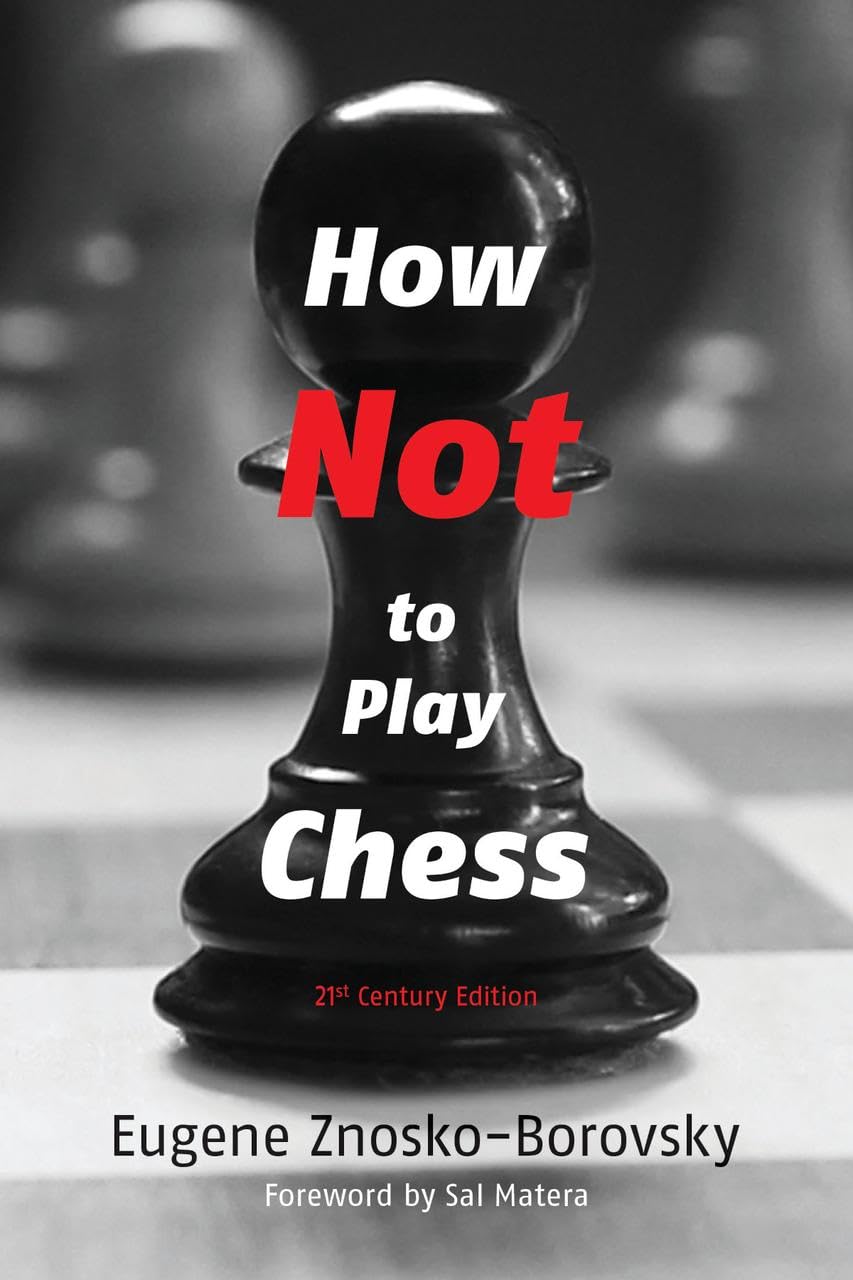



A Guiding Light for the Royal Game Almost 100 years ago, one of the classics of chess literature was published in French. It was How Not to Play Chess by Eugene Znosko-Borovsky. It clearly and very simply set forth the basic principles of the game and was immediately embraced by chessplayers worldwide. That first edition – originally in French – was translated into many languages and became a staple of chess instruction everywhere. However, it is not widely known that there were two more editions. The second edition was published in 1937. The final, third edition was released in 1948. Now, for the first time, this expanded third edition has been translated into English. Many diagrams have been added and algebraic notation is used. The result is a brilliant manual for the modern generation of chessplayers. "Znosko-Borovsky, whom I consider one of the great chess teachers, explains the hard work and mindset required to improve your chess ability. The advice and wisdom he offers is relevant for both beginners and grandmasters. In truth, this book describes a process of study. I was delighted to reread How Not to Play Chess -- this time in a refreshing new translation of the third and final edition. Once again, the book energized me. I wish you all well on your chess journey and believe that this gem will act as a guiding light." -Sal Matera, from the Foreword "Znosko-Borovsky, whom I consider one of the great chess teachers, explains the hard work and mindset required to improve your chess ability. The advice and wisdom he offers is relevant for both beginners and grandmasters. In truth, this book describes a process of study. I was delighted to reread How Not to Play Chess -- this time in a refreshing new translation of the third and final edition. Once again, the book energized me. I wish you all well on your chess journey and believe that this gem will act as a guiding light." -Sal Matera, from the Foreword Eugene Znosko-Borovsky (1884-1954) was a Russian master who eventually settled in Paris. He enjoyed some success playing internationally. However, his main claim to fame in the chess world was as an instructor and author. His books were – and still are – considered some of the best instructional manuals ever written. Do not leave any piece without a purpose, disconnected from the position. First, look at whether your pieces have prospects, whether they could occupy better squares and files. Although very well placed, it could be that they have no good move to make, that it is not possible for them to occupy stronger squares or coordinate with other pieces. Even so, it is essential to organize such a connection. Consider this: an isolated piece, disconnected from the others, may be the reason for your loss. It is easy to see the difference between a mechanical, completely impersonal analysis, all about calculation, and an interior analysis, more qualitative than quantitative and more difficult as a result. Great players, armed with a fertile mind and vast experience, completely ignore the first and only perform the second. Even so, by neglecting the fundamentals of a position, they often commit serious errors. You know that they do not always perceive in the same way the positions that arise in their games. So be careful. Analyze your position in the order and manner that we have indicated; exterior first, then interior. Tell yourself that this assessment is even more necessary if you have little experience. Your judgment will therefore be soundly motivated, as the laws of mechanics cannot be wrong. Of course, it is a task that will demand a lot of time to start with, but then this task will become easier. The more often you repeat it, the easier you will see the characteristic elements of a position that you would not have uncovered otherwise. This two-fold analysis also offers the advantage that it can be performed while your opponent is thinking, so without any loss of time. As it is difficult to do in the heat of battle, it is necessary to take advantage of moments of calm to finish it completely, such as when your pieces are all developed. This two-fold analysis, we have said, allows you to uncover all the characteristics of a position. Let us add that it must be supplemented by what can be called individual analysis. This concerns the essential aspects of a position. Sometimes it is just one thing that catches the eye: a far advanced pawn for example. Nevertheless, it is the important aspects that are neglected too often: the color of the bishop or the crucial fact of having castled on one side or another. Every move must be assessed considering these features. If we do not see them in time or if we do not give them enough attention, we are lost.