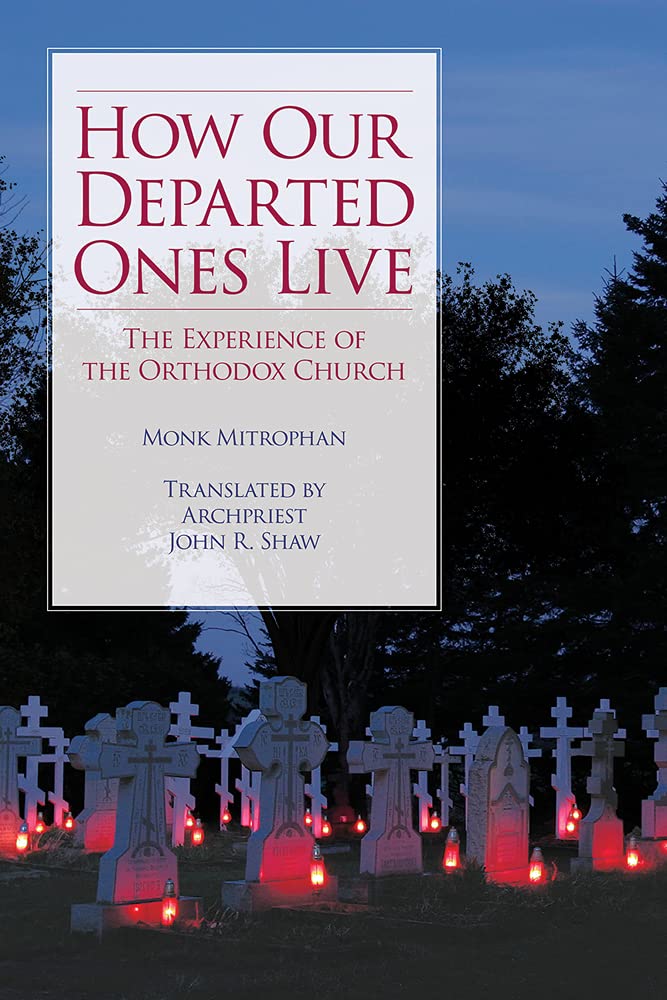



"Our Lord Jesus Christ is the Conqueror of death, and, consequently, of the death of our departed ones. Let us say to them in Him, not 'Farewell,' but 'Until we meet again, beloved spouse, good parents, dear brother or sister. Until we meet again!'" While many are now abandoning traditional religious practice, none the less, the reality of death and questions regarding the afterlife remain at the forefront of spiritual consciousness. How Our Departed Ones Live is the answer to those who seek the truth as expressed through the experience of the Orthodox Church. This comprehensive book discusses the source of death and mortality, the inner connection and mutual relationship between the living and the departed, intercession by the living for the departed, and life beyond the grave. It will comfort the grieving and inspire all Christians to strengthen their resolve as they seek first the Kingdom of God, and His righteousness. "More than just a book about death, this book is a catechism of the Orthodox Church. It provides a view of our faith, not from this world, but as if looking back from the next, revealing not how things are, but how things were meant to be, how they went wrong, how they are repaired, and the various results of all these events. This is a book for those who wish to know not only about the next life, but about this life and how to live in it. Truly this is a book that goes far, far beyond its title." —Archpriest David Moser "A long lost book written by a Russian monk some 130 years [ago] . . . has the power not only to shield, but to erase, that unfortunate 'sorrow of death' so ubiquitous in our American culture today." —Gregory Winsky, Esq, blogs.ancientfaith.com Monk Mitrophan was Russian Orthodox monk of the Konevets Monastery. John Robert Shaw is a liturgist, Slavist, and polyglot. In 2008 he was tonsured a monk with the name Jerome and subsequently consecrated as Bishop of Manhattan. How Our Departed Ones Live The Experience of the Orthodox Church By Monk Mitrophan, John R. Shaw Holy Trinity Publications Copyright © 2015 Holy Trinity Monastery All rights reserved. ISBN: 978-0-88465-401-8 Contents Foreword: The Story of the Rebirth of This Book, Translator's Preface, Introduction to the English Edition, FIRST PART Death in Relation to Immortality: Concerning Death, SECOND PART The Inner Connection and Mutual Relationship Between the Living and the Departed, THIRD PART The Dogmatic Teaching of the Church Concerning Intercession by the Living for the Departed, and Requesting Forgiveness for the Sins of Certain Sinners, FOURTH PART Life Beyond the Grave: Its Inner Connection with the Preceding Sections, Appendix 1 Reviews of the Original Russian Book, Appendix 2 Reviews of the French Language Edition, Acknowledgements, CHAPTER 1 FIRST PART * * * Death in Relation to Immortality Concerning Death 1. The Origin of the Word and Concept of "Death" The word and concept of death first appeared on earth in the Garden of Eden, from the lips of God Himself, Who said to our first ancestors: "In whatsoever day ye shall eat of it, by death ye shall die." 2. The Appearance of Death on Earth It is not known how long Adam and Eve lived in Paradise. The enemy's spite was not long in coming. All theologians are in agreement that the first man was a higher being, the likeness of the angels, and even the likeness of God; a being dedicated to divine Revelations and in all branches of knowledge moral and sinless. The present moral decline, progress for the worse or regress, is the result of ancestral sin. Concerning the higher perfection of our ancestors one can judge from the fact that they were given no commandments, no moral laws such as we have been given, but only the easiest commandment. Probably all of the main laws of the spirit were already in the soul of man; it cannot have been otherwise. If man was set as king over all things visible, then he was the crown of God's creation. The spirit was not weighed down by the flesh, and our forefather did not cry out as did St. Paul, "Who shall deliver me from this body of death?" But this moral downfall that St. Paul bewailed arose from the fall of Adam. With the fall of Adam, death of body and soul appeared on earth; "for by one man, sin entered the world, and through sin, death" (Romans 5:12), as the same St. Paul bears witness. Thus death became the inheritance of our forefathers, and therefore of all mankind. Who does not know this concept and word: death? The savage and the educated man know it equally. All humanity knows two truths: first, that we shall die, and second, no one knows when. 3. The Definition of Death As mysterious and incomprehensible as is the joining of the soul and body in the mother's womb, equally mysterious is the separation of the soul and body. It is God's commandment that everyone be ready for death at all times. This is the common lot of humanity, as a punishment for sin