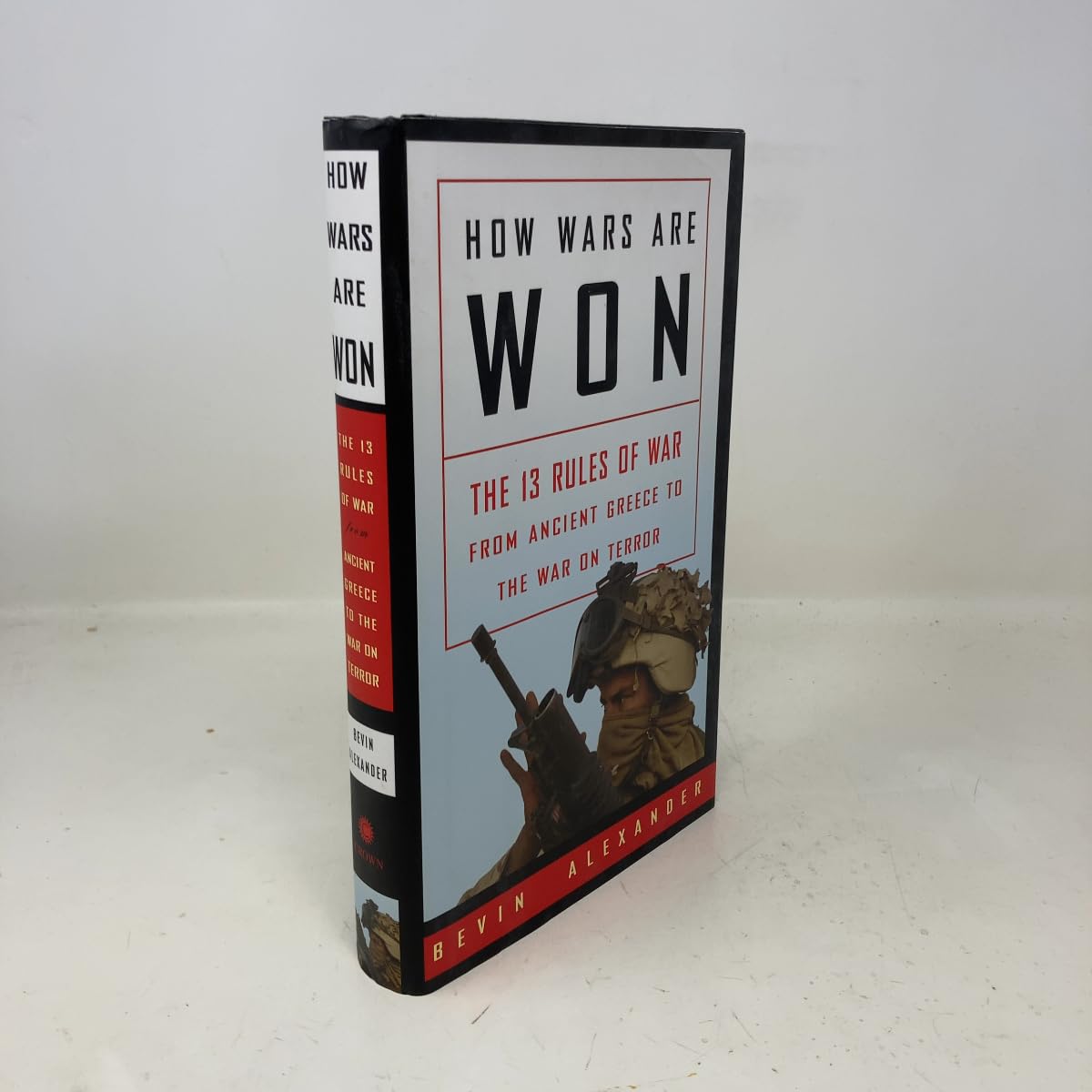
How Wars Are Won: The 13 Rules of War - from Ancient Greece to the War on Terror
$19.99
by Bevin Alexander



Both timely and timeless, How Wars Are Won offers a fascinating look at the history of warfare and the thirteen essential rules for achieving victory that have evolved from ancient times to the present day. Acclaimed military historian Bevin Alexander opens with an incisive, historically informed diagnosis of the new threat posed by terrorism. Based on interviews with war planners for the U.S. military, he introduces the battle tactics currently being developed and the ways in which new high-tech weaponry will be deployed. He also explains the ways in which the time-tested rules for waging war will remain relevant, and which of these rules will be most important in the new kind of warfare. Turning to the thirteen essential rules of battle, Alexander devotes a chapter to each, offering riveting accounts of four or five crucial historical battles that were won or lost because of either the brilliant or the disastrously unsuccessful application of that rule. Highlighting the crucial command decisions of the masters—including Alexander the Great, Genghis Khan, Napoleon Bonaparte, Stonewall Jackson, Erwin Rommel, and Douglas MacArthur—he brings the drama and challenge of military command vividly to life. The rules include: • Feign retreat: Pretend to be defeated, fake a retreat, and then ambush your enemy when you’re being pursued. This rule is especially relevant to guerilla-style warfare and was used to devastating effect by the North Vietnamese against U.S. forces during the Vietnam War. • Strike at enemy weakness: Avoid the enemy’s strength entirely by refusing to fight pitched battles, an alternate method running alongside conventional war from the earliest days of human conflict. It’s the most successful form of war but has been little recognized until recent years. This rule was followed brilliantly by Mao Zedong to defeat the Chinese Nationalists. • Defend, then attack: Gain possession of a superior weapon or tactical system, induce the enemy to launch a fruitless attack, then go on the offensive. This rule was employed repeatedly by the Eastern Roman general Belisarius against the Goths to reclaim vast stretches of the Roman Empire. From Crécy and Waterloo to Gettysburg and Austerlitz, Alexander’s accounts of famous battles offer fresh, surprising insights into the pivotal command decisions that won the day. How Wars Are Won also tells the fascinating story of the ways in which new technologies have consistently created both new oppor- tunities and troubling challenges in warfare, being employed to ingenious effect by some commanders while remaining horribly misunderstood by others. Heading into twenty-first-century warfare, we must use the lessons of history to guide us in shaping the strategies and tactics we need to win. How Wars Are Won is essential reading for all who are keen to understand the challenges of this new kind of war and how the wisdom of the past masters can be applied today. Using the works of Sun Tzu as a framework, Alexander has formulated 13 rules by which wars are won: striking at enemy weakness, feigning retreat, striking at a weak spot, etc. He devotes a chapter to each rule, describing famous battles that serve as examples of his rules in action, and then concludes each chapter with a post-9/11 implication as to the rule's application to the future of warfare. Some of Alexander's works, such as Lost Victories and How the Great Generals Win, show much original insight; others, like The Future of Warfare and How Hitler Could Have Won World War II, are not exceptional. The present work could be seen as a sequel to How the Great Generals Win, as it describes many of the same battles, and, logically, the great generals (from Napoeon and Genghis Khan to U.S. Grant and Erwin Rommel) utilized many of these principles for victory. His implications for the future are not especially thought-provoking, but this book can still serve as an excellent introduction to his work. Alexander's writing style is fluid, and his insights into many of the battles original. Recommended for military collections. Richard Nowicki, Emerson Vocational H.S., Buffalo, NY Copyright 2002 Reed Business Information, Inc. Alexander brings one of the oldest subjects of military history up to date usefully if not always outstandingly, for he tries to have his cake and eat it, too, by claiming that we are living in a wholly new era of warfare (i.e., war by terror) and that Alexander the Great and Napoleon can teach us profound and universal lessons. Alexander's strongest influence appears to be Sun Tzu, and some familiarity with that martial sage, whose Art of War seems to be translated anew every third year, aids in understanding and profiting from this book. Alexander's clear writing, thorough research across three millennia of world military history, and incorporation of recent events in the Balkans and Afghanistan when evaluating prospects and possibilities all strongly recommend the book. Still, for a ser