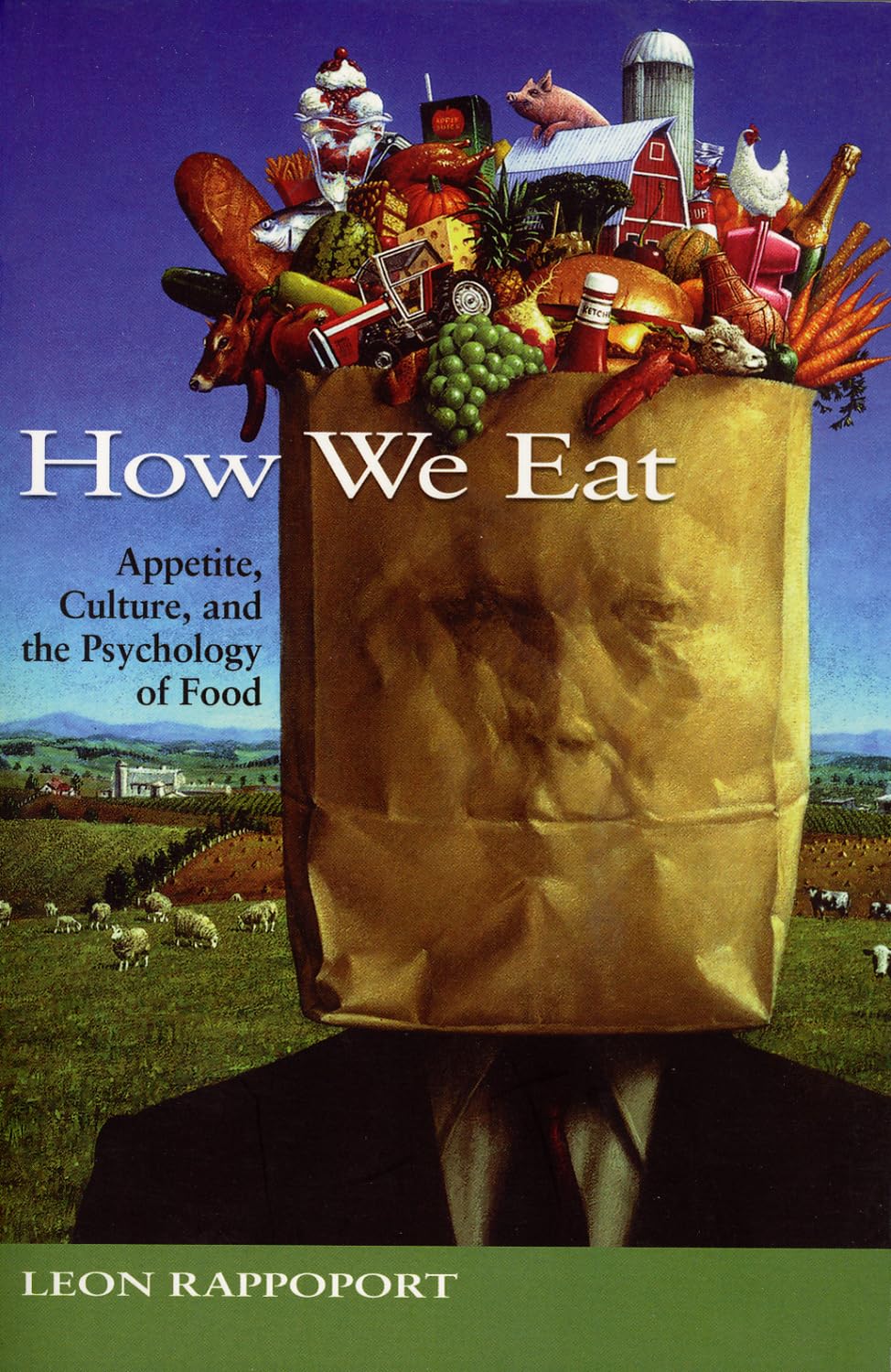



An informative look at the history of eating that’s a tasty combo of fact and fun We enjoy watching celebrity chefs on TV, but so few of us choose to cook at home. The gourmet health food industry is soaring, yet a longtime love affair with fast food endures. Food and eating habits — good and bad — have shaped cultures, accounted for behaviors, and created a sense of individual as well as cultural identity… but how? And why? Social psychology professor Leon Rappoport treats the dinner table like the therapist’s couch, asking us to lie back and spill our guts. Tracing our culinary customs from the Stone Age to the microwave, from the raw to the nuked, How We Eat illuminates our complex and often contradictory eating habits. Along the way, we meet with the hugely successful Fanny Farmer and Betty Crocker, encounter a murder case in which a Twinkie was suspect number one, learn about the table manners of cannibals, and, ultimately, that perhaps we truly are what we eat. "The focus of [this book] is welcome fun to peruse..." -- Gastronomica Leon Rappoport, Ph.D., was a social psychology professor at Kansas State University, where there is a memorial in his name for his devotion to the Department of Psychological Sciences and its students. How We Eat is the fourth book by Dr. Rappoport. How We Eat Appetite, Culture, and the Psychology of Food By LEON RAPPOPORT ECW PRESS Copyright © 2003 Leon Rappoport All rights reserved. ISBN: 978-1-55022-563-1 Contents Acknowledgments, INTRODUCTION A Half-Baked Notion, CHAPTER 1 From Myths to MacAttacks, CHAPTER 2 You Are What You Eat, CHAPTER 3 Feeding Frenzies, CHAPTER 4 The McDonaldization of Taste, CHAPTER 5 From the Raw to the Cooked to the Haute Cuisine, CHAPTER 6 Champagne Slippers, the Twinkie Defense, and He-Man Diets, CHAPTER 7 The Road to Wellville, CHAPTER 8 Concluding Reflections, Sources, Index, CHAPTER 1 From Myths to MacAttacks There is an embarrassing emperor's-new-clothes question about food behaviors that sooner or later imposes itself on anyone who takes this subject seriously: what is food? The question comes up partly from both research and common experiences showing that items considered to be good food, or even special delicacies in one group, culture, or subculture, are considered by others to be unfit for human consumption. It is often found more dramatically in the memoirs of world travelers and explorers. In The Oregon Trail, for example, Frances Parkman describes in striking detail the first time he ate a puppy dog. He was a guest in an Indian lodge at Fort Laramie when his host's oldest wife entered, carrying a tomahawk: "I had observed sometime before a litter of well grown black puppies, comfortably nestled among some buffalo-robes at one side; but this newcomer speedily disturbed their enjoyment; for seizing one of them by the hind paw, she dragged him out, and carrying him to the entrance of the lodge, hammered him on the head till she killed him. Conscious to what this preparation tended, I looked through a hole in the back of the lodge to see the next step of the process. The squaw, holding the puppy by the legs, was swinging him to and fro through the blaze of a fire, until the hair was singed off. This done, she unsheathed her knife and cut him into small pieces, which she dropped into a kettle to boil. In a few moments a large wooden dish was set before us, filled with this delicate preparation. A dog feast is the greatest compliment a Dacotah can offer to his guest; and knowing that to refuse eating would be an affront, we attacked the little dog and devoured him before the eyes of his unconscious parent." There is no mistaking Parkman's studied sense of repulsion at this scene. It was all the more impressive, therefore, to discover in Undaunted Courage, Steven Ambrose's account of the 1804 Lewis and Clark expedition from St. Louis to the Columbia River, quotations from the journal of Meriwether Lewis indicating that he and his men had acquired a taste for dog meat and preferred it to the game and horse meat they often lived on. My own experiences with the cultural relativism of cuisine have been relatively trivial. While I was stationed in Germany in 1955, my wife bought some corn on the cob at the army commissary. When our German landlady happened to see it, she made a face, calling it "pig food." Several years later, the shoe was on the other foot: while we were on a research fellowship in Oslo, a Norwegian colleague invited us to a traditional holiday meal of ludefisk (boiled dried cod), which we were just barely able to get down. My wife threw it all up when we got home. The moral of the story is that the body does not swallow cultural relativism as easily as the mind. For their part, nutrition experts and other authorities never seem to bother much with the question of just what is food; they are apparently content with the commonsense notion that food is simply the s