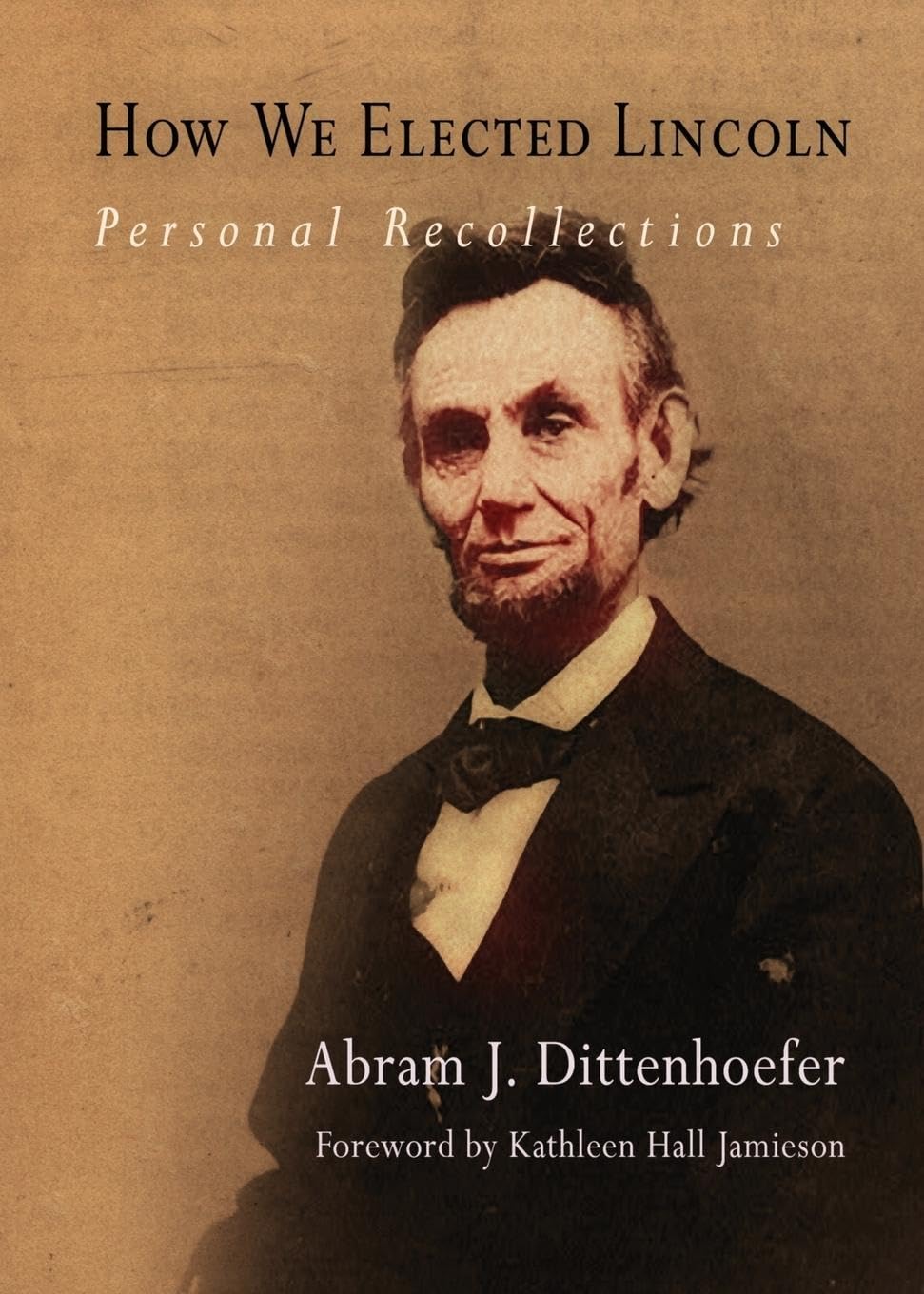



Abram J. Dittenhoefer was a young South Carolinian who embraced abolition and moved to New York in order to work for the newly formed Republican party and its antislavery platform. Even though he was in his early twenties, he quickly established himself as a savvy and creative campaigner, and when he encountered Abraham Lincoln in New York City on February 27, 1860, a mutual friendship and trust were established. Soon, Dittenhoefer became a member of Lincoln's political circle, and he helped direct both of Lincoln's successful bids for the presidency. In How We Elected Lincoln , originally published in 1916 and appearing now for the first time in paperback, we have the only firsthand account of Lincoln's political campaigns. Here Lincoln emerges as a real human being, full of doubts and convictions, while the usual dry-as-dust recitation of political facts is transformed into heated, vivid, nail-biting episodes. Lincoln was an underdog in both of his elections, and Dittenhoefer conveys the extreme tension and acrimony of each campaign. Drama surrounds this wartime president who faced a grueling reelection campaign at the same moment he was grappling with the darkest moments for his Union cause. Faced with competition within his own party, Lincoln resigned himself to defeat but continued to make astute decisions. The sudden success of Ulysses S. Grant on the battlefield in the autumn of 1864 turned the tide for both the Union Army and Lincoln's fortunes with the electorate. According to Dittenhoefer, Lincoln's greatest legacy was the eradication of American slavery, and in this compact account the author shows from direct experience the difficulties and resistance Lincoln encountered while working to achieve his goal. "Dittenhoefer's vivid account recalls my own recollections of those days." ― Robert T. Lincoln Abram J. Dittenhoefer (1835-1919) was a lawyer, jurist, and author who served as Justice of the City Court for New York. Kathleen Hall Jamieson is Director of the Annenberg Public Policy Center at the University of Pennsylvania and coeditor of Electing the President, 2004, available from the University of Pennsylvania Press. Foreword Kathleen Hall Jamieson Just after the election of 1856, the Supreme Court, in the Dred Scott case, stepped into an ongoing Congressional debate to rule that Congress could not bar slavery in the territories. Nor, said the decision, could the legislatures in the territories themselves. The year before the election of 1860, John Brown's attempt to inspire a slave rebellion led to his execution. In 1860 there were four major candidates for president: Abraham Lincoln, heading the Republican ticket; Stephen A. Douglas, the champion of the popular sovereignty Democrats; John Bell, of the Constitutional Party; and John C. Breckinridge, the nominee of the Southern Democrats. Breckinridge favored protecting slavery in the territories. The contest came down to Lincoln vs. Breckinridge, South vs. North and West. Indeed, Lincoln and his running mate, Hannibal Hamlin, did not even appear on ballots in the South. After a bitter election Abraham Lincoln won the Electoral College decisively by carrying the states of the West and North. But, taken together, the three other contenders garnered a larger popular vote than did "the Rail Splitter" from Illinois. The composition of the vote forecast the future. Here was a nation divided by region. Eighteen slave-free states supported Lincoln; eleven slave states backed Breckinridge. Douglas, who memorably had debated Lincoln over slavery and union in their earlier contest for the Senate, received only 12 electoral votes. In December 1860, after the ballots had been cast but before Lincoln had been officially notified of his election, South Carolina seceded from the union. The Charleston Mercury 's headline declared on December 20 of that year, "The Union Is Dissolved." Other states followed. On February 26, 1861, Abraham Lincoln replied to the Committee of Congress reporting the Electoral Count by writing "with deep gratitude to my countrymen for this mark of their confidence; with a distrust of my own ability to perform the required duty under the most favorable circumstances, now rendered doubly difficult by existing national perils; yet with a firm reliance on the strength of our free government, and the ultimate loyalty of the people to the just principles upon which it is founded, and above all an unshaken trust in the Supreme Ruler of the nations, I accept this trust." In his March 4, 1861 inaugural address Lincoln declared, "In your hands, my dissatisfied fellow countrymen, and not in mine, is the momentous issue of civil war. . . . You have no oath registered in heaven to destroy the Government, while I shall have the most solemn one to 'PRESERVE, PROTECT, AND DEFEND IT.'" Fortunately for Lincoln, the mass audience was far more likely to read his words than hear them. Until the advent of radio more than a half century later,