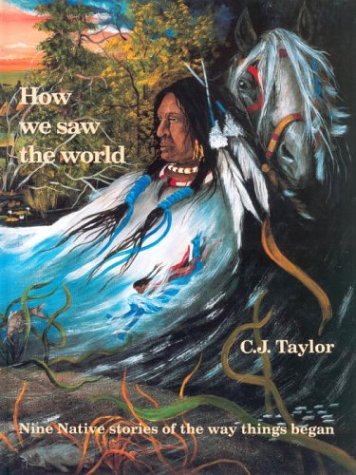



All peoples have their own stories of how the Earth was created, what separated the land from the seas, and how the many animals, fish, and other creatures came to have their particular characteristics. The native tribes of North America are no different: they too have stories about the “way things began.” A fascinating collection of tales that explain the origins of tornadoes, forest fires, butterflies, horses, Niagara Falls, why dogs are our best friends, and even a very funny story of why owls and rabbits look the way they do. Grade 2-5-An anthology of nine tales from different Native American traditions that explain how various physical and living aspects of the world came into being. Some are humorous, like the Mohawk story, "Why Rabbits and Owls Look the Way They Do." Others are moralistic-the islands off the coast of British Columbia, according to the Bella Coola, were formed from the bodies of unkind people who would not help an orphan in need. All of the selections reflect the hand of the Creator, an abiding sense of justice, and a love of natural beauty. They are told in simple, straightforward language that makes use of spare, well-chosen images. Because the stories rely on universal emotions of humor, sadness, delight, and fear, they are accessible to a wide audience. Taylor's illustrations are not as successful as those in The Ghost and Lone Warrior (Tundra, 1991). Frequent use of black underpainting and chaotic compositions give a somewhat disquieting tone to the book. Although it is not as scholarly or as artistically powerful as Virginia Hamilton's In the Beginning (Harcourt, 1988), the clarity and appeal of the tales make How We Saw the World a desirable addition. Carolyn Polese, Humboldt State Univ., Arcata, CA Copyright 1994 Reed Business Information, Inc. Gr. 4-6, younger for reading aloud. Nine stories from as many tribal nations explain such things as the origin of Niagara Falls, how horses came into the world, and why rabbits and owls look the way they do. Each short story is illustrated by a full-color painting, and brief notes on the tribal cultures mentioned are appended. In her introduction, Taylor, a self-taught Mohawk artist, briefly explains the religious focus of her paintings: "We had, and still have, a daily sense of the Creator and we worship by showing love and respect for our Mother Earth." A general list of sources is included on the verso of the title page, but none of the books mentioned are connected with any particular tale in the collection. Janice Del Negro About C.J. Taylor’s books: “Taylor tells the tale with straightforward ease: her paintings, exquisitely evocative of their primeval setting.” – Kirkus Reviews have their own stories of how the Earth was created, what separated the land from the seas, and how the many animals, fish, and other creatures came to have their particular characteristics. The native tribes of North America are no different: they too have stories about the way things began. A fascinating collection of tales that explain the origins of tornadoes, forest fires, butterflies, horses, Niagara Falls, why dogs are our best friends, and even a very funny story of why owls and rabbits look the way they do. About C.J. Taylor’s books: “Taylor tells the tale with straightforward ease: her paintings, exquisitely evocative of their primeval setting.” – Kirkus Reviews C.J. Taylor is an internationally acclaimed artist and children’s author of Mohawk heritage. She has traveled extensively throughout North America helping make the rich cultural history of native people accessible to the young. Her paintings are in many private collections across Canada and the US. She is a self-taught artist and storyteller who has organized exhibitions of Native art across North America. She lives near the Kahnawake Reserve outside Montreal. From the Trade Paperback edition.