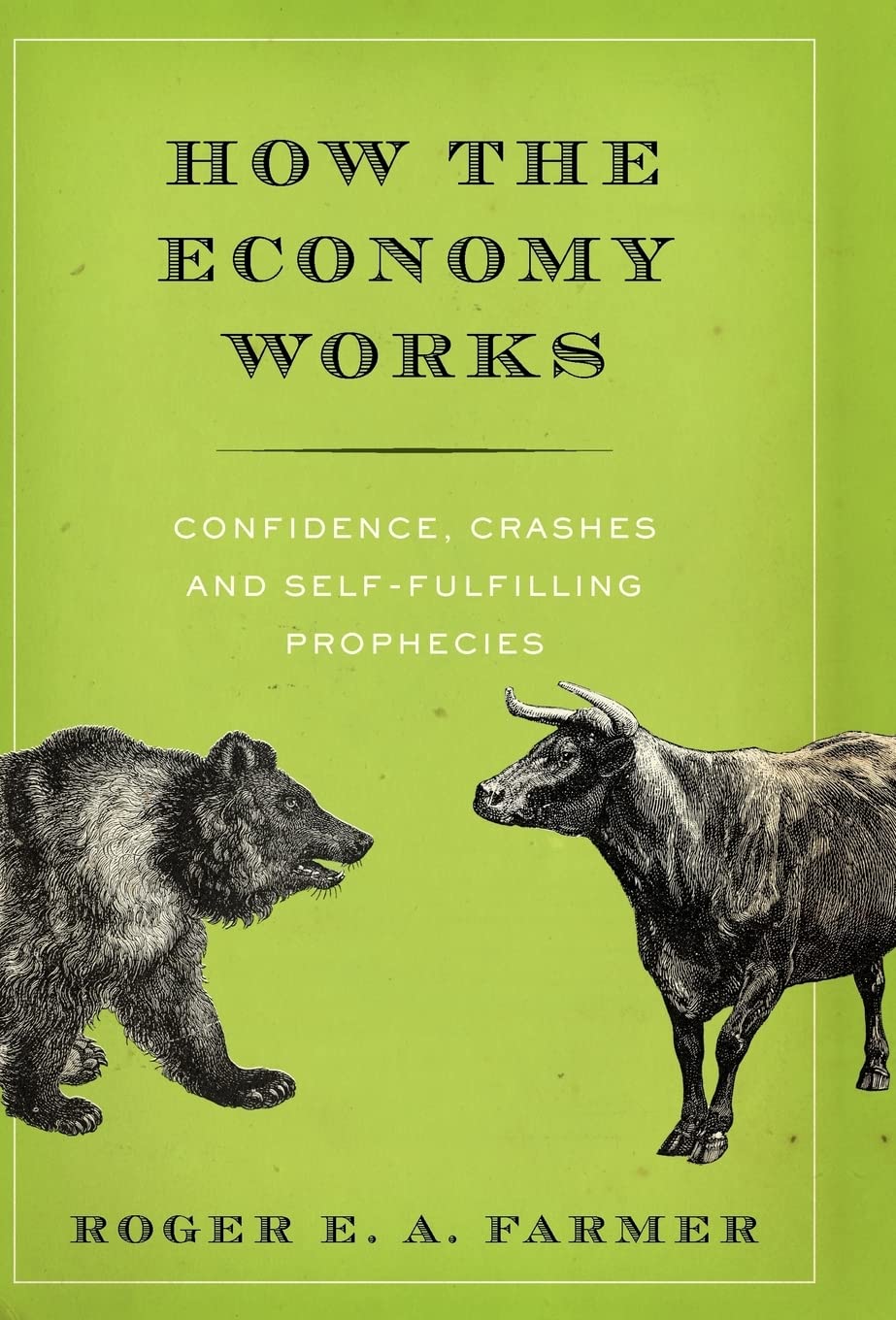
How the Economy Works: Confidence, Crashes and Self-Fulfilling Prophecies
$30.99
by Roger E. A. Farmer



"Of all the economic bubbles that have been pricked," the editors of The Economist recently observed, "few have burst more spectacularly than the reputation of economics itself." Indeed, the financial crisis that crested in 2008 destroyed the credibility of the economic thinking that had guided policymakers for a generation. But what will take its place? In How the Economy Works , one of our leading economists provides a jargon-free exploration of the current crisis, offering a powerful argument for how economics must change to get us out of it. Roger E. A. Farmer traces the swings between classical and Keynesian economics since the early twentieth century, gracefully explaining the elements of both theories. During the Great Depression, Keynes challenged the longstanding idea that an economy was a self-correcting mechanism; but his school gave way to a resurgence of classical economics in the 1970s-a rise that ended with the current crisis. Rather than simply allowing the pendulum to swing back, Farmer writes, we must synthesize the two. From classical economics, he takes the idea that a sound theory must explain how individuals behave-how our collective choices shape the economy. From Keynesian economics, he adopts the principle that markets do not always work well, that capitalism needs some guidance. The goal, he writes, is to correct the excesses of a free-market economy without stifling entrepreneurship and instituting central planning. Recent events have shown that we cannot afford to treat economics as an ivory-tower abstraction. It has a direct impact on our lives by guiding regulators and policymakers as they make decisions with far-reaching practical consequences. Written in clear, accessible language, How the Economy Works makes an argument that no one should ignore. Farmer explains the differences between classical and Keynesian economics and shows how they influenced the policy debate that developed after the 2007 world financial crisis began and exploded into a global disaster, with the collapse in the U.S. of Lehman Brothers in the fall of 2008. Along with a history of economic thought from 1776 to the present (noting it is incomplete), the author offers his suggestions for preventing future financial crises. “The correct response to the crisis is to set in place, in every country in the world, an institution to control the value of national stock market wealth by targeting the rate of growth of an index fund.” “Central banks should use changes in the size of their balance sheets to prevent inflation from rising too high or too low. They should use changes in the composition of their balance sheets to prevent bubbles and crashes.” This challenging book will appeal to the academic community but not to a broad range of readers. --Mary Whaley "Roger Farmer offers a new diagnosis for what ails the economy. His clear and forceful writing encourages policymakers and the public to think out of the box and reach for new solutions."-- Greg Mankiw, Professor and Chairman of the Economics Department at Harvard University "In the morass of me-too books about the financial crisis, How the Economy Works stands out as a truly big idea." -- BusinessWeek "Bringing new research to life in guiding policy in the aftermath of the financial crisis, Roger Farmer takes the economic ball up the middle between Hayek and Keynes. With an emphasis on swings in confidence and wealth, Farmer's criticisms of fiscal stimulus and interesting prescriptions for monetary policy should be essential reading for anyone trying to understand what happened, especially for economists and policymakers focused on recovery. Nonspecialists will find the book full of fascinating stories; economists will see some surprising new twists."-- Glenn Hubbard, Dean of the Columbia Business School, Columbia University, former Chairman of the Council of Economic Advisers "This is an important policy proposal from a top thinker. Farmer balances the traditions of Hayek and Keynes to formulate a new way to stabilize the economy-and to solidify society's confidence about its future prospects. He returns us to first principles and builds a clear, succinct argument in language that is easy to follow. No policymakers are rushing to adopt Farmer's approach; but the same was true for Keynes in the 1930s. Let's hope we don't need to experience another Great Depression before our economic leaders are seriously willing to rethink everything."-- Simon Johnson, Ronald A. Kurtz (1954) Professor of Entrepreneurship at the MIT Sloan School of Management, former chief economist at the International Monetary Fund "Farmer provides an excellent discussion of what went wrong with modern economics in the run up to the recent crisis. And to deal with the effects of the financial crisis, boosting investment and employment in the short and the long run, he provides a policy plan to induce a rapid and sustainable recovery through direct intervention in the st