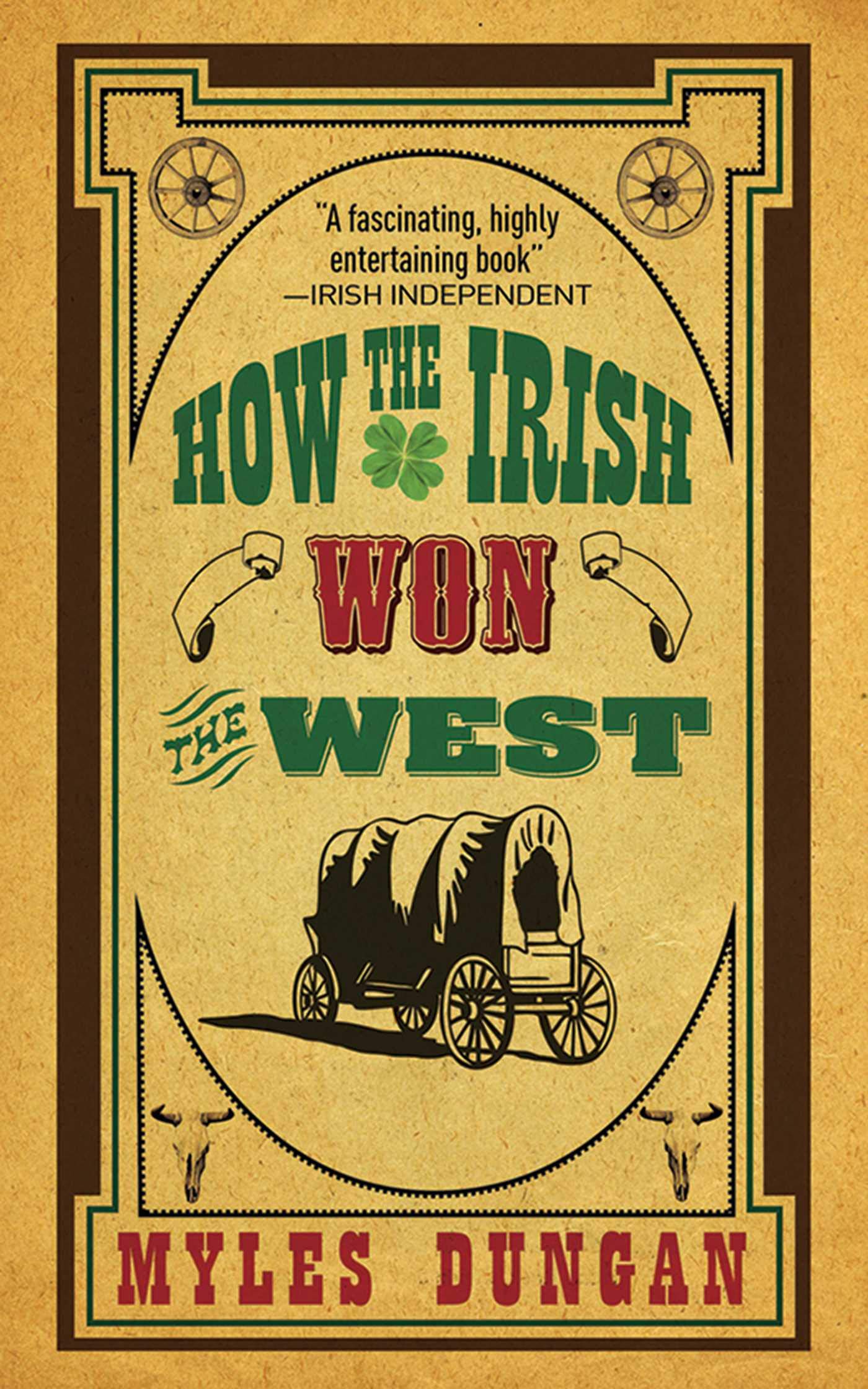



Here is the full story of the Irish immigrants and their decedents whose hard work helped make the West what it is today. Learn about the Irish members of the Donner party, forced to consume human flesh to survive the winter; mountain men like Thomas Fitzpatrick, who discovered the South Pass through the Rockies; Ellen “Nellie” Cashman, who ran boarding houses and bought and sold claims in Alaska, Arizona, and Nevada; and Maggie Hall, who became known as the “whore with a heart of gold.” A fascinating and entertaining look at the history of the American West, this book will surprise many and make every Irish American proud. Myles Dungan is a radio broadcaster and the author of several books, including The Stealing of the Irish Crown Jewels and How the Irish Won the West . He lives in Ireland. How the Irish Won the West By Myles Dungan Skyhorse Publishing Copyright © 2011 Myles Dungan All rights reserved. ISBN: 978-1-61608-100-3 Contents Title Page, Copyright Page, Dedication, PRE-CREDIT SEQUENCE, OPENING CREDITS - A NINETEENTH-CENTURY WESTERN TIMELINE, REEL ONE - INTRODUCTION: HOW THE IRISH REALLY WON THE WEST, REEL TWO - MOUNTAIN MEN: IRISH PIONEERS OF THE FUR TRADE, REEL THREE - THE DONNER PARTY: CANNIBALISM ON THE WESTERN TRAIL, REEL FOUR - INDIAN AGENT: THE LATER CAREER OF THOMAS FITZPATRICK, REEL FIVE - TOFFS: IRISH ARISTOCRATS WEST OF THE MISSISSIPPI, REEL SIX - NOT SO GENTLE TAMERS: IRISH WOMEN STAKE THEIR CLAIM, REEL SEVEN - HEROES AND VILLAINS: THE IRISH GOOD, BAD AND DISTINCTLY UGLY, REEL EIGHT - THE LINCOLN COUNTY WAR: MURPHY, DOLAN , RILEY, BRADY AND BILLY THE KID, REEL NINE - CAMEOS: PIONEERS, PLUTOCRATS, POPINJAYS AND POPULISTS, CLOSING CREDITS - ACKNOWLEDGEMENTS, NOTES, BIBLIOGRAPHY, USEFUL WEBSITES, INDEX, CHAPTER 1 REEL ONE INTRODUCTION: HOW THE IRISH REALLY WON THE WEST Sorry to disappoint, but ... the Pony Express went out of business after nineteen months, the gunfight at the OK Corral lasted less than thirty seconds, the Stetson was invented in Philadelphia, farmers outnumbered cowboys in the Old West by a thousand to one, Billy the Kid did not kill one man for each year of his short life, Frederick Remington never actually saw any cowboys in action because he was much too fat to get on a horse, Zane Grey was a New York dentist ... and so on. The American `Wild West' has been successfully mythologised over a period of a hundred years or more to the point where reality and fiction have become interchangeable. A young emerging American nation needed an heroic past of its own. Its very size, remoteness and harshness, as well as the hardy, independent characters who inhabited its space, meant that the American West was ready-made for hyperbole. Even before memories of significant historical events had begun to fade, storytellers were creating a mythic past from those very sources. It was `a past that never was and always will be', as one student of the frontier has put it. Certain elements of that past were undeniably ground breaking and `heroic'. But the nineteenth-century American West has been over-mythologised. Buffalo Bill, Frederick Remington, Hollywood and the `dime' novel have seen to that. Just as there are countless myths about the American West, there are many preconceptions about the Irish in the USA. They derive from convenient over-simplifications. One version of the Irish American story would have us believe that Irish nineteenth-century immigrants settled almost exclusively in the great eastern conurbations of New York, Boston and Philadelphia. Of course they did so in great numbers, but an interrogation of this particular myth quickly dispels it. Many, having acquired the urban skills they lacked on arrival, moved on from the stifling Irish ghettoes of the eastern seaboard. A significant percentage of those who did so settled in the West. In 1850 there were 900,000 Irish-born immigrants in the USA, only 0.4 per cent of whom lived in the western states. By 1920, one million US residents were Irish-born, 9 per cent of whom lived in the West. As historian David Emmons has put it in his monumental work on Butte, Montana, The Butte Irish: Class and Ethnicity in an American Mining Town 1875 — 1925: Contributing to the historical neglect of these westering Irishmen has been the assumption that the American West was the exclusive province of native-born Protestants who wished to farm or graze their cattle on it. Farmers and cattlemen there were, but there was also an urban West, filled with miners and smeltermen, loggers, railroad workers, longshoremen, and industrial tradesmen of every sort. Many were Irish. There is a natural tendency to equate the words `West' and `frontier' and indeed they are often interchangeable. But while the `West' was clearly the `frontier' at one point in American history, the `frontier' was as much an eastern as a western phenomenon. Arguably the American `frontier' was to be found east of the Mi