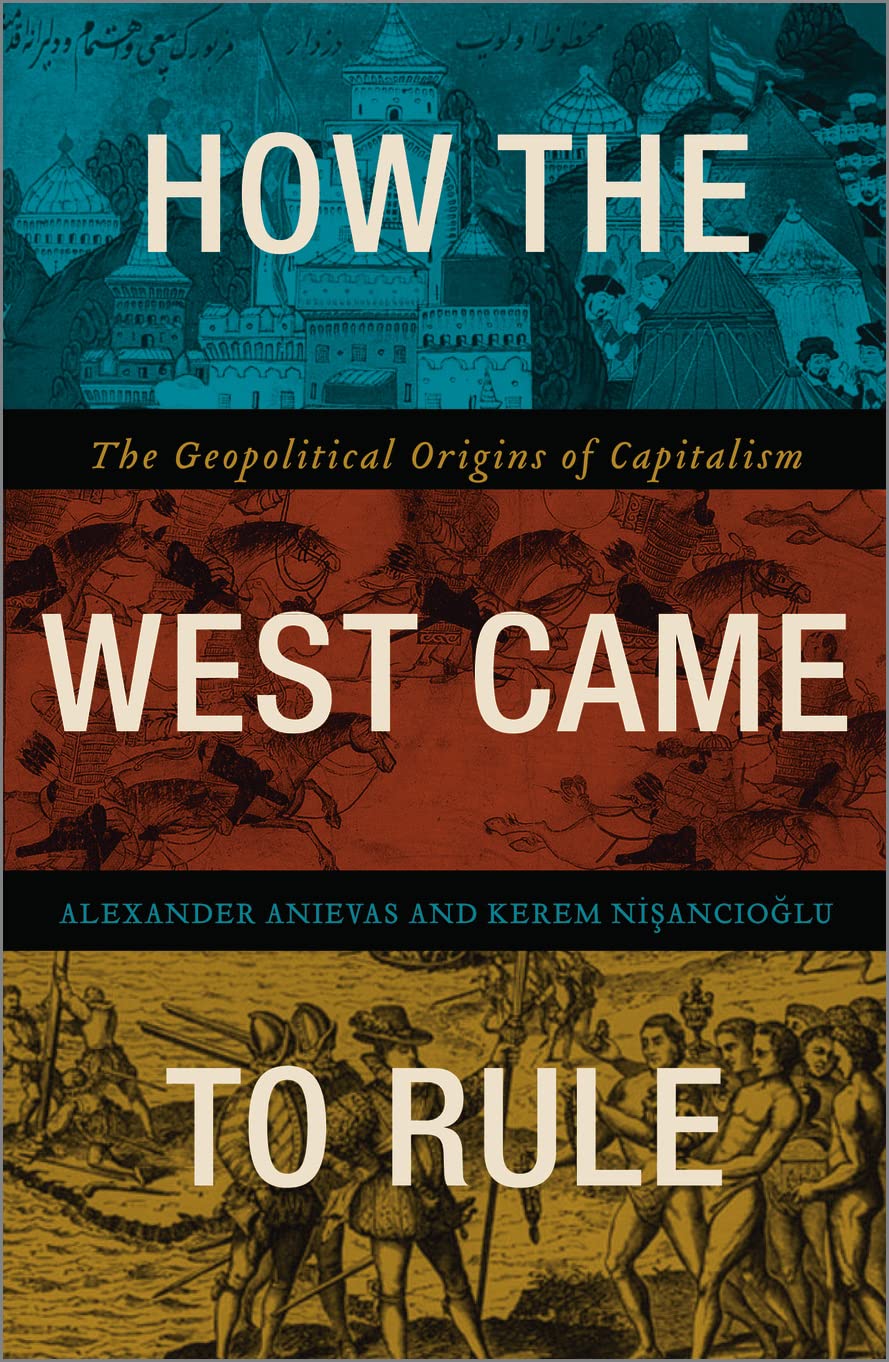



***Winner, International Studies Association International Political Sociology Best Book Prize 2017*** ***Winner, British International Studies Association International Political Economy Working Group Book Prize 2016*** Mainstream historical accounts of the development of capitalism describe a profess which is fundamentally European—a system that was born in the mills and factories of English and under the guillotines of the French Revolution. This groundbreaking book tells a very difference story. How the West Came to Rule offers a unique interdisciplinary and international historical account of the origins of capitalism. It argues that, contrary to dominant wisdom, capitalism’s origins should not be understood as a development confined to the geographically and culturally sealed borders of Europe, but the outcome of a wider array of global processes in which non-European societies played a decisive role. Here is a provocative, incisive explanation of how capitalism emerged in England and Europe through a dialectical intersocietal and geopolitical process. The authors’ aim to undermine a Eurocentric bias that has been prominent in the debate about capitalisms rise to supremacy, and their case is remarkably convincing. They provide a fundamental rethinking. Anievas and Nisancioglu contend that often cited assumptions are neither theoretically nor empirically tenable and deny the agency of non-Western societies to the emergence of capitalism. Topics covered include: *The Problem of Eurocentrism *The Problem of Historical Specificity *The Brenner Thesis: Explanation and Critique *The Geopolitical in the Making of Capitalism *The Political Marxist Conception of Capitalism *Rethinking the Origins of Capitalism *And much more! Through an outline of the uneven histories of Mongolian expansion, New World discoveries, Ottoman-Habsburg rivalry, the development of the colonies, and bourgeois revolutions, Alex Anievas and Kerem Nisancioglu offer an account of capitalism’s origins that convincingly argues against the prevailing Eurocentric narratives. It will change minds and open the eyes of historians, economists, and political thinkers. "Anievas and Nişancıoğlu have succeeded in providing new theoretical and historical perspectives to explain how capitalism prevailed to become a dominant force in global affairs. They offer a fundamental rethinking of the origins of capitalism and the emergence of Western domination by the interactive relations with the non-European world....Highly recommended." ― Choice Alexander Anievas is an Early Career Leverhulme Fellow at the Department of Political and International Studies, University of Cambridge. He is the author of Capital, the State, and War: Class Conflict and Geopolitics in the Thirty Years’ Crisis, 1914–1945 . How the West Came to Rule The Geopolitical Origins of Capitalism By Alexander Anievas, Kerem Nisancioglu Pluto Press Copyright © 2015 Alexander Anievas and Kerem Nijancioglu All rights reserved. ISBN: 978-0-7453-3615-2 Contents List of figures, X, Acknowledgements, xi, Introduction, 1, 1 The Transition Debate: Theories and Critique, 13, 2 Rethinking the Origins of Capitalism: The Theory of Uneven and Combined Development, 43, 3 The Long Thirteenth Century: Structural Crisis, Conjunctural Catastrophe, 64, 4 The Ottoman-Habsburg Rivalry over the Long Sixteenth Century, 91, 5 The Atlantic Sources of European Capitalism, Territorial Sovereignty and the Modern Self, 121, 6 The 'Classical' Bourgeois Revolutions in the History of Uneven and Combined Development, 174, 7 Combined Encounters: Dutch Colonisation in Southeast Asia and the Contradictions of 'Free Labour', 215, 8 Origins of the Great Divergence over the Longue Durée: Rethinking the 'Rise of the West', 245, Conclusion, 274, Notes, 283, Index, 371, CHAPTER 1 The Transition Debate: Theories and Critique In order to examine the object of our investigation in its integrity, free from all disturbing subsidiary circumstances, we must treat the whole world as one nation, and assume that capitalist production is everywhere established and has possessed itself of every branch of industry. Karl Marx, 1867 ... events strikingly analogous but taking place in different historic surroundings led to totally different results. By studying each of these forms of evolution separately and then comparing them one can easily find the clue to this phenomenon, but one will never arrive there by the universal passport of a general historico-philosophical theory, the supreme virtue of which consists in being super-historical. Karl Marx, 1877 Introduction In this chapter, we critically assess a number of influential Marxist-inspired theorisations of the transition to capitalism. We focus on such Marxist-inspired perspectives not because they exhaust the range of possible approaches to theorising the transition or because we think other perspectives ha