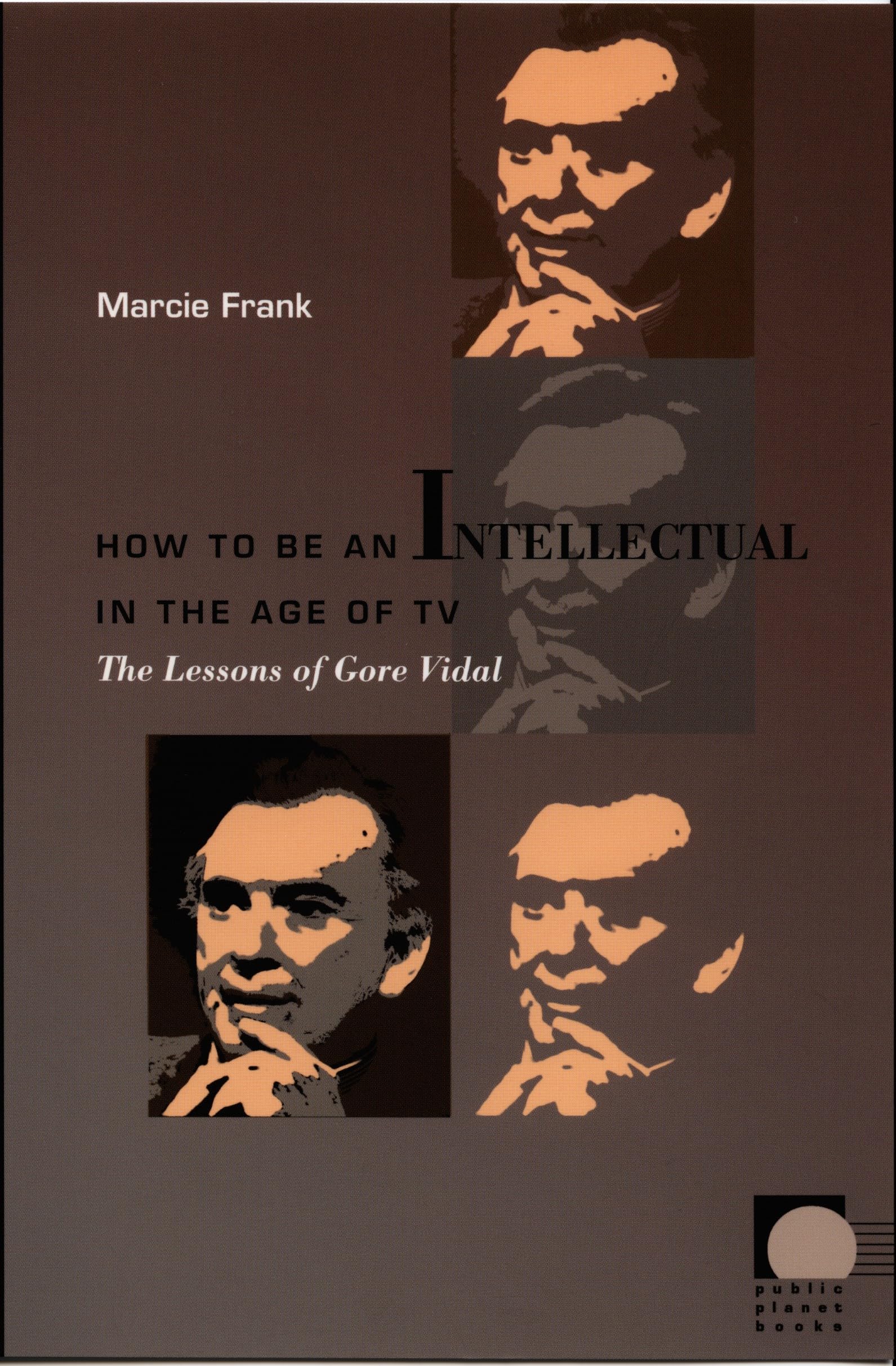
How to Be an Intellectual in the Age of TV: The Lessons of Gore Vidal (Public Planet Books)
$29.95
by Marcie Frank



Novelist, television personality, political candidate, and maverick social commentator, Gore Vidal is one of the most innovative, influential, and enduring American intellectuals of the past fifty years. In How to Be an Intellectual in the Age of TV , Marcie Frank provides a concise introduction to Vidal’s life and work as she argues that the twentieth-century shift from print to electronic media, particularly TV and film, has not only loomed large in Vidal’s thought but also structured his career. Looking at Vidal’s prolific literary output, Frank shows how he has reflected explicitly on this subject at every turn: in essays on politics, his book on Hollywood and history, his reviews and interviews, and topical excursions within the novels. At the same time, she traces how he has repeatedly crossed the line supposedly separating print and electronic culture, perhaps with more success than any other American intellectual. He has written television serials and screenplays, appeared in movies, and regularly appeared on television, most famously in heated arguments with Norman Mailer on The Dick Cavett Show and with William F. Buckley during ABC’s coverage of the 1968 Democratic National Convention. Frank highlights the connections between Vidal’s attitudes toward TV, sex, and American politics as they have informed his literary and political writings and screen appearances. She deftly situates his public persona in relation to those of Andy Warhol, Jacqueline Susann, Mary McCarthy, Susan Sontag, and others. By describing Vidal’s shrewd maneuvering between different media, Frank suggests that his career offers a model to aspiring public intellectuals and a refutation to those who argue that electronic media have eviscerated public discourse. “ How to Be an Intellectual in the Age of TV is an illuminating, wide-ranging, and provocative examination of Gore Vidal’s mulitple public identities—novelist, screenwriter, political commentator, TV personality. Marcie Frank’s insights into Vidal’s unique career and the cultural context in which it unfolded will appeal to anyone with an interest in American popular and literary cultures and the places where the two intersect.”—Tom Perrotta, author of the novels Little Children , Joe College , and Election “While other literary-minded writers of his generation (Updike, Bellow, Baldwin, Roth) barricaded themselves in bookchat, Gore Vidal took the full plunge into the new media age. There is no comparable figure to suture the two worlds, or two epochs.”—Michael Warner, author of Sex, Politics, and the Ethics of Queer Life “With her pithy deadpan and unresting curiosity, Marcie Frank is a wonderful interlocutor for Vidal. Fusing a startling range of recent histories, her short book is full of satisfying double-takes and provocations.”—Eve Kosofsky Sedgwick, author of Touching Feeling: Affect, Pedagogy, Performativity “Ultimately, for mass communication historians, Frank’s book primarily is a specific wake-up call about the possibilities of studying novelists as news sources of many times and even as newsworthy figures, and a general wake-up call about the lack of research (at least in the United States because Europe is far ahead here) on journalism, other mass media, and intellectuals (‘public’ or not).” -- Dane S. Claussen ― Journalism History "While other literary-minded writers of his generation (Updike, Bellow, Baldwin, Roth) barricaded themselves in bookchat, Gore Vidal took the full plunge into the new media age. There is no comparable figure to suture the two worlds, or two epochs."--Michael Warner, author of "Sex, Politics, and the Ethics of Queer Life" Marcie Frank is Professor of English at Concordia University in Montreal. How to Be an Intellectual in the Age of TV The Lessons of Gore Vidal By Marcie Frank DUKE UNIVERSITY PRESS Copyright © 2005 Duke University Press All right reserved. ISBN: 978-0-8223-3640-2 Contents Acknowledgments...................................................xiIntroduction......................................................11 The Print Intellectual..........................................172 The Screen Intellectual.........................................413 A Fine Romance..................................................694 Sexual Politics in the Print-Screen Circuit.....................915 TV: Another Erogenous Zone......................................111Notes.............................................................143Index.............................................................151 Chapter One The Print Intellectual It may seem strange to us that the paradigmatic intellectual was once so literary. It takes an effort to recall that the novelist sat at the top of this heap, especially considering that, for the most part, being a novelist today does not qualify you as a consultant on much of anything. But scientists like C. P. Snow, philosophers like Jean-Paul Sartre, and lite